Tiny Engineers? Evaluating the Worth of Engineering Kits for Two-Year-Olds
Introduction
In an age where STEM education is championed from the earliest possible moment, parents and caregivers are increasingly bombarded with marketing for “engineering kits” designed for toddlers. A quick online search reveals colorful boxes promising to turn your two-year-old into a mini inventor, complete with oversized plastic gears, snap-together connectors, and magnetic blocks. But the question that lingers in the minds of many thoughtful parents is simple yet profound: Are these kits genuinely beneficial for a child who has only just learned to walk and talk, or are they an overpriced gimmick that capitalizes on parental anxiety about cognitive development? This article will dissect the concept of engineering kits for two-year-olds, examining developmental appropriateness, potential benefits, risks, and practical alternatives. By the end, you will have a clear, evidence-informed perspective to make the best decision for your little one.
Understanding the Two-Year-Old Mind: Developmental Reality Check
Before assessing any toy or learning tool, it is crucial to understand what a two-year-old’s brain and body are actually capable of. At this age, children are in the midst of rapid sensorimotor and preoperational development, according to Jean Piaget’s influential theory. They are exploring the world primarily through their senses—touching, tasting, dropping, throwing—and through simple cause-and-effect actions. Fine motor skills are still rudimentary: a typical two-year-old can stack a few blocks, turn pages of a board book, and scribble with a thick crayon, but precise manipulations like aligning small pegs or snapping together intricate plastic pieces are often frustratingly out of reach.
Language is exploding, but abstract reasoning remains nearly nonexistent. The idea of “engineering” as a systematic process of design, testing, and improvement is far beyond their cognitive horizon. What they do understand is immediate physical feedback: if you push a block, it falls; if you spin a gear, it turns. Their play is egocentric and nonlinear—they will repeat the same action dozens of times not because they are “experimenting” but because the repetition itself is satisfying and predictable. Any assessment of engineering kits must therefore start by asking: Does this tool align with how a two-year-old naturally learns and plays, or does it impose adult expectations on a developing brain?
What Do “Engineering Kits for 2-Year-Olds” Actually Offer?
The term “engineering kit” is used loosely. For the toddler market, most kits include large, durable pieces that can be connected in various ways—for example, magnetic tiles that snap together, oversized gears mounted on a base, or plastic nuts and bolts that can be twisted. Brands like *Learning Resources*, *Magna-Tiles*, and *Melissa & Doug* have popular offerings. These sets often come with a few simple construction ideas printed on the box, such as building a tower, a car, or a windmill. The underlying claim is that through such play, children develop spatial reasoning, problem-solving skills, and an early understanding of mechanics.
In practice, a two-year-old’s interaction with these kits is typically limited. They may enjoy stacking magnetic squares because the magnets provide a satisfying click and the shapes are easy to handle. They might spin a gear and watch fascinated as the next gear rotates. But the sophisticated step of planning a structure or troubleshooting why a tower keeps falling is usually absent. Instead, the child engages in open-ended sensory exploration—and that is not necessarily bad. The question is whether the kit adds value beyond what simpler, cheaper, and more versatile toys already provide.
Potential Benefits: When Engineering Kits Can Be Worthwhile
Despite the skepticism, there are legitimate reasons why some engineering kits can be worth the investment for a two-year-old—provided you choose wisely and set realistic expectations.
1. Sensory and Motor Skills Development
High-quality kits with large, chunky pieces require grasping, pushing, pulling, and twisting. These actions strengthen the small muscles in the hands and fingers, which are essential for later writing and self-care tasks. Magnetic tiles, in particular, offer resistance and instant feedback that encourages repeated practice. A child who spends ten minutes snapping magnets together is honing hand-eye coordination without even realizing it.
2. Introduction to Cause and Effect
When a two-year-old places a gear on a peg and watches it spin, they are absorbing a fundamental principle of mechanics: motion can be transferred. Similarly, when they stack a block too high and it topples, they learn about gravity and balance. These are not abstract lessons for a toddler; they are visceral, concrete experiences that build intuitive knowledge. A well-designed kit can make these cause-and-effect relationships more salient than a simple set of wooden blocks might, because the pieces are designed to move and interact in specific ways.
3. Vocabulary and Social Interaction
If a parent or caregiver plays alongside the child, an engineering kit becomes a rich language opportunity. You can narrate actions: “You pushed the blue gear, and now the yellow one is spinning! That’s called a chain reaction.” You can introduce spatial words like “on top,” “underneath,” “through,” and “around.” This joint engagement—often called “serve and return” interaction—is far more valuable to a toddler’s cognitive growth than any product alone. The kit serves merely as a prop for human connection.
4. Fostering Persistence and Problem-Solving (With Limits)
While a two-year-old cannot systematically solve problems, they can experience the feeling of trying again when something does not work. For instance, if a plastic connector keeps slipping off, the child may attempt to push it harder or ask for help. This early frustration tolerance, when guided by a calm adult, plants seeds for resilience. However, the benefits are heavily dependent on the adult’s involvement. Left alone, a toddler may simply abandon a challenging piece and switch to another activity.
Potential Drawbacks and Risks: When They Are Not Worth It
The marketing for toddler engineering kits often oversells their educational value, leading to unrealistic expectations and, sometimes, wasted money. Here are the key reasons to pause before purchasing.
1. Overestimating Cognitive Readiness
Many kits are labeled for ages 2+ but actually require skills that emerge closer to age 3 or 4. For example, a set with multiple small connectors or pieces that must be aligned at precise angles will frustrate most two-year-olds. The resulting tantrums can make playtime stressful instead of joyful. A child who feels constant failure may develop negative associations with building and problem-solving.
2. Limited Longevity
A two-year-old’s interest in a specific kit may last only a few weeks. Unlike blocks, which can be used for years in increasingly complex ways, many engineering kits have a narrow range of possibilities. Once the child has mastered snapping the pieces together, there is little else to discover. The kit then sits unused, taking up space and cluttering the playroom. In contrast, a set of cardboard boxes, wooden spoons, and fabric scraps offers limitless, open-ended creativity that evolves with the child.
3. Overstimulation and Fragmentation of Attention
Some kits come with flashing lights, sounds, or dozens of unique pieces that demand focused attention. Toddlers are naturally prone to distractibility, and a highly structured kit can actually fragment their attention further. Simpler toys that allow for quiet, repetitive exploration—like a set of stacking cups or a shape sorter—often support deeper concentration. The American Academy of Pediatrics recommends minimal electronic features for children under two for precisely this reason.
4. Cost vs. Value
Quality engineering kits for toddlers can range from $20 to $60 or more. For a toy that may be used for a few months at most, that is a steep price. Parents on a budget can replicate many of the same learning experiences with household items. A colander and some pipe cleaners, for instance, provide fine motor work, spatial reasoning, and cause-effect learning at virtually no cost.
Developmentally Appropriate Alternatives to Consider
If you decide that a commercial engineering kit is not the right choice for your two-year-old, rest assured that you are not depriving them of valuable learning. In fact, some of the best “engineering” experiences come from everyday play.
1. Building Blocks (Simple Wooden or Large Plastic)
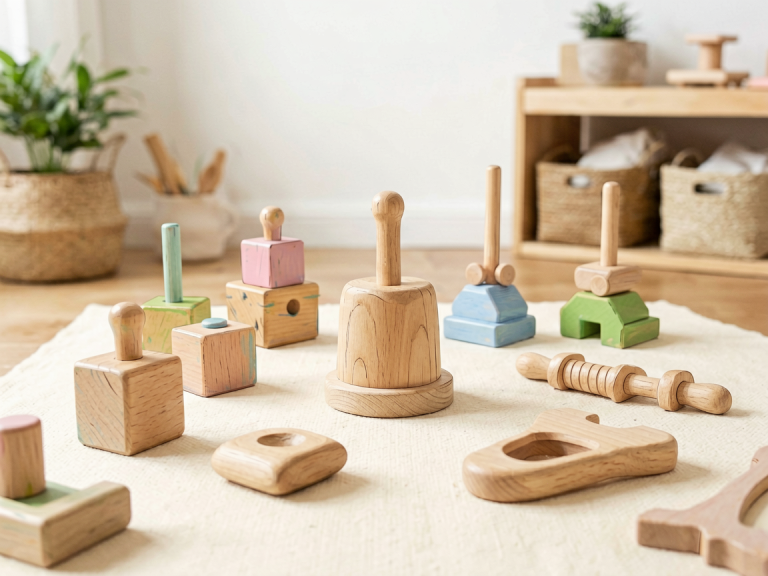
Classic unit blocks are superior to many specialized kits because they are versatile, timeless, and allow for open-ended construction. A two-year-old can stack, knock down, line up, and eventually create simple bridges and enclosures. The tactile feel and weight of wood also provide rich sensory input.
2. Loose Parts Play
Collect safe, non-toxic household objects: plastic lids, fabric scraps, cardboard tubes, empty spools, and large beads. Offer these in a basket and let the child explore. They will naturally engage in sorting, stacking, threading, and connecting—all foundational engineering skills. This approach encourages creativity and reduces the environmental footprint of commercial toys.
3. Water and Sand Tables
Fill a shallow tub with water or sand and provide cups, funnels, and spoons. The physics of pouring, scooping, and measuring are inherently hands-on and teach principles of volume, flow, and cause-and-effect. This is engineering in its most primal form.
4. Push and Pull Toys
A simple wagon that the child loads with blocks and pulls across the room teaches concepts of force, motion, and balance. It also strengthens gross motor skills. Similarly, a large cardboard box can become a car, a house, or a fort, inviting imaginative construction.
How to Choose an Engineering Kit (If You Decide to Buy One)
If after weighing the pros and cons you still want to purchase an engineering kit, here are criteria that maximize the chance it will be worthwhile:
- Look for large, chunky pieces that are easy for small hands to grasp. Avoid any kit with parts smaller than a toddler’s fist to prevent choking hazards.
- Prioritize open-endedness. Kits that allow many different configurations (like magnetic tiles or simple gears with a base) are more valuable than those that only allow one prescribed model.
- Avoid electronic components. Lights and sounds are distracting and reduce the child’s need to think creatively. Passive engagement is not beneficial for this age.
- Read reviews from real parents, not just marketing copy. Look for comments about durability, ease of use for a two-year-old, and whether the child actually returned to the toy over time.
- Set a price limit. Do not spend more than $25 on a single kit for a two-year-old, because the window of interest is small. Better to buy a cheaper, simpler set and supplement with household items.
Conclusion: Worth It, But Only With the Right Expectations
So, are engineering kits worth it for two-year-olds? The honest answer is: sometimes yes, but not in the way advertisers want you to believe. A high-quality, simple, open-ended kit can support fine motor development, cause-and-effect learning, and language enrichment—provided an adult actively engages with the child during play. However, the same benefits can often be achieved with blocks, loose parts, and everyday household items at a fraction of the cost and with greater longevity.
The real engineering that happens at age two is not about building bridges and gears; it is about building neural connections through sensory exploration, repetition, and human interaction. No plastic toy can replace the warmth of a caregiver’s voice, the patience of a guided hand, or the curiosity sparked by a cardboard box. If you choose to invest in a kit, do so as a tool—not a miracle worker—and let your child lead the way. In the end, the most valuable “engineering kit” is a safe, loving environment filled with time, space, and freedom to explore.