How to Compare Two Toys Before You Buy: 8 Criteria That Matter
Two toys, similar price, similar age range, similar promise on the box. One becomes the thing your child returns to for two years. The other is landfill by spring. The difference is rarely quality, and it is almost never the brand. It is a small set of structural features you can check in a store aisle in about five minutes, if you know what to look for.
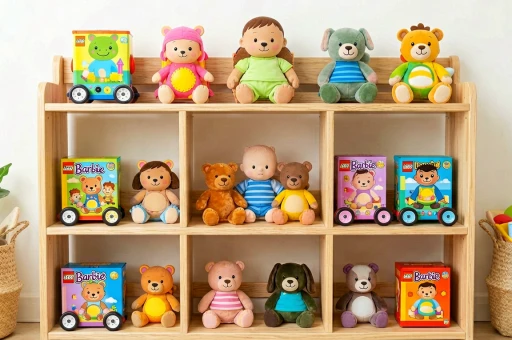
This is a comparison method, not a review. It works on blocks and robots alike, and it works best when you apply the same eight criteria to both options and score them honestly. The goal is not to find the objectively best toy — there is no such thing — but to predict which of two toys will survive contact with your actual child in your actual living room.
The comparison problem
The reason toy comparisons go wrong is that shoppers compare the wrong layer of the product. The box shows the peak moment: the finished castle, the robot mid-flip, the child laughing. It does not show session twenty, when the castle is built, the robot has done its three tricks, and the novelty is gone.
So the useful question is never “which toy is better?” It is “which toy has more to offer after the first hour?” Everything below is a way of answering that question with evidence you can see before you buy.
One practical note before scoring: compare toys within the same job. A craft kit and a marble run are both “toys,” but they occupy different slots in a child’s week. Comparing them produces a false choice. Compare two construction sets against each other, or two remote-controlled vehicles, or two craft subscriptions.
Criterion 1: Play patterns per dollar
Count the distinct things a child can do with the toy, then divide by price. This is the highest-signal criterion in the list.
Distinct means genuinely different, not different levels of the same action. A puzzle has one play pattern: assemble. A set of magnetic tiles has dozens: build a house, a tunnel, a ball run, a flat mosaic, a shape to trace, a structure to knock down, a pretend oven. Same category of “building toy,” very different density of play.
The score is not about complexity. A simple doll with jointed limbs earns a high score because the child supplies the story: doctor, teacher, sibling, villain, passenger. A complex electronic pet with five preprogrammed reactions earns a low score, because the child is watching a script.
How to check it: hold the toy and try to describe three activities that are not the intended one. If you cannot, the toy has a low ceiling.
Criterion 2: Time-to-first-play
Measure the minutes between “we own this” and “the child is playing.” Include assembly, batteries, app pairing, sticker application, and any adult explanation required.
Two toys with identical play value are not equal if one takes four minutes to set up and the other takes forty. The forty-minute toy will be used on Saturdays. The four-minute toy will be used on the average Tuesday after school, which is when most play actually happens. Multiply the difference across a year and it dominates the comparison.
There is a legitimate exception: toys where setup is the activity. A model kit, a pottery wheel, a big cooking set — the preparation is part of the point, and the child participates in it. The problem is not setup. The problem is setup the child cannot help with and the adult does not enjoy.
Criterion 3: Skill ceiling
Ask how far the toy can go. A toy with a high ceiling has a next step: harder builds, faster runs, more complex patterns, new rules the child invents.
Low ceiling: a toy that can be mastered in one session and then offers nothing new. High ceiling: a toy where a seven-year-old and a twelve-year-old can both be challenged by the same box, at different levels.
This is where cheap construction toys often beat expensive electronic ones. A $30 set of connectors and rods has a ceiling set by the child’s imagination. A $120 robot with a fixed set of voice commands has a ceiling set by the firmware. Our comparison of craft kits versus open art supplies makes the same point in a different medium: the kit hands over an idea, the supplies hand over a medium, and only one of them keeps growing.

Criterion 4: Solo or social
Neither is better, but they are not interchangeable, and most purchases fail because the parent bought for the wrong mode.
Solo toys — puzzles, drawing, building, reading-adjacent play — buy you quiet time and independence. Social toys — board games, role-play sets, building projects with rules, anything with a turn structure — buy you family time and negotiation practice. A toy that requires a partner will sit unused in a house with one child and a busy evening schedule. A toy that is strictly solo will bore a child who is used to playing with a sibling.
Be specific about the household: how many children, what ages, how much adult attention is realistically available at 5 p.m. on a Wednesday. Then compare the two candidate toys on that axis first, because no amount of play value compensates for a toy that never gets a partner.
Criterion 5: Consumables and hidden costs
Add up the first year, not the sticker price. Some toys are a one-time purchase; others are a subscription with a plastic housing.
- Consumables: paper, clay, beads, refill cartridges, sticker packs, special paper for a printer toy.
- Power: how many batteries, what size, and how often. Rechargeable is better only if the battery is replaceable.
- Expansion: does the toy only become interesting with a second set? That is a hidden doubling of price.
- App dependence: a toy that requires a phone or tablet to function has a second failure point and a shorter practical life.
Put both toys on the same first-year total and the comparison often flips. The $40 kit that needs $60 of refills is a $100 toy.
Criterion 6: Footprint and cleanup
Toys compete for floor space, table space, and adult patience. Compare the two candidates on three numbers: how many pieces, how much flat surface the play requires, and how long cleanup takes.
Three hundred loose pieces in a house with a toddler and a dog is a different proposition from thirty. A toy that needs a dedicated table will not get used on the kitchen table at dinner time. A toy with a hundred tiny accessories costs five minutes of cleanup per session, which quietly becomes the reason nobody gets it out.
Compare storage too: does the toy come with a container that actually works, or will you be buying bins? A toy that cannot be put away in under two minutes will be left out, stepped on, and eventually resented.
Criterion 7: Durability and parts availability
Look at the joints, the hinges, the thin plastic tabs, and the connection points. Then ask a question most shoppers never ask: can I buy replacement parts?
Toys with replaceable parts have a much longer service life. A building system with individual pieces for sale outlives a set with a proprietary connector you cannot reorder. A ride-on with replaceable wheels outlives one with a molded-in axle.
For battery toys, check whether the compartment is screw-secured — that is a safety feature and a durability signal at the same time. For anything with fabric, check whether it can be washed. For anything with stickers, assume they will peel and decide whether the toy still works without them.
Criterion 8: Resale and hand-down value
A toy with resale value is cheaper than its sticker price suggests, because part of the cost comes back. Wooden blocks, quality building systems, metal ride-ons, and well-made dolls hold value. Licensed character toys, electronic novelties, and anything trend-driven usually do not.
This criterion matters most if you have more than one child or a healthy hand-me-down network. A toy that survives two children and a cousin has a cost per child of a third of its price. A toy that breaks in month four has a cost per child of the full price, plus the frustration.
Scoring two toys side by side
Score each toy from 1 to 5 on the eight criteria, then look at the shape of the scores rather than the total.
- Play patterns per dollar
- Time-to-first-play (5 = instant)
- Skill ceiling
- Fit with your household’s play mode
- Total first-year cost, including consumables
- Footprint and cleanup burden (5 = easy)
- Durability and parts availability
- Resale and hand-down value
Two things to watch in the results. First, a toy that scores 5 on play patterns but 1 on cleanup and 1 on footprint will lose in practice; friction beats value. Second, a wide spread between the two totals usually means the decision is easy and you were overthinking it. A narrow spread means the toys are close, and you should let the child’s stated interest break the tie.
If both toys pass, buy the one that matches the interest you can actually name. If both fail, the honest answer is neither — and the budget is better spent on a book, a membership, or nothing at all.
When the cheaper toy wins
Cheaper wins more often than parents expect. It wins when the expensive option’s extra cost is in electronics, licensing, or packaging rather than in materials or part count. It wins when the child’s interest is early and exploratory, and a $20 version will tell you whether the interest is real before you invest in the $150 version. It wins when the toy is likely to be outgrown within a year.
Expensive wins when the cost is in materials and precision: real wood instead of particle board, sealed bearings instead of friction joints, a battery that can be replaced. It also wins when the toy will be used daily by multiple children for years, because the per-use cost collapses.
The pattern to remember: pay for materials and use, not for the promise on the box. For concrete swaps, our alternatives guides cover the cheaper routes into most popular categories, including longer-lasting alternatives to jigsaw puzzles.
Frequently asked questions
Is it worth buying the more expensive version of a toy my child already loves?
Usually yes, once the interest is proven. Upgrading a toy the child already uses daily is one of the highest-return purchases you can make, because you are buying more of something with demonstrated demand. Upgrading a toy the child has never played with is just a more expensive version of the original mistake.
How do I compare toys when I am shopping online?
Look for the boring details: piece count, assembled dimensions, battery type, recommended age, and whether replacement parts are listed. Read the one- and two-star reviews specifically — they tend to describe failures after a few weeks, which is exactly the information the marketing copy hides.
Do more pieces mean a better building set?
Only up to a point. Piece count matters for the size of what can be built, but a set with many specialty pieces and few basic ones is less flexible than a smaller set of standard pieces. Count the basic bricks and plates, not the total.
Should I buy two similar toys to compare them at home?
Rarely. Buy one, keep the receipt, and watch how your child plays with it for two weeks. If the answer is “barely,” that is your comparison result — and it cost you one toy instead of two.
If you have not yet narrowed the field, start with our guide to choosing a toy in ten minutes, then bring the shortlist back to this checklist.
Fresh from the Guide
- Age-by-Age Toy Guide: What Actually Fits Kids From 1 to 10 2026年10月23日
- How to Compare Two Toys Before You Buy: 8 Criteria That Matter 2026年10月23日
- How to Choose a Toy: A 10-Minute Decision Framework for Parents 2026年10月23日
- Coding Toys for Kindergarteners: Worth the Hype or Just a Gimmick? 2026年8月27日
- Coding Toys for 13-Year-Olds: Are They Worth the Hype and the Price? 2026年8月27日
- Engineering Kits for Tweens: Choosing the Right Build 2026年8月6日