Age-by-Age Toy Guide: What Actually Fits Kids From 1 to 10
Age ranges on toy packaging look like a difficulty rating. They are not. In the United States, the age mark is primarily a safety statement tied to hazards such as small parts, and secondarily a rough guess about interest. That mismatch is why a four-year-old can be bored by a toy labeled “4+” and fascinated by one labeled “6+,” and why a “3+” building set is often the best purchase for a five-year-old.
This guide covers what children are generally working on at each age from one to ten, what kind of toy supports that work, and what to skip. Treat the bands as overlapping, not as gates. Children develop on their own schedule, and a child at the older end of a band will often be ready for the next one.
What an age label actually tells you
Three things, and no more:
- The hazard floor. Toys for children under three are subject to small-parts requirements, so a “3+” label usually means “contains pieces that are a choking risk for a child who mouths objects.”
- The manufacturer’s liability boundary. The label is the age at which the maker is comfortable being responsible for the toy’s use.
- A weak signal about attention span. Age marks often correlate with complexity, but loosely, and marketing pressure pushes them younger.
What the label does not tell you is whether your child will care. That is a question about interests, and interests are specific. A child who has spent six months building with anything they can stack will get more from a construction set two years “too old” than from an age-perfect toy that does one thing.
If you only remember one rule from this page, remember the asymmetry: buying below the label is a safety decision, and buying above it is a judgment call. The first has a hard floor; the second does not. For how small parts are actually assessed, see our guide to choking hazards and age recommendations.
Ages 1–2: cause, effect, and mouths
What they are working on: cause and effect, object permanence, gross motor control, and the discovery that their hands can change the world. Everything goes in the mouth, because the mouth is a sensory organ with better data than fingers at this age.
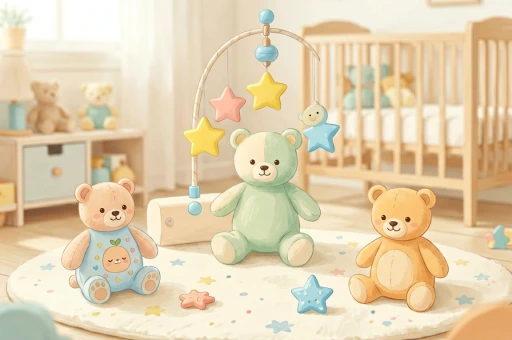
What works: large, simple objects with a clear physical response. Stacking cups, nested boxes, chunky board books, a ball that rolls, a push-along toy that stays upright, a posting box with large pieces, textured fabric, a low sturdy stool to climb. Toys that make a satisfying sound when hit are doing real work — the child is learning that action produces result.
What to skip: anything with pieces smaller than a toilet-paper tube, anything with button batteries accessible without a screwdriver, magnetic toys, battery toys that play loud music at close range, and anything with a screen. Also skip toys that require the child to “use it correctly” — at this age, correct use is whatever the child is doing.
Safety notes: check for detachable eyes and loose screws on hand-me-downs, and be strict about button batteries, which cause severe internal injury within hours of being swallowed. Our piece on button batteries in toys explains what to look for in battery compartments.
Ages 3–4: stories, roles, and small parts
What they are working on: pretend play, language, simple classification, and the beginning of turn-taking. This is the age when a box becomes a boat and a stick becomes a sword, and when the child starts assigning roles to figures — and to you.
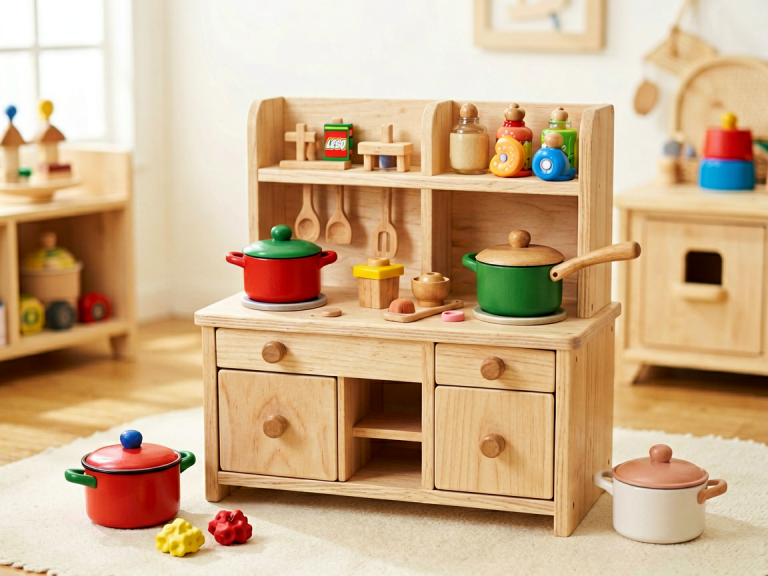
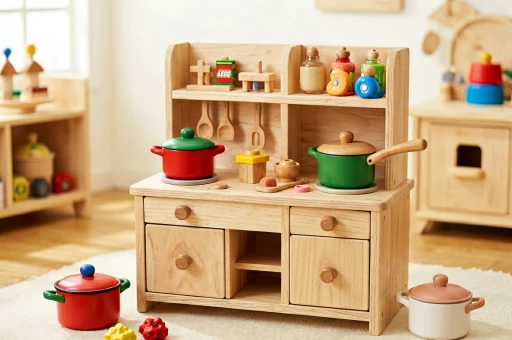
What works: dress-up clothes, play kitchen and play food, dolls and animal figures, chunky puzzles with knobs, washable markers and big paper, sand and water play, simple construction with large pieces, vehicles with working doors. Anything that lets the child act out a scene they have observed is doing double duty: language and social rehearsal.
What to skip: complex rule-based games (the rules become a fight), kits with many tiny consumables, and toys that require reading instructions to enjoy. Also be wary of toys with a single electronic script — the child will exhaust it in a week and then use it as a prop anyway.
Safety notes: this is the age where small-parts rules loosen but choking risk does not disappear, especially with younger siblings in the house. Keep a “big kid table” rule if you have a mixed-age household. This is also when the child starts climbing on toys, so check stability.
For a worked example of matching a specific interest to a specific product category at this age, our guide to buying coding toys for 3-year-olds walks through the same reasoning: buy the play pattern, not the label.
Ages 5–6: rules, plans, and real tools
What they are working on: rule-following, planning a sequence, fine motor precision, and the first real interest in “doing it properly.” This is the golden age for board games, because the child can finally hold a rule in mind and lose without dissolving.
What works: simple board and card games, standard interlocking bricks, scissors and glue with supervision, beginner chapter books, marble runs, pattern and sequencing toys, real kitchen tasks with child-safe tools, magnifying glasses and bug catchers, chalk and pavement games. Toys that produce a visible result — a built structure, a finished drawing, a won game — land well because the child can evaluate their own work.
What to skip: toys with hundreds of tiny pieces and no storage, electronic toys that promise to teach reading or math through button-pressing, and anything that requires sustained adult setup on a school night.
Safety notes: real tools are appropriate now, with supervision and clear rules. Trampolines, scooters, and bikes move up the risk list as speed increases — helmets are non-negotiable from this age.
Ages 7–8: mastery, collections, and comparison
What they are working on: mastery of a skill, peer comparison, collecting and categorizing, and reading for information rather than story. This is the age when children start wanting to be good at something, and when they notice what other children have.
What works: building sets with real complexity, chapter book series, strategy games, sports equipment, craft kits that produce a finished object, science kits with a real procedure, models, collectible card games, and tools for a hobby the child has chosen. The theme is depth over novelty: the child wants to get better, so buy the thing that rewards practice.
What to skip: trend toys bought to match a peer group (they date fast and rarely get played with), and toys that are too simple — a seven-year-old will reject a “baby toy” faster than a two-year-old will reject anything.
Safety notes: this is the age of scooters, skateboards, and first sleepovers. Check helmet fit, and check that any electronic toy with messaging or camera features has parental controls configured before it goes in the room. This is also the age when buying mistakes get expensive, because the toys cost more and the child’s requests get more specific.
Ages 9–10: projects, identity, and independence
What they are working on: long projects, identity, privacy, and independence from adult direction. Play starts to look like hobby, and the child wants to be the author of the activity rather than the operator of a toy.
What works: real tools and real materials — a sewing machine, a soldering kit with supervision, a camera, a musical instrument, a serious building system, a model that takes weeks, a sports skill, a cooking project, a programming environment with a physical output. Games with real strategy. Books the child chooses.
What to skip: “educational” electronics with a fixed curriculum, anything branded for a younger age group, and toys that require a parent to run the session. At this age adult-led play reads as supervision, and supervision reads as a chore.
Safety notes: the hazards shift from swallowing to tools, heat, electricity, and online accounts. Read the tool instructions with the child rather than for them, and set up accounts together. Screen time is now a negotiation, not a toggle.
The “one age up” trap
Buying a year ahead feels like ambition. Often it is just a toy the child cannot yet use, which produces frustration and then abandonment — and the parent concludes the child “isn’t into” the activity, when the real problem was timing.
Buy one band up only when the limiting factor is pieces (small parts) rather than skill. A six-year-old can often handle a construction set labeled 8+ because the only reason for the 8+ mark is piece size. A six-year-old cannot handle a chemistry set labeled 10+ because the reason for the 10+ mark may be chemicals and procedures.
If you are unsure, buy at the label and add a smaller, cheaper version of the next step. Two toys at the right level beat one toy that is too advanced.
Safety checks that change with age
The hazards do not disappear as children grow; they change shape.
- Under 3: choking on small parts, button batteries, magnets, cords, and unstable furniture.
- 3–6: choking from mixed-age toys, falls from climbing toys, and small-parts toys brought home by older siblings.
- 7–10: wheels and speed, tools and heat, water, and online features on connected toys.
- Any age: recalls. Check secondhand toys against the CPSC recall database before they enter the house, and register new products so you get notified.
A five-minute check at the door — small parts, battery compartments, loose pieces, sharp edges — catches most of what actually injures children.
Toys that work at every age
A short list of toys that survive the whole decade, which is why they are usually the best value in the house:
Wooden blocks. Stacking at one, cities at four, architecture at nine. Nothing else has that range.
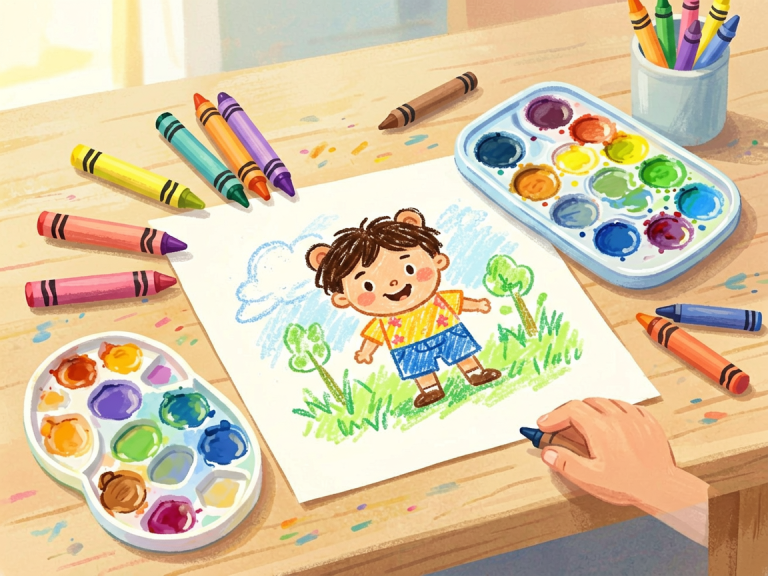
Plain paper and drawing materials. The cheapest high-ceiling toy in existence, and the one that adapts to every stage of representational skill.
A good ball. From rolling to catching to a real game, with a decade of skill progression built in.
Figures and animals. Props for every story the child will ever tell, from pretend play to stop-motion animation at ten.
Sand, water, and a container. The most reliably absorbing material for children under eight, and the cheapest.
If you want to apply a stricter test to a specific purchase, our guide to choosing a toy in ten minutes gives you a checklist you can run in the aisle, and the parent buying guides section covers specific categories age by age.
Frequently asked questions
At what age can a child play with small LEGO-style bricks?
Most children are ready around four, and the packaging usually reflects that with a 4+ label. The real variable is whether the child still mouths objects and whether there is a younger sibling in the house. If either answer is yes, keep the small pieces for supervised sessions at a table.
Is it bad to buy toys for an older age range?
Not if the age difference exists only because of small parts. It is a problem when the age mark reflects tools, heat, chemicals, or electronics. Check why the label is what it is before you decide it does not apply.
Should toys be sorted by age in the house?
Sort by hazard rather than age. A bin of “small pieces” that only comes out when the toddler is asleep is more useful than an age-based system that nobody maintains.
How many toys should be available at once?
Few enough that a child can see and reach everything. Most families find that a rotating set of a dozen or so toys, with the rest stored, produces more engaged play than a room where everything is out.
Do age labels matter for gifts?
Yes, and they matter most when you are buying for someone else’s child, because you do not know what is already in the house or what the child mouths. When in doubt, buy at the label or below it and add a note that the receipt is kept.
Fresh from the Guide
- Age-by-Age Toy Guide: What Actually Fits Kids From 1 to 10 2026年10月23日
- How to Compare Two Toys Before You Buy: 8 Criteria That Matter 2026年10月23日
- How to Choose a Toy: A 10-Minute Decision Framework for Parents 2026年10月23日
- Coding Toys for Kindergarteners: Worth the Hype or Just a Gimmick? 2026年8月27日
- Coding Toys for 13-Year-Olds: Are They Worth the Hype and the Price? 2026年8月27日
- Engineering Kits for Tweens: Choosing the Right Build 2026年8月6日