Choosing Toys for 2-Year-Olds That Encourage Independent Play
At age two, children are bursting with curiosity, energy, and a growing sense of autonomy. They want to do things “by myself,” yet they still need guidance and safe boundaries. One of the most valuable gifts you can give a two-year-old is the ability to play independently. Independent play isn’t just a convenience for busy parents; it is a critical developmental milestone that fosters creativity, problem-solving, focus, and emotional regulation. The toys you choose play a huge role in whether your toddler can engage deeply on their own. The right toys invite exploration, encourage trial and error, and can hold attention without constant adult involvement. This article outlines how to select toys for two-year-olds specifically to support independent play, along with practical strategies for making those toys work.
Why Independent Play Matters at Two
Before diving into toy selection, it helps to understand why independent play is so important at this age. Two-year-olds are rapidly developing language, motor skills, and social-emotional understanding. When they play alone successfully, they learn to self-soothe, make decisions, and experience a sense of mastery. Independent play also strengthens attention span—each time a toddler sticks with a puzzle or stack of blocks for ten minutes, they are building neural pathways for focus. Additionally, when a child invents their own scenarios with toys, they exercise imagination and cognitive flexibility. These skills are the foundation for later academic learning and healthy relationships. The goal is not to leave your child alone for hours, but to support moments of solo engagement that grow longer over time. The proper toys can make those moments more likely to happen.
Key Principles for Choosing Toys
Not all toys are equal when it comes to fostering independent play. For a two-year-old, the best toys are typically open-ended, developmentally appropriate, and slightly challenging but not frustrating. Here are core principles to keep in mind.
Open-ended over single-purpose. Toys that can be used in many ways—wooden blocks, play silks, shape sorters, stacking cups—encourage a child to invent their own games. A single-purpose toy like a singing electronic robot that only repeats phrases may entertain briefly, but it often leads to passive watching rather than active exploration. Open-ended toys let the child be the boss, which is exactly what independent play needs.
Sensory-rich but not overwhelming. Two-year-olds learn through their senses. Toys with pleasing textures, weights, and sounds—like natural wooden pieces, soft fabrics, or simple rattles—invite tactile investigation. However, avoid toys with flashing lights and loud, repetitive sounds, which can overstimulate and actually reduce sustained attention. Calm, predictable materials help a toddler focus on their own actions.
“Just right” difficulty. A toy that is too easy becomes boring; too difficult causes frustration and a call for help. Look for toys that match your child’s current abilities but offer a next step. For example, if your child can stack two blocks, a set of large blocks lets them practice stacking three or four. If they can match basic shapes, choose a shape sorter with slightly more complex shapes. This balance keeps them engaged and builds confidence without needing an adult to rescue them.
Manipulable and grasp-friendly. Two-year-old hands are still developing fine motor control. Choose toys that are large enough to swallow-proof (no choking hazards) but not so large that they are hard to hold. Pieces that fit together, snap, stack, roll, or fit inside one another are ideal. Good grip design matters—chunky knobs, rounded edges, and lightweight materials make it easier for a toddler to manipulate toys independently.
No batteries preferred. While some battery-operated toys have educational value, many encourage “watch and listen” behavior rather than “do and create.” For independent play, toys that respond to the child’s own physical effort—like a marble run or a wooden train—are superior. They teach cause and effect naturally because the child must act to get a result. Plus, quiet toys are gentler on everyone’s nerves.
Top Toy Categories That Support Independent Play
Based on the principles above, certain categories are especially powerful for fostering self-directed play in two-year-olds. These toys have stood the test of time because they meet toddlers at their developmental level and invite endless variations.
Building and stacking sets. Simple wooden blocks, large interlocking bricks, or nesting cups are classics. A two-year-old can stack a tower, line pieces up, knock it down, and start again. This kind of play develops spatial awareness, hand-eye coordination, and problem-solving. Because blocks have no predetermined outcome, a child can spend long stretches deciding where to place each piece. Look for sets with multiple shapes and colors, but avoid tiny blocks that pose choking risks.
Pretend play props. At two, children start to imitate adult actions. A small set of safe kitchen tools (wooden spoon, pot, and play food), a baby doll with a blanket, or a toy telephone can spark imaginative scenarios. These props work best when they are realistic enough to recognize but simple enough to command. Keep just a few props available at a time—too many choices can overwhelm a toddler. Pretend play is naturally engaging because the child creates the story.
Shape sorters and simple puzzles. Shape sorters with chunky pieces and puzzles with large knobs are excellent for focused, independent problem solving. They require concentration and give clear visual feedback when a piece fits. Choose puzzles based on real-life objects like animals, vehicles, or fruit. A child may not complete the puzzle on the first try, but they will return to it again and again, eventually mastering it without help.
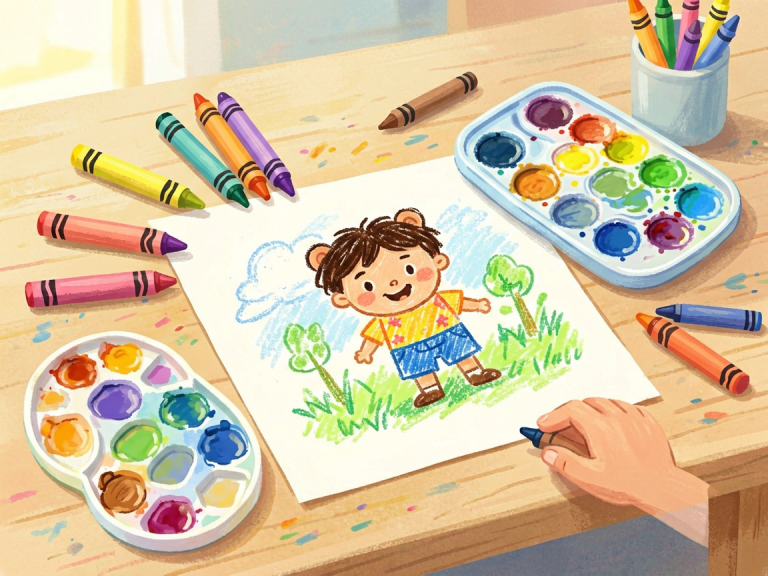
Art supplies with safe boundaries. Crayons (large, non-toxic), washable markers, and large paper can keep a toddler busy for quite a while. Independent art play helps with cause-and-effect learning, color recognition, and fine motor skills. To make art safe and successful for solo play, provide a limited palette (e.g., three colors) and a taped-down sheet of paper. Place the supplies in a low cabinet or tray so the child can access them on their own—this is a direct invitation to independent play.
Sensory bins. A shallow bin filled with dry rice, sand, or water-safe beads, along with scoops, cups, and funnels, offers a wonderfully absorbing experience. Sensory bins are open-ended and deeply calming for many toddlers. Supervise sensory play for safety, but you can encourage solo play by setting the bin up next to a low table and letting your child explore without interruption. Avoid materials that can be swallowed or put in the nose; use edible or non-toxic options if needed.
Ride-on toys and push toys. Large movement toys like a wooden push cart or a ride-on car are excellent for physical independence. They help with balance, gross motor skills, and spatial confidence. A two-year-old can push a toy lawnmower around the garden or drive a car through the living room on their own. These toys work best in open, safe areas where the child can move freely without constant correction.
What to Avoid When Choosing Toys
Even well-intentioned purchases can backfire. Some toys actually hinder independent play, either by making the child dependent on an adult or by creating frustration. Here are common pitfalls.
Avoid toys with many tiny pieces. Small parts that scatter easily can cause stress and require adult help to pick up. They also present choking hazards. For a two-year-old, fewer, larger pieces are much better.
Avoid highly realistic electronic replicas. A toy cellphone that says “hello” and “beep” might amuse a child briefly, but it does not invite creative thinking. The child simply presses a button and waits for a response. Independent play thrives on imagination, not on passive responses from a device.
Avoid toys that are too advanced for age. Complex construction sets, small magnetic tiles, or crafts requiring precise skills will quickly lead to frustration and a plea for help. While it is okay to offer occasional challenges, the core of your toy library should be comfortably within reach.
Avoid toys that require constant adult assembly. Toys with many parts that snap together tightly, or activities that need adult instruction to start, will inevitably interrupt your child’s flow. Look for toys that are ready to play with as soon as the child picks them up.
Setting Up the Environment for Independent Play
The best toy selection in the world will not work if the environment does not support it. How you present toys matters as much as which toys you choose. First, rotate toys regularly. If a child sees the same ten bins every day, they will become numb to them. Keep a few toys available at once and swap them every week or so. This keeps curiosity alive without overwhelming the child. Second, organize toys on low shelves with clear, simple labels (or photos). When a child can see their choices and pick one independently, they are more likely to engage deeply. Avoid shoving everything into a deep toy chest where nothing is visible. Third, create a dedicated play space with minimal distractions. A small rug, a low table, and a calm corner of the room work better than a chaotic playroom. Finally, model quiet focus yourself. When you sit nearby and read or do quiet work without entering the play, your child learns that independent play is a normal, valued activity. Gradually increase the distance and time, and do not interrupt unless your child genuinely asks for help.
Conclusion
Choosing toys for a two-year-old with independent play in mind is less about buying the newest gadget and more about selecting simple, open-ended, beautifully designed materials that invite discovery. Focus on toys that can be used in many ways, match your child’s motor and cognitive level, and do not rely on screens or batteries. Building blocks, shape sorters, pretend play props, safe art supplies, and sensory bins are all wonderful choices. Equally important is how you present those toys: rotate them, keep them accessible, and give your child space and time to explore without constant intervention. When you pair the right toys with a supportive environment, you give your child a gift that lasts a lifetime—the joy of self-directed play and the confidence to create their own world. Remember, every child is unique. Observe what captures your child’s attention, follow their lead, and adjust your toy collection accordingly. Independent play does not happen overnight, but with patience and thoughtful toy choices, you will soon see your two-year-old happily absorbed in their own small universe, playing and growing all by themselves.