Beyond the Screen: Top Alternatives to Educational Tablets for 7-Year-Olds
For many parents, the educational tablet has become a default answer to the question of how to keep a seven-year-old engaged, entertained, and learning. These devices promise interactive apps, animated lessons, and endless adaptive content. But by age seven, children are at a critical developmental crossroads: they are moving from concrete thinking toward more complex reasoning, their fine motor skills are sharpening, and their social and emotional awareness is expanding rapidly. While tablets can offer useful exposure to digital literacy, they often encourage passive consumption, shorten attention spans, and reduce opportunities for hands-on problem-solving. Fortunately, there is a rich universe of screen-free alternatives that are not only more engaging but often far more educational. The best alternatives to educational tablets for 7 year olds are those that spark curiosity, invite deep play, and allow children to manipulate real objects, collaborate with others, and experience the joy of discovery. Below are carefully selected categories that outperform any app.
Why Seven-Year-Olds Need More Than a Screen
At seven, children are no longer toddlers who merely poke at colors and sounds. They ask “why” endlessly, they love to sort, build, collect, and classify, and they are beginning to understand rules, strategies, and cause-and-effect relationships. A tablet’s touchscreen interface, while intuitive, is a limited sensory tool. It fails to provide the tactile feedback of wooden blocks, the smell of crayons, or the physical resistance of a mechanical gear. Neurologically, hands-on learning creates stronger neural connections because it engages multiple senses simultaneously. When a seven-year-old constructs a bridge from straws and tape, they experience tension, balance, and failure in a way that no cartoon simulation can replicate. Moreover, screen-free activities help regulate mood and attention. Research shows that excessive screen time at this age is linked to reduced impulse control and shorter bedtime. Replacing the tablet with physical alternatives gives a child the opportunity to practice patience, perseverance, and creativity. It also allows parents to step back and see the child’s natural interests emerge, unprompted by algorithms. Therefore, the goal is not to eliminate technology entirely, but to choose experiences that build the cognitive and emotional muscles that screens often leave underdeveloped.
Classic Board Games and Strategy Puzzles
Board games are arguably one of the strongest alternatives to educational tablets because they combine math, language, social skills, and strategy in an irresistibly fun package. Games like “Ticket to Ride: First Journey” teach map reading and logical planning, while “Qwirkle” encourages pattern recognition and spatial reasoning. For a seven-year-old, the ideal game has clear rules, moderate luck, and plenty of decision-making. Chess and checkers may seem old-fashioned, but they train working memory and forward-thinking in a way that no app can match, because the physical pieces demand that a child visualize moves and anticipate consequences. Additionally, cooperative games like “Outfoxed!” or “Forbidden Island” (junior version) teach teamwork and emotional regulation, as children learn to celebrate shared victories and reassure each other after losses. Beyond games, puzzles such as 100-piece jigsaw puzzles with maps, dinosaurs, or solar system themes provide quiet focus and spatial awareness. A seven-year-old can work on a puzzle over several days, learning how to organize pieces by color and edge, a metaskill that transfers directly to reading comprehension and scientific classification. The key advantage is that board games and puzzles create face-to-face interaction. A child sees a parent or sibling smile, frown, or laugh, and they must read those social cues. This is something a tablet, even with video chat, cannot authentically offer. When parents say “let’s play a game,” they are saying “let’s be present together,” and that sense of shared attention is profoundly educational.
Building and Engineering Sets That Fuel Problem-Solving
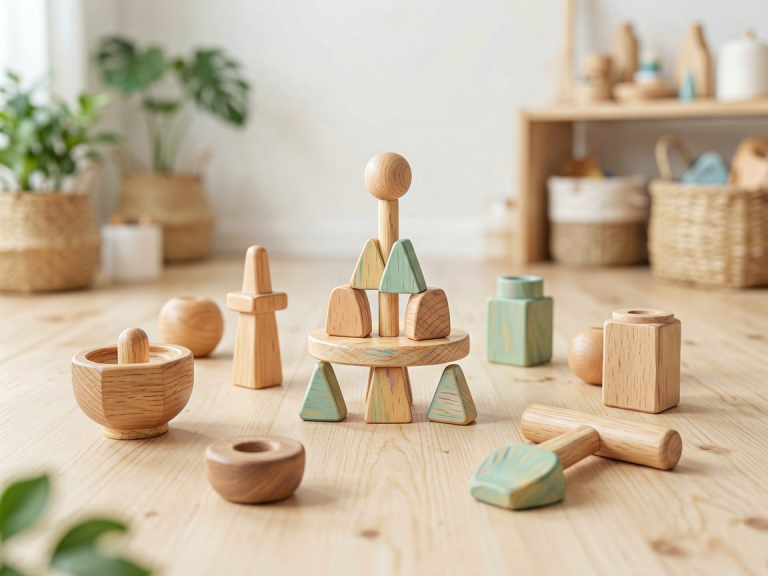
At age seven, children are natural engineers. They love to take things apart and (sometimes) put them back together. Instead of a virtual physics app, provide real construction materials. Classic wooden blocks are still excellent, but more complex sets like LEGO Classic or magnetic tiles encourage deliberate design and structural thinking. A child who builds a tower that falls learns about gravity, stability, and iterative improvement. Better yet, move beyond branded kits. Give seven-year-olds a “tinker box” filled with cardboard tubes, rubber bands, paper clips, popsicle sticks, and a low-temperature glue gun. The open-ended nature of these materials forces them to plan, measure, and improvise. For example, ask the child to build a bridge that can hold a heavy book, or a marble run that takes at least ten seconds for the marble to reach the bottom. These challenges are far richer than any app task because they involve trial and error with physical consequences. More structured options include K’NEX, Meccano, or Snap Circuits, which introduce basic mechanics and electronics. When a child connects wires to a motor and sees a fan spin, they learn that electricity is real and powerful. They also learn to read instructions, a skill that is increasingly rare in the age of instant video tutorials. Perhaps most importantly, building sets develop resilience. The child may become frustrated when a model collapses, but the feeling of rebuilding it successfully is unmatched. That resilience is the single greatest “educational outcome” a parent could desire.
Interactive Science Kits for Hands-On Discovery
Seven-year-olds are natural scientists, full of hypotheses about why things float, sink, melt, or explode. Educational tablets often offer virtual labs with pre-programmed outcomes, but nothing beats a real volcano made from baking soda and vinegar, or a hand-lens used to inspect a real leaf. Interactive science kits are among the best alternatives to tablets because they transform abstract concepts into tangible experiences. Look for kits that cover the child’s current passions: weather, bugs, magnets, crystals, or simple chemistry. A kit like “GeoSafari Jr. Kidnoculars” or a butterfly garden gives a child the chance to observe living things, record data, and ask questions. Even simpler: a kitchen scale, a set of measuring cups, and a notepad can be a “kitchen science lab.” Baking is a perfect educational activity, requiring reading, fractions, sequencing, and patience. When a child makes biscuits too flat, they hypothesize that the baking powder was old or the oven was too cool. That hypothesis, testing, and adjustment is the essence of the scientific method. For structured experiments, choose kits that come with clear instructions but also encourage free exploration. Avoid kits that are purely “magic shows” with one-time outcomes. The best science kits are those that can be reused in multiple ways, such as a microscope with prepared slides plus blank slides for collecting pond water. By giving a child ownership over their own discoveries, these kits build a deep sense of wonder and authorship that a screen-based quiz can never simulate.
Creative Arts and Craft Supplies That Grow the Imagination
Educational tablets often feature drawing apps and music-making programs, but a seven-year-old’s creativity flourishes when they can smear paint, cut paper, twist pipe cleaners, and mold clay. Art supplies are not merely entertainment; they are serious cognitive tools. Drawing with pastels or watercolors develops fine motor control and hand-eye coordination. Cutting and gluing requires bilateral coordination and spatial planning. More importantly, open-ended art allows a child to express emotions that they may not yet have the vocabulary to verbalize. A seven-year-old who feels anxious about school may draw a chaotic storm scene, while another child might create a careful portrait of family members. When parents ask about the artwork, they open conversations about feelings, colors, and symbols. Craft projects also teach project management. If a child decides to make a cardboard castle, they must envision the final structure, gather materials, create a plan, and execute it over several days. This is the same executive functioning that academic tests try to measure, but it develops naturally through play. Consider subscription art boxes, but also simply stock a home shelf with paper, tape, yarn, fabric scraps, and non-toxic paints. Avoid giving children coloring books exclusively; those can limit creative thinking. Instead, offer blank paper and challenge them to invent their own imaginary creature, design a new kind of vehicle, or create a board game from scratch. Each of these tasks lights up the prefrontal cortex far more intensely than tapping a virtual button.
Chapter Books and Audiobooks: A Gateway to Deep Focus
Reading is, without question, one of the most powerful educational alternatives to a tablet. At seven, many children are transitioning from picture books to early chapter books, but they still need encouragement and guidance. Rather than handing them a tablet filled with reading apps, take them to the library and let them choose physical books. The tactile act of turning pages, seeing the progress of a bookmark, and noticing the thickness of the book to be conquered is motivating. Series like “Magic Tree House,” “My Father’s Dragon,” or “The Kingdom of Wrenly” offer simple yet compelling narratives that build stamina for longer stories. Furthermore, audiobooks are an excellent companion, not a screen substitute. Listening to a well-narrated story on a CD or an MP3 player (yes, an old device without video) develops listening comprehension, vocabulary, and imagination. A seven-year-old who hears a description of a dragon soaring over mountains creates their own mental imagery, which is far richer than any app’s animation. Reading aloud to a child also remains crucial. When a parent reads a difficult word with expression, the child learns pronunciation, tone, and emotional context. After finishing a chapter, ask open-ended questions like “What do you think will happen next?” or “Why did the character do that?” These conversations are the highest form of education. To make reading even more attractive, create a cozy reading nook with pillows and a flashlight. Let the child read to a pet, a sibling, or a favorite stuffed animal. The goal is to associate reading with comfort, agency, and pleasure. No tablet app can replace the smell of a library, the weight of a book, or the pride of finishing a 100-page story.
Outdoor Exploration Tools: Nature as the Ultimate Classroom
At seven years old, children are physically restless and intensely curious. The outdoors is a living laboratory. Instead of an educational tablet full of animal facts, give them a magnifying glass, a bug catcher, a compass, and a simple field guide. A child who flips over a rock and discovers pill bugs learns about habitats, defense mechanisms, and decomposition. They can begin a “nature journal” where they draw and describe what they see. This practice combines science, writing, and art in one transformative activity. Geocaching is another brilliant alternative: using a GPS device (not a phone with a kid-friendly app, but an actual handheld GPS unit) to search for hidden containers. This teaches map reading, cardinal directions, and persistence. Even a simple walk in the park can become an adventure if you bring collection bags and ask the child to find ten different leaves or five smooth stones. Then at home, they can sort, measure, and research what those objects are. A seven-year-old can also learn gardening. Planting a seed, watering it daily, and watching it sprout teaches biology, responsibility, and delayed gratification. In an era of instant feedback from screens, gardening is a beautiful counterpoint. Outdoor play also provides crucial physical exercise, which improves attention, sleep, and mood. Many parents worry that they lack the knowledge to be “nature educators.” That is fine. Let the child be the leader. Provide the tools and ask questions like “What do you notice?” “How is this different from yesterday?” “Why do you think that bug is moving slowly?” This kind of inquiry-based learning is the gold standard, and it costs nothing but time outdoors.
Conclusion: Choosing Play That Builds a Whole Child
The best alternatives to educational tablets for seven-year-olds are not expensive gadgets or complex curricula. They are simple, real-world materials that invite a child to think, make, move, and connect. Board games teach strategy and social grace; building sets teach physics and resilience; science kits teach curiosity and method; art supplies teach expression and planning; books teach language and empathy; and outdoor tools teach observation and wonder. None of these require batteries, Wi-Fi, or parental locks. They do require something more valuable: a parent’s time, attention, and willingness to let the child make mistakes. By stepping away from the tablet, a seven-year-old learns that learning is not a passive swipe but an active adventure. The hands that fold paper, the eyes that study a ladybug, and the voice that narrates a story are building the foundations of a lifelong love of discovery. So the next time you reach for the tablet for your seven-year-old, pause. Put down a pile of blocks, open a book, or head outside. The screen can wait. The child’s imagination, however, should never have to.