Beyond the Screen: The Best Alternatives to Learning Tablets for Babies
In today’s hyper-digital world, it is almost impossible to walk into a nursery, a pediatrician’s waiting room, or even a family gathering without seeing a tiny infant staring intently at a glowing screen. Learning tablets marketed specifically for babies — those colorful, durable, toddler-proof devices loaded with flashy apps, lights, and sounds — have become a billion-dollar industry. They promise early literacy, number recognition, and cognitive stimulation, all wrapped in a parent-friendly package. Yet an increasing body of research in pediatric neuroscience and early childhood development suggests that these devices, however convenient, may do more harm than good. Babies’ brains are not miniature adult brains; they are exquisitely designed to learn through real-world, multi-sensory, and relational experiences. Therefore, the question is not whether learning tablets are helpful, but rather what truly superior alternatives exist that respect a baby’s developmental needs. This article explores the best alternatives to learning tablets for babies — alternatives that are not only safer but also far more effective in building the foundational skills that matter most.
Why Look Beyond Learning Tablets?
Before diving into the alternatives, it is essential to understand why so many parents are seeking substitutes. The American Academy of Pediatrics recommends zero screen time for children under 18 months, except for video chatting. The reasons are compelling. Babies learn best through three-dimensional interactions: they need to touch, taste, smell, hear, and see objects from multiple angles. A flat screen cannot provide the rich tactile feedback that helps develop fine motor skills. Moreover, the rapid scene changes and artificial rewards built into tablet apps can overstimulate the developing prefrontal cortex, potentially reducing attention span and self-regulation. The interactive nature of a tablet also undermines the most crucial element of early learning — the human connection. When a baby taps a screen and a cartoon character claps, the baby’s brain releases dopamine, but it is a shallow reward compared to the genuine delight of a parent’s smile or a shared laugh. Real alternatives must therefore be interactive, sensory-rich, and relationship-centered.
1. Sensory Play Bins: The Ultimate Hands-On Learning Toolkit
One of the most powerful alternatives to a learning tablet is the humble sensory play bin. These are shallow containers filled with natural, safe materials that babies can explore freely. For example, a bin filled with uncooked rice, small scoops, and plastic cups offers endless opportunities for cause-and-effect learning that far surpasses any app. When a baby picks up a handful of rice and lets it fall, they are not only practicing their pincer grasp — they are also learning object permanence, weight, texture, and gravity. Sensory play also stimulates multiple brain regions simultaneously, helping to build neural connections that support later problem-solving and creativity.
A more structured variation is a themed sensory bin. For instance, a fall-themed bin might include dried leaves, small gourds, and a few pinecones. As the baby touches the bumpy gourd or crushes a dry leaf, they are processing different textures and temperatures. This type of learning is impossible to replicate on a screen because it involves proprioception — the sense of body position and movement. Furthermore, sensory bins encourage solitary exploration, which cultivates independent play skills — something tablets often sabotage by requiring constant external stimulation. Parents can join in occasionally to label objects (“That’s a rough leaf!”) which builds vocabulary, but the baby remains the active agent in their own discovery.
2. Board Books with Interactive Features: Reading as a Shared Experience
While many learning tablets claim to teach early literacy, they often do so through passive consumption. A better alternative is a sturdy board book designed for tiny hands. The key is not the book itself but the *interaction* that happens around it. When a parent holds a baby on their lap, turns the pages, points to pictures, and makes animal sounds, the baby’s brain is absorbing emotional cues, rhythm, and prosody — all critical for language development. The act of turning a page also builds fine motor control, something a swipe does not.
To replace the “interactive” promises of a tablet, choose books with flaps, mirrors, different textures (like the classic “Pat the Bunny”), or simple pop-ups. These features engage a baby’s curiosity in a physical way. For example, lifting a flap reveals a hidden picture, teaching object permanence and prediction — a far more meaningful cognitive challenge than tapping a virtual button. Additionally, reading together fosters bonding through eye contact, shared laughter, and the warmth of a caregiver’s voice. A study published in *Pediatrics* found that babies who are read to from an early age have larger vocabularies and better reading readiness by kindergarten. Tablets, by contrast, often interrupt this shared experience because the baby becomes fixated on the device rather than on the parent.
3. Musical Instruments and Sound Exploration
Many learning tablets for babies come preloaded with songs, animal sounds, and musical notes. Yet there is a world of difference between passively hearing a digitized melody and actively producing sound. Giving a baby a simple, safe instrument — like a wooden maraca, a small drum, or a jingle bell rattle — offers profound developmental benefits. When a baby shakes a rattle, they are learning about cause and effect (shaking produces sound), hand-eye coordination, and motor planning. They also experience the joy of agency: *I made that sound.* This sense of control is crucial for developing self-efficacy.
Moreover, real instruments provide natural variation. A wooden xylophone will produce slightly different tones depending on how hard it is struck, teaching the baby about dynamics and force. A tablet, in contrast, produces perfectly uniform sounds, which is less informative. Musical play also engages the auditory cortex in ways that are different from tablet-based apps. Live music — especially if a parent sings along — introduces emotional content (sad, happy, lullaby) that helps babies attune to social cues. A simple set of plastic egg shakers or a small baby piano can provide months of rich, screen-free learning.
4. Outdoor and Natural World Exploration
One of the most overlooked yet profoundly effective alternatives to learning tablets is simply going outside. The natural environment is a dynamic, multi-sensory classroom that no app can compete with. A baby lying on a blanket under a tree can watch leaves dance in the wind, feel a cool breeze on their skin, hear birds chirp, and see changes in light and shadow. These experiences stimulate the visual system in a gentle but complex way, supporting the development of depth perception and visual tracking. Outside, there are no flashy animations, only real-life patterns that the baby must learn to organize.
Even a short walk in a stroller can be a learning opportunity. Pointing out a passing dog, the shape of a cloud, or the smell of flowers builds vocabulary and observational skills. For babies who are old enough to sit or crawl, a supervised play session in a safe patch of grass allows them to feel the texture of leaves, pick up pebbles (with mouth supervision), and watch ants crawl. These activities help develop the sense of wonder and curiosity that genuine learning requires. In contrast, tablets present a curated, simplified version of the world — one where the baby is a passive consumer rather than an active explorer.
5. Open-Ended Building Toys and Stackers
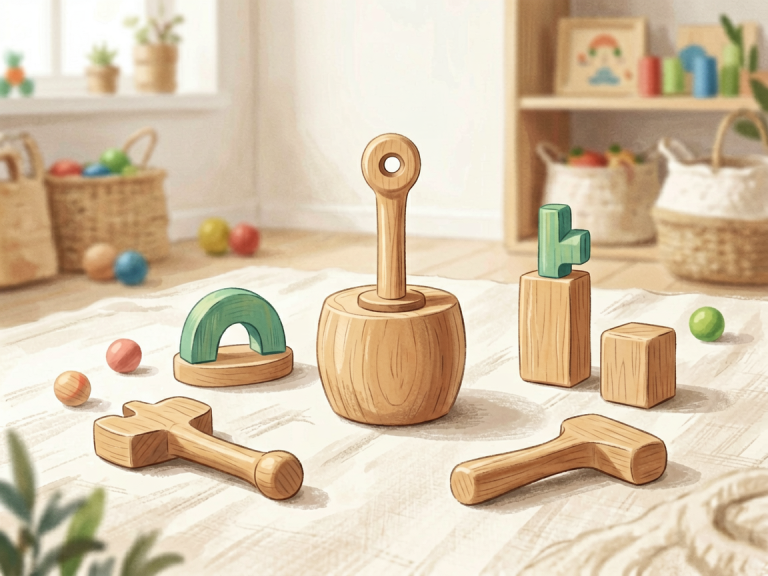
The Montessori method has long emphasized the value of open-ended materials — toys that have no single “correct” use and can be manipulated in countless ways. Stacking cups, wooden blocks, nesting dolls, and simple shape sorters are classic examples. These toys teach a baby about spatial relationships, balance, size, and gravity in a hands-on way. For instance, when a baby tries to stack a larger block on top of a smaller one and it topples, they are conducting a real physics experiment. A tablet does not provide this feedback — virtual blocks cannot fall because of weight distribution; they simply disappear or reset. The physical resistance of real objects is essential for developing a sense of force and motion.
Open-ended toys also encourage creativity and problem-solving. A baby might discover that a cup can be used as a drum, a hat, or a container for other objects. This divergent thinking is the opposite of the rigid, goal-oriented tasks that learning tablets often present (e.g., “tap the circle to get a reward”). Tablets train babies to seek a single correct answer, while open-ended toys cultivate the ability to generate multiple possibilities — a skill more valuable in an unpredictable world.
6. Social Interaction and Peek-a-Boo Play
It might seem obvious, but the best “learning tool” for a baby is another human being. Face-to-face interaction provides the most complex and rewarding input a baby can receive. A game of peek-a-boo, for example, teaches object permanence, social reciprocity, and emotional regulation — all in the span of 20 seconds of giggling. When a parent makes exaggerated facial expressions, varies their voice pitch, and responds to the baby’s cues, they are building the neural architecture for language, attachment, and empathy. No tablet can mimic the subtlety of a real human face: the flutter of eyelashes, the crinkle at the corner of an eye, the micro-expressions that convey joy or surprise.
Simple games like “this little piggy,” patty-cake, or tickling are far more effective at building body awareness and social connection than any app. Babies also learn turn-taking — a foundational social skill — through these interactions. In a world increasingly concerned with screen addiction, the simple act of sitting on the floor and playing with a baby is the most powerful alternative of all.
Conclusion: The Real Tablet Is the World Around Them
The marketing campaigns for baby learning tablets often evoke a sense of urgency — you must give your baby a head start, or they will fall behind. But the science tells a different story. The most critical period of brain development, from birth to age three, is optimized not by digital stimulation but by rich, real-world experiences mediated by caring adults. The alternatives discussed above — sensory bins, board books, musical instruments, outdoor exploration, open-ended toys, and human interaction — are not merely “second best” options. They are actually superior in every meaningful way. They build stronger neural pathways, foster deeper emotional bonds, and cultivate the kind of curiosity that lasts a lifetime.
So before you hand your baby a screen, consider offering them a handful of rice, a wooden block, a leaf from the backyard, or simply your own smiling face. These are the tools that have worked for millennia, and they still work today. The best learning tablet for a baby is no tablet at all — it is the beautiful, messy, three-dimensional world they were born to explore.