Are Wooden Blocks Worth It for 2-Year-Olds? A Comprehensive Guide for Parents
Introduction: The Timeless Appeal of Wooden Blocks
Walk into any early childhood classroom, playroom, or even a minimalist Scandinavian home, and you are likely to spot a set of wooden blocks. These simple, unassuming cubes, rectangles, and triangles have been a staple of childhood for centuries. But in an era of flashing lights, talking robots, and interactive tablets, parents often find themselves asking a practical question: *Are wooden blocks truly worth the investment for a 2-year-old?* The answer, as research and developmental psychology suggest, is a resounding yes—but the full picture is more nuanced than a simple thumbs-up. This article will dissect the cognitive, physical, social, and emotional benefits of wooden blocks for toddlers, weigh them against modern alternatives, and offer practical advice for parents navigating the crowded toy market.
The Developmental Power of Open-Ended Play
Cognitive Growth and Problem-Solving Skills
At age two, a child’s brain is developing at an astonishing rate, forming up to one million new neural connections every second. Wooden blocks are a quintessential example of an open-ended toy—one that has no fixed purpose, no single correct way to play. This openness is precisely what fuels cognitive development. When a toddler stacks two blocks and watches them tumble, they are not just making noise; they are experimenting with gravity, balance, and cause-and-effect relationships. Research in early childhood education consistently shows that block play strengthens spatial reasoning, which is a strong predictor of later mathematical ability. A 2018 study published in *Child Development* found that preschoolers who engaged in structured block play scored higher on tests of spatial visualization and mental rotation. For a 2-year-old, even the simplest act of placing a block on top of another requires hand-eye coordination, planning, and the ability to adjust actions based on feedback.
Language and Symbolic Thinking
Blocks also serve as powerful tools for language development. As toddlers build towers, houses, or “castles,” they naturally narrate their actions or describe what they are creating. A parent who sits nearby and says, “You put the red block on top of the blue one. That tower is very tall!” is not just commenting—they are scaffolding vocabulary and sentence structure. Moreover, wooden blocks encourage symbolic thinking. A block can become a phone, a car, a piece of cake, or a bed for a toy animal. This capacity to use one object to represent another is a foundational cognitive skill that underpins reading, mathematics, and creative problem-solving later in life.
Physical Benefits: Fine and Gross Motor Development
Strengthening Little Hands and Fingers
A 2-year-old’s fine motor skills are still emerging. Grasping, lifting, turning, and precisely placing wooden blocks requires the use of small muscles in the hands and fingers. Unlike plastic blocks that often snap together with little effort, wooden blocks demand a controlled grip and deliberate placement. This repeated practice helps develop the pincer grasp, which is essential for writing, buttoning clothes, and using utensils. The texture and weight of wood also provide valuable sensory feedback—tactile input that helps the brain map the relationship between hand movements and the physical world.
Whole-Body Engagement
While fine motor skills get the spotlight, block play also engages gross motor skills. A toddler might kneel, stretch, or stand on tiptoes to place a block on a tall tower. They might crawl across the floor to retrieve a fallen piece. They might even carry a bucket of blocks from one side of the room to another, practicing balance and coordination. This full-body involvement is far richer than the sedentary, screen-based play that dominates many modern childhoods. Wooden blocks invite movement, posture adjustments, and spatial awareness in a way that no digital app can replicate.
Social and Emotional Learning Through Block Play
Collaboration and Turn-Taking
Even when a 2-year-old plays alone, they are learning. But block play often becomes a social activity, especially in family settings or daycare environments. When two toddlers build together, they must negotiate: “My block here,” “No, mine there.” They learn to share, to wait for a turn, and to express frustration without aggression. These early social exchanges are the building blocks—pun intended—of emotional intelligence. A study from the University of Texas at Austin observed that block play among toddlers correlated with higher levels of cooperative behavior and lower levels of conflict compared to other types of toy play.
Frustration Tolerance and Resilience
One of the most valuable lessons wooden blocks teach is how to handle failure. A tower inevitably falls. A carefully balanced arch collapses. A 2-year-old’s initial reaction might be a cry or a tantrum. But with gentle adult guidance, they learn to rebuild. They discover that failure is not permanent, and that persistence leads to success. This is a lesson in resilience that no electronic toy can offer, because digital games often provide instant success or immediate reset buttons. Wooden blocks, with their unforgiving physics, teach children that effort and patience are required to create something stable.
Comparing Wooden Blocks to Other Toys for 2-Year-Olds
Plastic Building Blocks: Convenience vs. Quality
Many parents wonder: why spend more on wooden blocks when plastic bricks like Duplo or Mega Bloks are cheaper and more colorful? There are several differences. Plastic blocks often have interlocking mechanisms that simplify construction, meaning the child relies less on balance and more on snapping pieces together. While this can be fun and less frustrating, it also removes some of the cognitive challenge. Additionally, plastic blocks are typically lighter and less satisfying to hold. They may contain phthalates or BPA if made cheaply (though most reputable brands are safe). Wooden blocks, especially those made from solid hardwoods like beech or maple, feel substantial and warm. They also tend to be quieter—a significant advantage for parents who value a peaceful home.
Electronic and Screen-Based Toys
The most direct competitor to wooden blocks today is the tablet or smartphone app. Many educational apps claim to teach shapes, colors, and problem-solving. But research from the American Academy of Pediatrics warns that passive screen time does not offer the same developmental benefits as hands-on, sensory play. A screen is a two-dimensional representation, while a wooden block is a three-dimensional object that a child can rotate, feel, and manipulate. The haptic feedback and proprioceptive input from handling real objects are irreplaceable. Moreover, screen-based play often encourages solitary consumption rather than creative construction. For a 2-year-old, the brain is wired to learn through physical interaction with the environment—wooden blocks align perfectly with this developmental need.
Practical Considerations for Parents
Safety and Material Quality
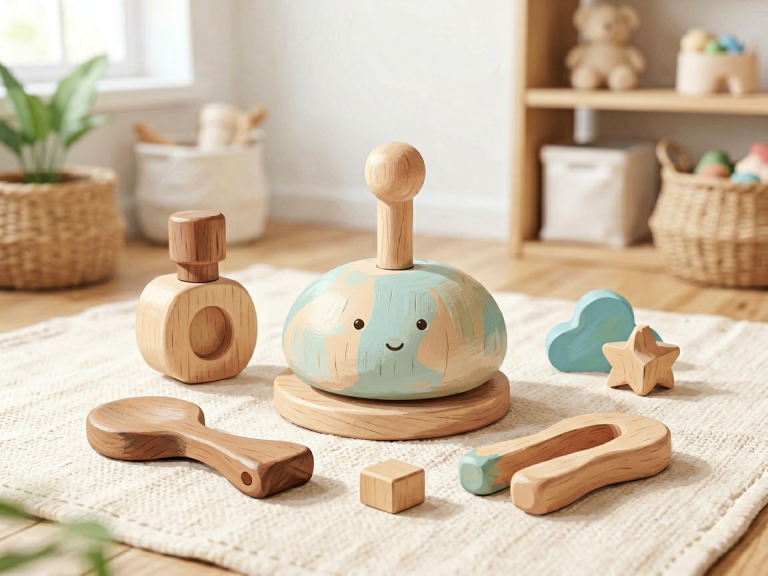
Not all wooden blocks are created equal. When choosing a set for a 2-year-old, prioritize safety. Look for blocks made from sustainably sourced hardwoods, finished with non-toxic, water-based paints or oils. Avoid blocks with sharp edges, splinters, or small pieces that could pose a choking hazard. A good rule: the block should be large enough that it cannot fit entirely inside a toddler’s mouth. Many high-quality brands, such as Melissa & Doug, Grimm’s, or PlanToys, meet these standards. Be wary of cheaply made blocks that may have lead paint or formaldehyde in the adhesives. The initial investment in a premium set can last for years and even be passed down to younger siblings.
The Montessori and Waldorf Connection
Wooden blocks are central to both Montessori and Waldorf educational philosophies, which emphasize natural materials, simplicity, and child-led learning. In a Montessori environment, blocks are presented without interruption, allowing the child to discover their properties independently. Waldorf educators prefer blocks in natural, unfinished wood to encourage imaginative transformation. If you are drawn to these pedagogies, wooden blocks are practically non-negotiable. Even if you are not a follower of any specific method, these approaches offer a compelling rationale: children learn best when they are free to explore, make mistakes, and create their own meaning.
Cost vs. Longevity
A quality set of wooden blocks can cost anywhere from $30 to $100 or more, which might seem steep for a toy that does nothing but sit there. Compare this to a $40 interactive toy that lights up, sings, and talks—and then breaks after three months. Wooden blocks are remarkably durable. They do not require batteries, they are easy to clean, and they rarely break. A 2-year-old will use them now, but a 5-year-old will use them differently—building bridges, counting blocks, sorting by color, or incorporating them into elaborate pretend play. Many families report that wooden blocks remain a favorite toy through age 7 or 8. When you amortize the cost over several years, the per-use price is negligible.
How to Maximize the Value of Wooden Blocks
Parental Involvement Matters
Blocks are excellent for independent play, but they shine brightest when an adult joins in. Sitting on the floor with your toddler, narrating their actions, asking open-ended questions (“What else could we add to make it stronger?”), and modeling constructive behavior can significantly enhance the learning outcomes. You don’t need to “teach” anything—just be present. The simple act of building together strengthens the parent-child bond and provides rich language exposure.
Rotating and Expanding the Play
To keep block play fresh, consider rotating the blocks with other open-ended materials. Add small toy animals, scarves, or cardboard tubes. Let your toddler use blocks to create enclosures for toy cars or ramps for marbles. The more you integrate blocks into varied play scenarios, the more possibilities your child will discover. Some parents even use blocks for early math games: counting, sorting by size or color, or matching shapes. The versatility is almost endless.
Avoiding Overstimulation
Finally, remember that less is often more. A huge bin of hundreds of blocks can overwhelm a 2-year-old. A smaller, curated set of 30–50 blocks is usually sufficient. Allow your child to focus on a few pieces at a time. This encourages deeper concentration and reduces the clutter that can lead to frustration. A calm, organized play space sends a powerful message: this toy deserves your attention.
Conclusion: An Investment in Childhood, Not Just a Toy
So, are wooden blocks worth it for 2-year-olds? The evidence is clear. They support cognitive, physical, social, and emotional development in ways that few other toys can match. They are safe, durable, and environmentally friendly. They grow with the child, offering new challenges and opportunities for years. And perhaps most importantly, they invite the kind of slow, thoughtful, creative play that is increasingly rare in a world of instant gratification. For the price of a few fast-food meals, you can give your toddler a tool that will help them build not just towers, but the foundational skills for a lifetime of learning. Yes, wooden blocks are absolutely worth it.