The Toddler STEM Kit Dilemma: Investment in Early Genius or Overhyped Plaything?
Introduction: The Rise of STEM for the Diaper Set
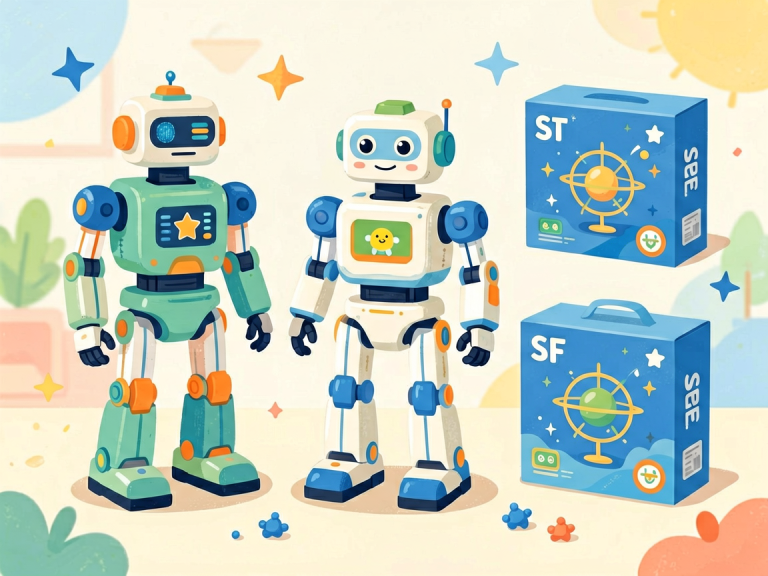
Walk into any toy store today, and you will be confronted by a dazzling array of brightly colored boxes promising to turn your two-year-old into the next Einstein. "STEM Kits for Toddlers" – the acronym standing for Science, Technology, Engineering, and Mathematics – have become the fastest-growing segment of the early childhood educational toy market. Parents, bombarded by studies showing that 90% of brain development occurs before age five, feel a subtle but persistent pressure to optimize every waking moment. The question hangs in the air like a mobile over a crib: *Should I buy STEM kits for my toddler?*
The answer, as with most parenting quandaries, is neither a definitive yes nor a resounding no. It is a nuanced landscape where a child’s developmental stage, the quality of the kit, and – most importantly – the role of the parent all intersect. This article dissects the promise and the peril of STEM kits for children aged 18 months to four years, providing a research-backed framework to help you decide whether your hard-earned money is best spent on a circuit-building set for a three-year-old or on a classic wooden block set and a trip to the park.
The Allure: What STEM Kits Promise (And Sometimes Deliver)
The marketing is seductive. A typical toddler STEM kit might claim to teach "computational thinking," "early physics concepts," or "engineering design principles." On the surface, this seems like a fantastic shortcut. Instead of a pile of random toys, you get a curated, age-appropriate package that systematically introduces concepts like cause and effect, spatial reasoning, and pattern recognition.
One of the most legitimate arguments in favor of high-quality STEM kits is their ability to scaffold executive function skills. A simple kit for a two-year-old might involve sorting translucent colored shapes by hue and size, then stacking them on a light-up pegboard. The child must inhibit the impulse to simply scatter the pieces, must hold in working memory the rule of "red goes here, blue goes there," and must demonstrate cognitive flexibility when the pattern changes. These are the very building blocks of self-regulation and academic readiness.
Moreover, many toddler STEM kits are designed around "tinkering" – open-ended exploration. For example, a magnetic tile kit allows a 3-year-old to attach square magnets to a refrigerator to build a 2D house, then realize that if they connect four squares in a ring, they create a 3D cube. This is not just play; it is an intuitive introduction to geometry, balance, and magnetic polarity. A 2017 study published in *Science* found that even brief, structured play with cause-and-effect toys can improve toddlers' ability to reason about unobserved causal mechanisms. In other words, a well-designed kit that lets a toddler press a button and see a ball roll down a ramp is teaching them how to form and test hypotheses – the core of the scientific method.
The Hidden Costs: When Kits Become Educational Theater
However, the STEM kit industry is largely unregulated, and many products for toddlers suffer from a crippling flaw: they are not truly designed for toddlers. A common pitfall is what I call "age-label inflation." A box might read "Ages 2+" but contain dozens of tiny pieces that are both a choking hazard and far too complex for a child who still puts everything in their mouth. The frustration this generates is not "productive struggle"; it is pure dysregulation. A screaming two-year-old who cannot snap the plastic gears together is not learning engineering – they are learning that play is a source of stress.
Another significant hidden cost is the displacement of "free play." Developmental psychologist Alison Gopnik of UC Berkeley famously argues that human toddlers are the most powerful learning machines in the universe precisely because they are allowed to engage in unstructured, exploratory play – playing in the mud, banging pots, making up imaginary scenarios. A highly structured STEM kit, with its predetermined steps and "correct" outcomes, can inadvertently squelch this spontaneous creativity. When a kit tells a child to put the red block on the blue block to make the light go on, the child learns compliance, but they may not learn the deeper joy of discovery that comes from trying the yellow block and seeing what happens next.
Furthermore, there is the risk of the "parent-as-sage" dynamic. Many STEM kits are accompanied by thick instruction booklets and suggested "learning outcomes." This can transform a parent from a play partner into a micromanager, hovering and correcting: "No, sweetie, the gear goes here, not there." This constant interruption of a child’s own exploratory drive can increase anxiety and decrease intrinsic motivation. A 2021 study in *Child Development* found that when parents provided excessive directive guidance during puzzle play, preschoolers showed lower persistence and less independent problem-solving later on. The best STEM kit, ironically, may be one that the parent leaves on the floor and walks away from.
A Developmental Reality Check: What Toddlers Actually Need
To answer the question "should I buy STEM kits for toddlers," we must first ask: what does a toddler’s developing brain truly need? According to the National Association for the Education of Young Children (NAEYC), the most critical elements for cognitive growth in the first three years of life are: warm, responsive interaction with caregivers; rich language exposure; and opportunities for sensory-motor exploration. A toddler learns about gravity not from a diagram, but by dropping a spoon from their high chair fifty times. They learn about buoyancy by splashing a rubber duck in the bathtub. They learn about cause and effect by shaking a rattle.
A genuine toddler STEM kit should align with these principles. It should be primarily sensory: involving textures, sounds, colors, and smells. It should be safe, with large parts and no batteries that require a screwdriver. It should be open-ended – meaning there is no single "right answer." The best kits for this age group are often deceptively simple: a set of nesting cups that can be stacked into a tower or used as molds in sand; a set of large interlocking gears that can be arranged in any configuration; a water play table with scoops, funnels, and tubes.
How to Evaluate a STEM Kit: A Practical Checklist for Parents
Before you click "Add to Cart," run the kit through this five-point filter:
- The 80/20 Rule of Adult Help: Can your child independently engage with at least 80% of the kit without your direct instruction? If it requires constant adult intervention to make anything interesting happen, it is a toy for you, not for your toddler.
- The Open-Endedness Test: Once the "suggested activity" is done, can the pieces be used in a different way? A set of magnetic blocks is open-ended. A kit that involves snapping a specific plastic flower onto a specific stem to match a picture is closed-ended.
- The Choking Hazard Check: Are all parts larger than a toilet paper roll? For children under three, any part that fits inside a standard 1.5-inch diameter tube is a danger. Many popular "small parts" kits do not belong in a toddler room.
- The Frustration Threshold: Does the kit have a built-in margin for error? For example, a bead maze where the bead can fall off the track is frustrating. A gear set where gears that are not perfectly aligned still turn but wobble is forgiving and teaches cause and effect without tears.
- The "Is This a Toy or a Curriculum?" Question: Does the box scream "educational" in a way that makes your stomach clench? If the marketing promises to make your child "kindergarten-ready" or "boost IQ," be suspicious. Good toys don't need to sell themselves as medicine.
Conclusion: Buy With Discernment, Not Guilt
So, should you buy STEM kits for your toddler? The answer is a conditional yes – provided you choose wisely and frame them correctly. A well-designed catapult that your three-year-old can load with a pom-pom and launch across the living room is a fantastic tool. A kit that claims to teach "block-based coding to babies" by having them press a button that makes a robot move forward is likely overpriced and under-stimulating.
The greatest "STEM kit" in the world cannot replace the cognitive benefits of taking a walk and pointing out ants carrying a leaf (biology), baking cookies and measuring flour (mathematics), or building a fort from cushions and blankets (engineering). The toys we buy should supplement the real-world experience, not substitute for it. If you decide to invest in a STEM kit, do so with the understanding that its primary purpose is not to teach, but to invite curiosity. Buy a kit that sparks more questions than answers. Buy one that you will not feel compelled to "teach" from. And above all, remember that the most powerful STEM tool in your home is not in a box – it is your presence, your patience, and your willingness to say, "I wonder what would happen if we tried this?" That question, asked freely, is the only curriculum a toddler ever truly needs.