The Ultimate Toy Safety Guide for Parents
Quick answer: Check the specific toy’s age label, warnings, condition and recall status before use. Pay particular attention to accessible small parts, magnets, batteries, cords and damaged components. No material, logo or household size test guarantees that a toy is safe.
A buying and inspection checklist
| Check | What to look for | Action when uncertain |
|---|---|---|
| Identity | Manufacturer, exact model and instructions | Do not rely on a generic marketplace description |
| Age and warnings | Restrictions for the intended user | Choose a suitable alternative rather than overriding the label |
| Small or loose parts | Detached pieces, damaged seams and broken connections | Remove from play until assessed |
| Batteries and magnets | Accessible components or damaged compartments | Stop use; keep loose parts away from children |
| Recall and history | Exact model, including second-hand products | Follow an official recall remedy; do not resell or donate recalled items |
Small parts: do not use a cardboard tube as certification
A household toilet paper tube is not the specified small-parts test cylinder. US 16 CFR 1501.4 describes placing articles into a specified cylinder and testing components detached during applicable use and abuse testing. A toy’s length, a bead hole’s diameter or its soft texture does not replace those requirements.
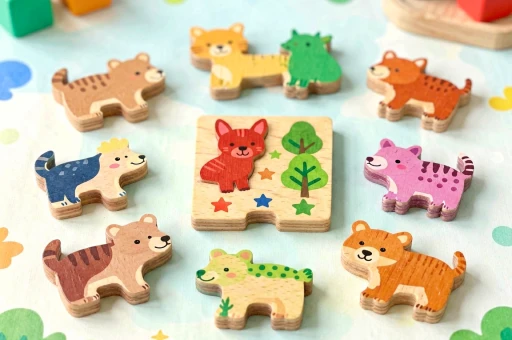
Keep small parts away from children under three and consider mouthing behaviour and younger siblings. Supervision does not remove a product’s age restriction. Other hazards, such as cords, batteries and magnets, need separate attention even when a piece does not fit a small-parts cylinder.
Labels are not interchangeable guarantees
“Non-toxic,” “BPA-free,” “wooden” and recycling codes do not establish all aspects of toy safety. Standards, conformity markings and third-party certification programmes have different roles; do not describe ASTM or EN71 as organisations that certify every toy. Look for the manufacturer’s information and applicable documentation rather than relying on an attractive badge.
Do not decide chemical safety by smell or paint colour, and do not assume a home test can certify an older toy. If the source, condition or intended use is unclear, choose another item.
Manage the home, not just the purchase
Store an older child’s small-part sets where a younger child cannot reach them. Use a separate play area and account for dropped pieces during cleanup. Inspect toys after damage as well as during routine tidying. Loose magnets, accessible batteries or broken parts are reasons to stop use, not to improvise repairs with tape.
Follow the product’s own cleaning and repair instructions. Do not apply one disinfectant, water temperature or washing method to all toys. Keep electrical items out of water unless their instructions explicitly permit the intended use.
Water beads need a specific decision
Water beads can expand after swallowing and cause serious internal injury. A “non-toxic” label does not address that physical risk. Read our water bead risk and response guide before considering them for a home with children.
If you suspect ingestion or injury
Do not wait for an online article to determine whether a swallowed battery, magnet or water bead is dangerous. Seek urgent professional advice. In the United States, Poison Control can be reached at 1-800-222-1222. For choking, difficulty breathing, collapse or another immediate emergency, call emergency services. Outside the US, use your local emergency or poison service.
Scope and sources
This is a household decision checklist, not a safety certificate, laboratory test or medical assessment. The small-parts section refers to the US test procedure; water bead information is supported by National Capital Poison Center guidance. Product-specific warnings and local requirements still apply.