STEM Kits for One-Year-Olds: A Developmental Necessity or an Unnecessary Gimmick?
—
Introduction
In the age of hyper-accelerated early childhood education, parents are bombarded with marketing claims that promise to turn their babies into little geniuses. Among the most prominent products are STEM kits—boxes filled with seemingly scientific, technological, engineering, and mathematical activities designed for children as young as twelve months. The question that haunts many new parents is simple yet daunting: “Should I buy STEM kits for my one-year-old?” On the surface, the idea of fostering early problem-solving skills, curiosity, and a love for learning sounds undeniably appealing. However, a deeper examination reveals a complex interplay between developmental science, commercial interests, and the actual needs of a one-year-old brain. This article will dissect the arguments for and against STEM kits for toddlers, drawing on child development research, expert opinions, and practical considerations, ultimately helping you decide whether your hard-earned money and precious time are better spent elsewhere.
—
Understanding the One-Year-Old Brain: What Real Development Looks Like
Before evaluating any product, it is essential to understand the developmental milestones and cognitive capacities of a typical one-year-old. At twelve months, children are in a period of rapid sensorimotor exploration, as described by Jean Piaget’s theory of cognitive development. They learn primarily through their senses—touching, tasting, shaking, dropping, and banging objects. Their attention spans are measured in seconds or, at most, a few minutes. They are just beginning to understand cause and effect in the most primitive sense: if I push this ball, it rolls; if I drop my spoon, it falls. Language is still emerging, with most one-year-olds speaking only a few words but understanding far more. Crucially, the part of the brain responsible for logical reasoning, abstract thought, and sustained focus—the prefrontal cortex—is still in its infancy and will not mature for decades.
What does this mean for STEM learning? True STEM education involves hypothesizing, experimenting, analyzing data, and drawing conclusions. A one-year-old cannot do any of these things in a meaningful way. The “experiments” they perform are purely accidental: they might notice that a tower of blocks falls when they hit it, but they lack the cognitive framework to intentionally test variables or retain that knowledge for future use. Instead, what they are actually doing is engaging in sensory play, gross and fine motor development, and social-emotional bonding with caregivers. Any toy—be it a $50 STEM kit or a simple cardboard box—can facilitate these fundamental processes. Therefore, the first critical insight is this: we must not confuse the sophisticated branding of “STEM” with the simple, unstructured exploration that truly benefits a one-year-old.
—
The Allure of STEM Kits: What They Claim to Offer
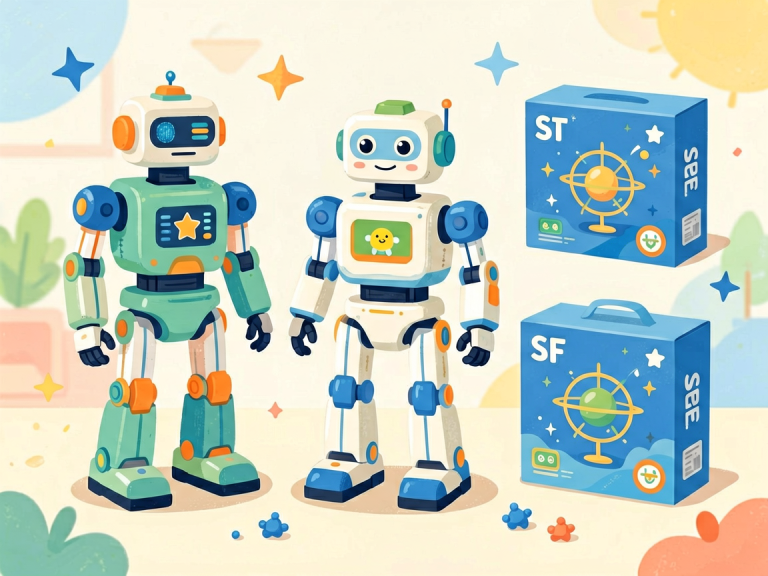
STEM kit manufacturers for infants typically market their products with promises that resonate deeply with modern parental anxieties. They claim to “jumpstart logical thinking,” “build a foundation for future math success,” “enhance spatial awareness,” and “develop problem-solving skills.” The kits often contain items like colorful stacking rings, shape sorters, magnetic tiles, simple puzzles, textured balls, and activity cards that suggest “experiments” such as mixing colored water or observing sinking and floating objects. At first glance, these activities seem educational and purposeful. Moreover, many kits come with guides that explain the supposed developmental benefit of each component, giving parents a sense of control and direction in their child’s learning journey.
The appeal is undeniable in a culture that values measurable outcomes and early academic preparedness. Parents worry that without early enrichment, their child might fall behind. STEM kits offer a structured, seemingly scientific solution. They also relieve the mental load of having to invent activities on one’s own—something many tired parents appreciate. However, the question remains: do these kits actually deliver on their promises, or are they simply repackaging ordinary playthings with a fancy label? A closer look at the components reveals that most items in a STEM kit for one-year-olds are indistinguishable from classic Montessori toys or simple household objects. A wooden shape sorter, for instance, has been used for centuries and is not inherently “STEM” unless an adult frames it that way. The difference lies in the marketing and the price tag.
—
The Scientific Reality: What Research Says About Early STEM Exposure
Developmental psychologists and early childhood educators have conducted extensive research on the effects of structured versus unstructured play in infancy. The overwhelming consensus is that for children under two, unstructured, child-led, and relationship-rich play is far more beneficial than any predetermined curriculum. The American Academy of Pediatrics, in its 2018 policy statement on play, emphasizes that play is essential for building executive function skills, language, and social competence—but that this play should be free, imaginative, and guided by the child’s own interests. There is virtually no peer-reviewed evidence that a formal STEM kit for a one-year-old produces any lasting cognitive advantage over a set of simple blocks, a collection of plastic containers, or time spent outdoors.
Furthermore, studies on the so-called “baby genius” industry have repeatedly shown that many commercial products make inflated claims. A famous 2007 study published in *Pediatrics* found that infant DVDs and videos designed to teach language actually resulted in lower vocabulary scores for infants who watched them, compared to those who interacted with real people. While STEM kits are not screen-based, the same principle applies: passive or semi-passive engagement with pre-designed materials cannot replace the dynamic, responsive interaction between a child and a caregiver. A one-year-old learns best when an adult follows their gaze, names objects, and engages in reciprocal babbling or gestures. The cardboard box that a mother turns into a “car” while making engine sounds is, neurologically speaking, far more valuable than a glossy STEM kit that instructs the child to place a round peg in a round hole—something that many one-year-olds cannot yet do with precision anyway.
—
Potential Downsides of STEM Kits for One-Year-Olds
Beyond the lack of proven benefits, there are several concrete reasons why purchasing STEM kits for a one-year-old may be counterproductive. First, the emphasis on “correct” usage can frustrate both parent and child. Many kits come with activity cards that imply a specific way to play. When a one-year-old inevitably ignores the instructions and instead chews on the magnet, throws the wooden piece across the room, or tries to stack shapes in the wrong order, parents may feel pressured to “correct” them. This can turn play into a low-stress performance, robbing it of joy and spontaneity. Second, the clutter factor is real. One-year-olds have small worlds, and overloading their environment with specialized toys can actually reduce the quality of their play. Too many options lead to divided attention and shorter engagement spans. A simple, minimalist play space with a few rotating objects often yields deeper exploration.
Third, the cost is often unjustifiable. High-quality STEM kits for toddlers can range from $40 to over $100. That money could buy a lifetime supply of art supplies, a set of wooden blocks that will last for years, or a subscription to a children’s museum membership. More importantly, it could be spent on experiences that truly matter: a parent-child music class, a trip to the park, or even just a few extra hours of undivided attention. Finally, there is a subtle risk of “intellectualizing” infancy. When we constantly frame play as “STEM learning,” we may inadvertently send the message that a child’s worth is tied to measurable cognitive output. This can create performance anxiety in both parent and child long before formal schooling even begins.
—
What Actually Works: Better Alternatives to STEM Kits
If the goal is to support a one-year-old’s cognitive and motor development, there are far more effective and affordable alternatives. The most powerful “STEM toy” is a responsive caregiver. Face-to-face interaction, where an adult narrates actions (“You dropped the ball! It rolled under the table!”), provides the scaffolding that builds language, attention, and causal reasoning. Simple household items—plastic measuring cups, wooden spoons, empty tissue boxes, pots and pans—offer endless sensory and cause-and-effect learning opportunities. Water play (supervised), sand play, and outdoor exploration of leaves, rocks, and grass are all rich in sensory input that builds neural connections.
Open-ended toys like stacking cups, nesting bowls, blocks, and soft balls allow for multiple forms of play and grow with the child. A set of simple wooden rings, for example, can be stacked, rolled, sorted by color, or used as pretend food. These toys cost a fraction of a branded STEM kit and never come with instructions, allowing the child to take the lead. Additionally, books with high-contrast pictures, textures, and flaps provide early literacy exposure and language development. None of these need to be labeled “STEM” to be effective. In fact, a study from the University of Cambridge found that children who engaged in more free play with everyday objects showed stronger problem-solving skills later on than those who used more structured educational toys.
—
When Might a STEM Kit Be Reasonable?
While the overall recommendation leans toward “skip the kit,” there are specific scenarios where a STEM kit might be a worthwhile purchase. For parents who feel completely lost about how to engage with their one-year-old—perhaps first-time parents who lack confidence or knowledge about infant development—a well-designed kit can serve as a springboard for ideas. If the kit includes clear, research-based guidance that emphasizes following the child’s lead rather than imposing activities, it might reduce parental anxiety and encourage more interaction. Furthermore, some children have particular interests (e.g., fascination with wheels, magnets, or water) that a specialized kit could support.
Another consideration is gifting. If you are a relative or friend looking for a present, a STEM kit may feel more substantial and “educational” than a stuffed animal, and it can be a conversation starter about the child’s development. However, it is crucial to choose a kit that prioritizes sensory exploration, open-ended use, and safety (no small parts, BPA-free materials). Look for brands that have input from developmental experts and avoid those that make extravagant claims. In the end, even in these edge cases, the kit should be viewed as a supplement to, not a replacement for, simple, loving, everyday interactions.
—
Expert Opinions: What Pediatricians and Educators Say
To bring authoritative voices into the discussion, consider the advice of Dr. Alison Gopnik, a renowned developmental psychologist at the University of California, Berkeley. In her book *The Scientist in the Crib*, she explains that babies are natural scientists who learn through observation and interaction, not through formal instruction. She argues that the best thing parents can do is provide a safe, rich environment and then pay close attention. Similarly, the National Association for the Education of Young Children (NAEYC) recommends that for infants and toddlers, learning should be integrated into daily routines and play, not separated into “subjects.” A 2020 position statement from NAEYC explicitly warns against pushing academic content too early.
Pediatrician Dr. T. Berry Brazelton, whose work has influenced generations of parents, emphasized that the emotional relationship between parent and child is the bedrock of all learning. When a parent is stressed about “teaching” STEM, that stress can transfer to the child. Instead, he advocated for relaxed, joyful interactions. In short, the consensus among experts is clear: formal STEM education is inappropriate for one-year-olds. What matters is responsive caregiving, language-rich environments, and plenty of time for unstructured, messy, silly play. A STEM kit, while not harmful in itself, is unlikely to provide any unique benefit that cannot be achieved more simply and cheaply.
—
Conclusion: The Verdict on STEM Kits for One-Year-Olds
So, should you buy a STEM kit for your one-year-old? The evidence-based answer is: probably not. While the idea is appealing, the marketing far exceeds the actual developmental value. A one-year-old does not need an elaborate kit to begin their journey as a “little scientist.” They need a warm lap, a patient voice, a cardboard box, a wooden spoon, and the freedom to explore without the pressure of achieving a predetermined outcome. The money and energy spent on a STEM kit could be redirected toward experiences that truly foster curiosity, creativity, and connection—the real foundations of future STEM success. If you do decide to purchase one, choose it for its potential to spark joy and interaction, not as a shortcut to genius. And remember: the most powerful “STEM tool” in your home is already there—it is you, the parent, engaging with your child in the messy, beautiful, unpredictable dance of early development. Trust that, and you will never need a kit to prove it.