The Great Toddler STEM Debate: Should You Buy STEM Kits for Your 2-Year-Old?
Introduction
As a parent or caregiver of a two-year-old, you are constantly bombarded with marketing messages promising that the right toy will turn your child into a future engineer, coder, or scientist. Among the most persistent of these messages is the call to buy STEM kits — products advertised as tools to introduce Science, Technology, Engineering, and Mathematics to even the youngest learners. The question “Should I buy STEM kits for 2 year olds?” is one that many modern parents ask, often with a mix of curiosity and guilt. On one hand, you want to give your toddler every possible advantage; on the other hand, you may worry about pushing too hard too early, or about wasting money on items that will be ignored or destroyed in minutes. This article will provide a balanced, evidence-based exploration of this question, looking at child development, the real nature of toddler learning, the pros and cons of commercial STEM kits, and practical alternatives. By the end, you will have a clear framework to make an informed decision that aligns with your child’s unique needs and your family’s values.
Understanding the 2-Year-Old Brain
Before evaluating any product, it is essential to understand what is happening inside the mind of a typical two-year-old. At this age, children are in the midst of a remarkable cognitive explosion. They are developing language at a staggering rate, beginning to engage in symbolic play (using a block as a “phone,” for instance), and starting to understand cause and effect in very concrete ways. However, their attention span is extremely short — measured in minutes, not hours. They learn primarily through sensory exploration, movement, and direct interaction with their physical environment. A two-year-old does not learn by passively watching a demonstration or following a step-by-step instruction manual. Instead, they learn by touching, tasting (unfortunately), dropping, banging, stacking, and pulling apart. The prefrontal cortex, responsible for impulse control and planning, is still very immature. Consequently, frustration tolerance is low, and the concept of “following directions” is only just emerging. Any toy or kit that requires a child to sit still, wait for a result, or complete a multi-step process is likely to be met with confusion or a tantrum. This context is crucial: a STEM kit for a two-year-old must align with these developmental realities, not fight against them.
What Are STEM Kits for Toddlers?
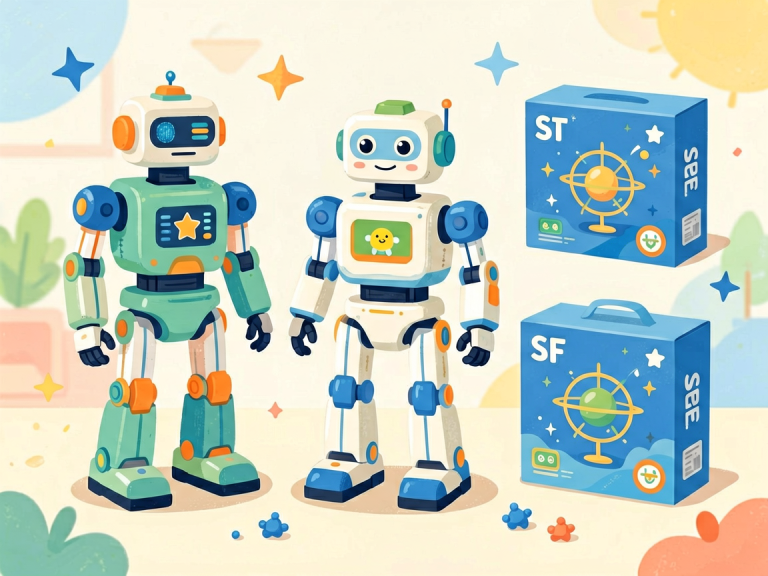
STEM kits marketed for children as young as two come in many forms. Common examples include: magnetic tile sets with large, chunky pieces; simple building blocks made of wood or plastic with a “STEM” label; color-mixing science kits with provided liquids and droppers; “coding” toys that involve pressing buttons to make a robot move forward or turn; and pattern-matching puzzles that claim to introduce mathematical thinking. Some kits come with cards showing specific builds or “experiments” for the parent to guide. Others are more open-ended, like a set of large gears that interlock. The price range varies widely, from around twenty dollars to well over a hundred. The marketing often emphasizes that these kits will develop problem-solving skills, spatial reasoning, early math concepts, and an “engineering mindset.” But the critical question is whether the actual play experience fulfills these promises for a child who is still learning to use a fork.
The Case for Buying STEM Kits
Proponents of introducing STEM kits at age two offer several thoughtful arguments. First, many of these kits are designed with large, safe pieces that are appropriate for toddlers — think of oversized duplo-style blocks or non-toxic, magnetic tiles with sealed magnets. When used under supervision, these can encourage fine motor skill development, hand-eye coordination, and the early understanding of balance and gravity. A two-year-old who repeatedly stacks a block tower and watches it fall is, in a very real sense, conducting an experiment in physics. Second, high-quality STEM kits often provide a structure that helps parents engage more deeply with their child. A plain set of blocks may be ignored, but a kit with a colorful guide showing how to build a simple “bridge” can inspire a parent to sit down and scaffold the child’s learning through conversation: “Let’s put the blue block here. Oh, it fell! Why do you think that happened?” This kind of rich, verbal interaction is far more valuable than the toy itself. Third, exposure to the vocabulary of STEM — words like “magnet,” “gear,” “force,” “pattern” — can lay a linguistic foundation that benefits later formal learning. If a child hears “This red gear turns the blue one” while playing, they are absorbing not only words but also a concept of cause and effect.
The Case Against Buying STEM Kits
Despite these potential benefits, there are compelling reasons to hesitate. The most significant concern is that many so-called STEM kits for toddlers are developmentally inappropriate. They often assume a level of cognitive control and fine motor precision that a two-year-old simply does not possess. For example, a kit that includes a small screwdriver or tiny pegs presents a choking hazard and a high likelihood of frustration. Even “coding” toys for toddlers — which usually involve pressing a large button and watching a toy move — are often too simple to teach any real concept of sequencing; the child quickly learns to press the button repeatedly, and the learning becomes rote, not conceptual. Another major issue is the risk of over-scheduling play. Two-year-olds learn best through unstructured, open-ended play that they initiate themselves. When a toy has a defined “correct” way to use it (e.g., “make the tower 10 blocks high to complete the challenge”), it can stifle creativity and turn play into a task. Moreover, the commercial pressure to buy STEM products can create anxiety in parents, making them feel that if they do not purchase the latest kit, their child will fall behind. In reality, the most powerful predictors of later academic success are not early exposure to formal concepts, but rather secure attachment, language-rich environments, and opportunities for free play.
Alternatives to Commercial STEM Kits
If the evidence suggests that commercial STEM kits are often more marketing than substance, what should a parent do instead? The good news is that the best “STEM education” for a two-year-old is already available in every household, often for free. Here are several powerful alternatives that support exactly the same skills without the price tag:
- Open-ended building materials: Simple wooden blocks, cardboard boxes, plastic containers, and empty yogurt cups are far more versatile than any pre-packaged kit. A two-year-old can stack them, knock them down, fill them with water (supervised), and use them as pretend food. This builds spatial reasoning, motor skills, and creativity.
- Water and sand play: A basin of water with cups, funnels, and spoons teaches volume, displacement, and cause and effect. Sand or rice in a tub does the same for texture and construction. These activities are classic sensory experiences that underpin scientific thinking.
- Nature exploration: Walks outside to collect leaves, rocks, and sticks allow a child to observe patterns, colors, and textures. Asking simple questions like “Which rock is heavier?” or “How many red leaves did you find?” introduces classification and measurement.
- Puzzles: Simple wooden puzzles with large knobs help with shape recognition and problem-solving. They are a form of early geometry and logic.
- Household items: Measuring cups, spoons, sieves, and old keys are fascinating to a two-year-old. They offer opportunities to explore size, fit, and function.
These alternatives have the added advantage of being low-pressure, inexpensive, and easily replaced. They also encourage the kind of open-ended, self-directed play that is most beneficial for a toddler’s developing executive function.
How to Choose Wisely if You Decide to Buy
If, after weighing the arguments, you still feel inclined to purchase a STEM kit — perhaps as a gift or because your child has shown a particular fascination with gears or magnets — there are ways to choose wisely. Look for products that are explicitly labeled for ages 18 months or 2 years, with no small parts. The best kits are those that are essentially open-ended: a set of large magnetic tiles, a collection of oversized gears that can be arranged in any pattern, or a set of stacking cups with different-sized holes. Avoid kits that require following a specific sequence or that come with “experiment cards” for toddlers — these are likely too cognitive demanding. Also, prioritize quality over quantity. A single set of high-quality wooden blocks will outlast a dozen flimsy plastic kits. Finally, remember that the kit is just a tool; your involvement is what truly matters. Sit with your child, narrate what you see, and let them lead. If your child loses interest after five minutes, that is entirely normal — do not force it. The kit should serve play, not the other way around.
Conclusion
So, should you buy STEM kits for your 2-year-old? The answer is not a simple yes or no. It depends on the specific kit, your child’s temperament, and your expectations. Many commercial STEM kits are overhyped and developmentally mismatched, and the vast majority of a toddler’s STEM learning happens through everyday play with simple, open-ended materials. However, a carefully chosen, minimalistic kit that prioritizes sensory exploration and large-motor building can be a worthwhile addition to a playroom, provided it is used as a supplement to — not a replacement for — free play and adult interaction. The most important investment you can make in your child’s future scientific thinking is not a product from an online store, but your time, your attention, and your willingness to let them lead the exploration. Before you click “buy,” ask yourself: Will this kit spark curiosity and joy, or will it create pressure and frustration? Trust your instincts. You already have everything you need to raise a little scientist.