The Siren Call of the Box: Why Packaging Shouldn’t Guide Toy Purchases for Nine-Month-Olds
The Bright, Shiny Trap
Walk into any toy store, and the first thing you notice is the barrage of color. Rainbow-bright cardboard, grinning cartoon animals, and promises of “developmental genius” screamed from every shelf. For a frazzled parent of a nine-month-old, these packages seem like the answer to everything: they promise engagement, intelligence, and hours of quiet play. But beneath the glossy laminate and die-cut windows lies a dangerous assumption — that what appeals to an adult’s eye has any bearing on what a nine-month-old’s brain actually needs. When we buy toys based on packaging for 9-month-olds, we are not shopping for the child. We are shopping for the marketing department’s idea of childhood, and that is a costly mistake in both money and missed developmental opportunities.
What a Nine-Month-Old Really Sees (and Doesn’t See)
To understand why packaging is such a poor guide, we must first step into the perceptual world of a nine-month-old. At this age, visual acuity is still maturing. While older children and adults perceive fine details, contrast gradients, and complex scenes, a nine-month-old is drawn to high-contrast patterns, bold primary colors, and, most importantly, faces. They do not read the cheerful text that says “BABY’S FIRST STEM LAB” or “INTERACTIVE LIGHT-UP SENSORY JUNGLE.” They do not understand the adorable illustrated fox on the box, nor do they understand the function of the buttons, slides, and sound modules depicted in action shots. What they do see is a large, shiny, rectangular object — the box itself. In fact, many nine-month-olds are far more fascinated by the cardboard packaging than by the toy inside. This is a well-known joke amongst parents: you spend forty dollars on a motorized musical octopus, and the baby happily chews the cardboard insert. The irony is not just humorous; it is revealing. It shows us that the packaging is designed for the adult’s purchasing decision, not for the infant’s play experience.
The Myth of “Age-Appropriate” Advertising
Toy manufacturers are masters of the vague “ages 9 months+” label. This label gives a false sense of scientific rigor. But what does “9 months+” actually mean based on the packaging? Usually, it means the toy contains no small parts that immediately detach, and the plastic is hard enough not to be bitten apart in the first ten minutes. That is a bare-minimum safety threshold, not a developmental endorsement. Consider the typical packaging: it shows a blissful infant sitting upright, finger pressing a large glowing button, while the words “CURRICULUM-BASED” are plastered in a starburst. What the packaging does not show is the reality of nine-month-old motor skills. At nine months, many babies can sit independently, but they are also on the move — crawling, pulling up, cruising. Their play is dominated by mouthing, banging, dropping, throwing, and grasping. They are little scientists of physical causality: “If I drop this, it falls. If I shake this, it rattles.” They do not follow multi-step instructions. They do not engage in pretend play. They do not need a toy that “speaks” or “plays music” if that toy requires pressing a tiny button with precise fine-motor control. Yet packaging often showcases the toy’s flashiest feature, making it look like the baby is interacting with it meaningfully. In reality, a nine-month-old may simply mouth the button until the batteries dislodge, or lose interest in the flashing surface because the light is too harsh and disorienting.
The Development Trap of Over-Stimulation
Another trap of packaging-driven purchasing is the promise of “sensory stimulation.” Packaging blasts phrases like “MULTI-SENSORY ADVENTURE,” “OVER 20 SOUNDS AND LIGHTS,” and “TRIGGERS ALL SENSES.” For a nine-month-old, however, less is often more. Neurologically, infants at this age are developing what experts call “attention control” and “state regulation.” They are learning to filter out irrelevant stimuli and focus on what matters. A toy that blasts strobes, sirens, and spinning objects all at once may cause a baby to become over-aroused, fussy, or surprisingly passive — frozen in the face of sensory overload. The packaging never tells you that. It shows a smiling baby reaching happily toward the chaos, but that image is staged, often with a much older child. When you rely on packaging, you are subscribing to the idea that more features equal more development. Yet research in infant development consistently shows that simple, open-ended materials — wooden blocks, textured balls, fabric scarves, nesting cups — support deeper exploration and problem-solving better than flashy electronic gadgets. The best toy for a nine-month-old may not even come in a bright box; it might be a set of multi-colored stacking rings, which encourage fine motor reach, visual tracking, and the all-important skill of releasing objects. But a package of plain stacking rings doesn’t win in a visual contest. It doesn’t have a dramatic explosion or a chattering monkey. So it sits on the shelf, ignored.
Safety Beyond the “Choking Hazard” Checkbox
Packaging-oriented buying also introduces a subtler safety risk. When we focus on the outward appearance of a toy, we forget to examine the toy itself. Nine-month-olds explore primarily through their mouths. Their gums are strong; their bites are surprisingly powerful. Toys that look safe in a sealed blister pack can fail catastrophically in the real world: painted surfaces that flake, seams that crack into sharp shards, strands of hair or string that wind around little fingers, or “super-soft” plush that sheds synthetic fibers. The packaging might cheerfully say “BPA-FREE” and “NON-TOXIC,” but that says nothing about structural integrity after a week of gnawing. Also, consider the packaging material itself. Some packaging uses thin plastic films or styrofoam inserts. A nine-month-old can choke on those if the packaging is left within reach — and it always is, because the baby is more interested in the box than the toy. So the very act of buying based on packaging creates a temporary hazard that the parent then must manage. Ironically, you might buy a toy because the package looks bright and safe, then spend the next hour prying the baby’s fingers off the sharp cellophane that was holding it in place.
The Environmental and Economic Toll
Choosing toys by packaging also leads to wasteful purchases. The packaging is designed to look appealing, not to be durable or functional. How many times have parents bought a highly packaged toy, brought it home, and watched the baby ignore the toy in favor of the tissue paper or the cardboard box? Then, within days, the toy itself becomes boring because its functions are repetitive (or require adult assistance). The money is wasted; the package goes to recycling; the toy goes to the growing pile of “maybe later.” For a nine-month-old, that pile is enormous anyway. In the quest to provide the best, we drown them in plastic tchotchkes. Meanwhile, the most developmentally appropriate objects — kitchen spoons, silicone spatulas, empty cardboard oatmeal containers, and cardboard tubes — are free and endlessly engaging because they are open-ended. A cardboard tube can be banged, mouthed, dropped, rolled, poked, and thrown. A battery-operated “talking” toy car cannot be thrown without damage, and if it is, it might break into sharp pieces. So the package-driven toy also tends to be the more dangerous toy when the baby does what babies do: hurl it across the room.
How to Break the Cycle
So what is a parent to do when the aisles are a kaleidoscope of deceptive boxes? First, ignore the front of the box entirely. Flip it over and read the back — but look for what is not there. Look for a clear list of materials and a simple, minimal list of features. Be wary of any claim that is emotionally manipulative, like “grows with your child” or “award-winning.” Second, before buying, ask this question: “What will my nine-month-old physically do with this toy?” Can they grasp it with two hands? Can they mouth it safely? Does it encourage action — touching, shaking, squeezing, dropping? If the answer is that the baby will simply sit and watch the toy move or light up, then the baby is not playing; they are spectating. That is not healthy play for a nine-month-old. Third, remember that the baby’s curiosity extends to the packaging itself. Instead of fighting that, we can embrace it: give them a safe, empty cardboard box, or a clean jar with a screw-on lid. That is not a cheap cop-out; it is a sophisticated gift. It aligns with how a nine-month-old learns — through active manipulation of objects in space, discovering gravity, texture, and cause and effect.
A Better Way to Shop
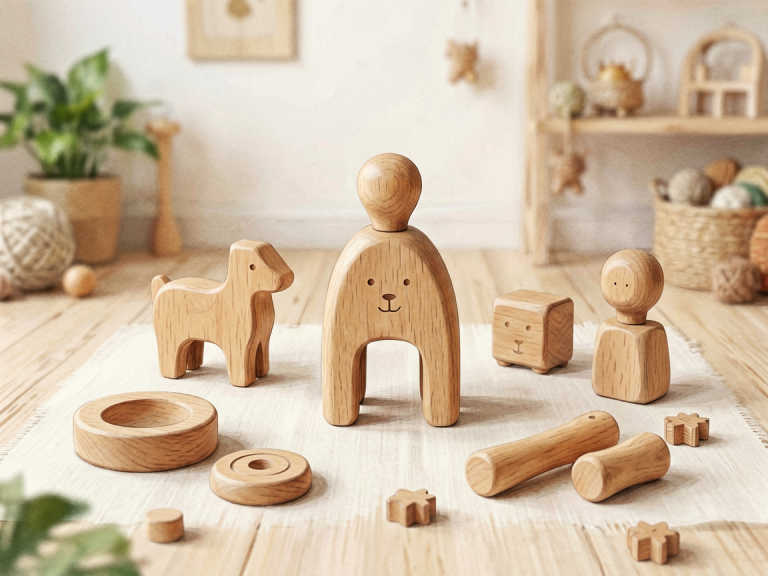
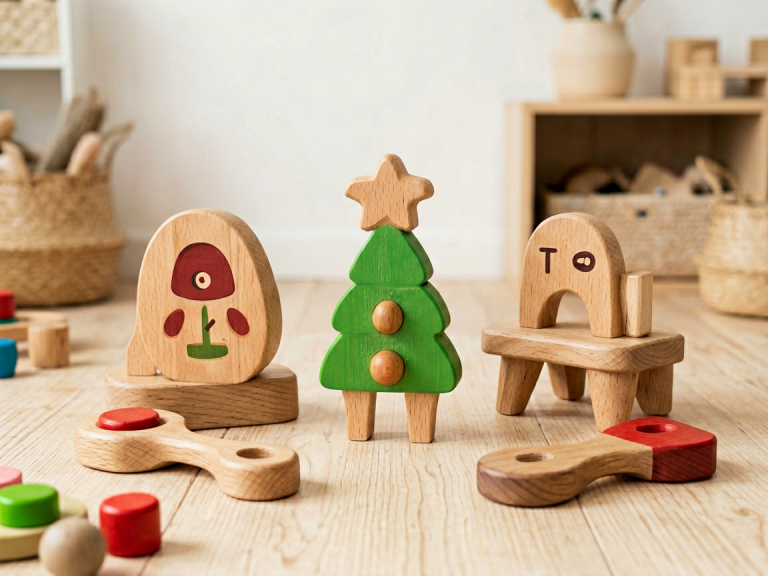
The most effective strategy is to stop shopping by aisle and start shopping by a mental checklist. For a nine-month-old, the ideal toy is one that is safe to mouth, easy to grasp, free of small detachable pieces, and not reliant on batteries. Good examples include: large wooden or silicone teethers, soft fabric blocks with different textures and squeakers, balls with gentle bumps, stackable cups, and simple activity boxes with doors and levers (but again, check for smooth edges and sturdiness). Even better: many of these are sold in simple mesh bags or plain cardboard boxes, precisely because they are not expected to dazzle adults. That is a signal. When you see a toy that comes in minimal packaging, it is often because the maker trusts the toy itself, not the wrapping. That is the kind of toy you want to put into your baby’s hands.
Conclusion: The Box Is Not the Present
As the holiday season approaches, or indeed any occasion that calls for a gift, resist the allure of the flashing, towering, over-decorated package. Remember that a nine-month-old does not experience the world the way you do. Their delight is not found in glossy marketing or in the promise of future genius. It is found in the simple, tactile, messy reality of objects that they can grasp, taste, drop, and rediscover. The packaging is a silent salesman, and it is not on your side. It is on the side of profit. The next time you are tempted to buy a toy because the box is irresistibly cute, take a step back. Look at the baby. Look at their hands, their mouth, their eyes. And then hand them the box itself. You will have saved your money, given them joy, and learned the most important lesson of toys for nine-month-olds: the best packaging is the one you throw away. The real gift is the freedom to explore — unfettered, unstructured, and completely unconcerned with what the box tells you to buy.