Safe Toys for Babies: A Parent’s Guide to Choosing Wisely
Why Toy Safety Matters More Than Ever
Every parent remembers the moment their baby first reaches for a toy, eyes wide with curiosity and tiny fingers ready to grab, shake, and inevitably mouth the object. That moment is joyful, but it also carries a profound responsibility. Babies explore the world primarily through their senses—especially touch and taste—which means that any toy placed in their hands will almost certainly end up in their mouths. This natural behavior, while essential for development, makes toy safety a critical concern from the very first months of life.
The statistics are sobering. According to the U.S. Consumer Product Safety Commission, thousands of children under the age of three are treated in emergency rooms each year for toy-related injuries. Many of these incidents involve choking, strangulation, or ingestion of small parts. Others stem from toxic materials, sharp edges, or poorly constructed items that break apart easily. While no parent can eliminate every risk, understanding what makes a toy safe—and what does not—can dramatically reduce the chances of harm. This guide is designed to help you navigate the confusing world of baby toys, offering practical, evidence-based advice so that playtime remains joyful, curious, and above all, safe.
Key Criteria for Baby-Safe Toys
1. Size and Shape: The Choking Hazard Test
The single most important factor in toy safety for babies is size. Babies have a natural tendency to put everything in their mouths, and their airways are very small. A toy or any removable part that is smaller than 1.25 inches in diameter and 2.25 inches in length can easily become lodged in a baby’s throat. A common rule of thumb is the “toilet paper roll test”: if an object fits entirely inside a standard toilet paper roll, it is too small for a baby under three years old. Even if a toy is large overall, check for eyes, buttons, wheels, or other attached pieces that could be pulled off and become choking hazards. Avoid toys with any loose parts, and be wary of stuffed animals with plastic noses or embroidered details that can be bitten or tugged free.
Shape also matters. Round, soft-edged toys are preferable to those with pointed or angular protrusions. Long, thin toys, such as a toy cane or a slender rattle handle, can poke the back of the mouth and trigger the gag reflex or, worse, cause injury to the soft palate. Look for toys that are sturdy and cannot be compressed into a smaller shape. A foam ball that can be squeezed down to the size of a marble is dangerous, even if its resting size seems large.
2. Materials and Toxicity: What’s Inside Matters
Babies do not just lick their toys; they gnaw, chew, and suck on them for extended periods. This means that any chemical in the toy’s material can be ingested. The most notorious concern is Bisphenol A (BPA), once common in certain plastics, which has been linked to hormonal disruptions. Fortunately, many countries now ban BPA in baby products, but not all plastics are created equal. Look for labels that say “BPA-free,” but also be aware of other plasticizers like phthalates, which are used to soften PVC and are also harmful. The safest bet is to choose toys made from natural, untreated materials: solid wood (not particleboard or plywood with glue), organic cotton or wool, and food-grade silicone.
Wooden toys are excellent choices, provided they are finished with water-based, lead-free paint or simply left bare. Avoid toys with shiny, glossy finishes, as those often contain varnish or shellac that can chip. For silicone toys, ensure they are made from 100% food-grade silicone without fillers. A simple pinch test can help: pure silicone is smooth and does not change color when twisted; filled silicone feels sticky or has a slight odor.
Also consider the issue of heavy metals. Old or antique toys, as well as toys purchased from unregulated markets, may contain lead in their paint or plastic. Lead is especially dangerous for developing brains. Always buy from reputable brands that adhere to safety standards, and check for certification labels such as CE (in Europe) or ASTM F963 (in the United States). If a toy has a strong chemical smell, do not buy it—your baby’s nose is not as discerning as your own, but that smell is a warning sign.
3. Durability and Construction: The Pull-and-Tug Test
A toy for a baby must be able to withstand enthusiastic abuse. Babies will throw, drop, stomp, and yank on their toys with surprising force. A well-made toy should survive all of that without breaking, cracking, or losing pieces. Before giving any toy to your baby, perform your own stress test. Pull on all attached parts with moderate force. Squeeze the toy to see if it deforms permanently. Bend it, twist it, and drop it on a hard floor. If anything cracks, separates, or sheds fragments, it is not safe.
Seams on fabric toys are a common weak point. Check that all stitching is tight and double-stitched. Remove any loose strings or threads, as they can wrap around tiny fingers or toes and cause circulation problems. Also beware of toys with batteries—always ensure the battery compartment is secured with a screw, not a snap, so that a determined baby cannot pry it open and access the small, potentially lethal batteries or magnets. If a toy uses magnets, make sure they are fully enclosed and cannot be reached even after a drop.
Selecting by Age and Developmental Stage
Birth to Six Months: Simple and Visual
In the first months, babies are not yet mobile, but they are developing their vision and sense of hearing. Safe toys for this stage include high-contrast black-and-white cloth books, soft fabric rattles, and unbreakable mirrors. These toys should have no small parts and no long strings. For a newborn, a mobile above the crib is lovely, but ensure it is installed out of reach and cannot be pulled down. Soft plush toys are acceptable only if they have no loose parts, no bean-filled pellets that can leak, and no beaded eyes or noses. Avoid any toy with a string longer than 7 inches, as this poses a strangulation risk when the baby begins to move and roll.
Six to Twelve Months: Grasping and Teething
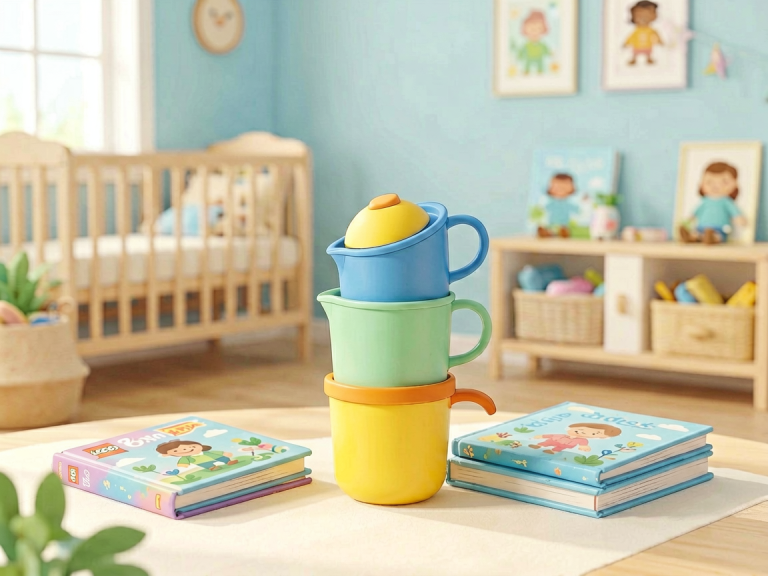
At this age, babies become active explorers. They grasp, pass toys from hand to hand, and put everything in their mouths to soothe sore gums. Teething rings made of solid, food-grade silicone or natural rubber are ideal. However, avoid liquid-filled teethers, because if the toy is punctured, the liquid inside may be unsanitary or even toxic depending on the solution. Also, avoid “jewelry”-type teethers with beads that can come loose. Stacking cups, soft blocks, and ring-stackers are also excellent, but make sure they are large enough that they cannot be swallowed whole and that they are free of sharp edges.
During this stage, babies also start to push up and rock. Large, sturdy toys like activity centers or sit-to-stand walkers should have a wide base and a low center of gravity to prevent tipping. Be careful with walkers that allow the baby to roll—these have been banned in some countries due to fall risks, especially near stairs. If you choose a stationary activity table, ensure it has no pinch points for tiny fingers.
Twelve to Twenty-Four Months: Moving and Manipulating
Toddlers are now walking, climbing, and testing their physical limits. Toys that encourage movement, such as push carts and ride-on cars, are popular, but they must be stable and have no exposed screws or sharp edges. Avoid ride-on toys that are too lightweight, as they can tip over easily when the child leans. In this age range, children also love to explore cause and effect, so simple shape sorters and large building blocks are great. Blocks should be made of soft material or lightweight wood with rounded corners. Check that the paint is non-toxic and that no block is smaller than the choking hazard threshold.
This is also the age when babies may be tempted to pull toys behind them or push them across the floor. Any pull toy with a cord should have a cord that is no longer than 12 inches and ideally attached with a breakaway clip. Remove any strings or ribbons from playthings, even if they seem decorative.
Red Flags and Warning Signs to Avoid
Beyond the basic criteria, there are some absolute red flags that should make you put a toy back on the shelf without a second thought. First, avoid toys that make extremely loud noises. While rattles and squeakers are fun, a noise louder than 85 decibels can damage a baby’s hearing. Test a squeaky toy by holding it near your own ear; if it makes you wince, it is too loud. Second, avoid toys with any surface that is sticky or feels oily—this can indicate a plasticizer leaking out. Third, avoid toys that are labeled with “not suitable for children under 36 months” unless you are absolutely certain your baby will not mouth them. That label exists for a reason. Finally, be cautious with wooden toys that have visible knots or cracks, as they can splinter easily. Run your fingers along every edge to feel for roughness.
The Role of Supervision and Regular Inspection
No toy is 100% safe in every situation, and even the best-designed toy can fail over time. The most crucial safety measure is active adult supervision during play. However, babies often play independently for short periods while parents are nearby, so it is essential to inspect toys regularly. Do this every few weeks: look for cracks, splinters, loose threads, or color fading. Wash fabric toys in a gentle cycle with fragrance-free detergent, and wipe plastic or silicone toys with warm soapy water. Do not use harsh disinfectants that may leave residues. Sunlight can also help dry and freshen toys, but prolonged exposure may degrade some plastics.
As your baby grows, reassess each toy. A toy that was safe at six months may become dangerous at eighteen months if a toddler can break off parts or fit small pieces in their mouth. Do not be sentimental about keeping a toy that has shown signs of wear. It is better to replace it than to risk an emergency room visit.
Conclusion: Play Safe, Grow Safe
Choosing safe toys for babies is not about wrapping them in bubble wrap or eliminating all risk. It is about making informed, deliberate choices that allow your child to explore the world with confidence and curiosity. By focusing on size, material, durability, and developmental appropriateness, you can create a play environment where joy and safety go hand in hand. Remember that the best toy is often the simplest: a soft cloth, a sturdy wooden block, a smooth teething ring. These items inspire imagination and discovery without hidden dangers. So trust your instincts, read labels carefully, and always keep an eye on your little one. After all, the very safest toy is one shared with a loving, attentive parent.