Beyond the Jigsaw: Parent-Approved Alternatives to Puzzle Toys That Build Real Skills
Why Rethink the Puzzle Box?
For decades, puzzle toys have been the default “smart” gift for children. Parents buy wooden pegboards, chunky floor puzzles, and 500-piece landscapes, believing that fitting pieces together is the gold standard of cognitive development. And puzzles are indeed valuable—they teach spatial reasoning, patience, and pattern recognition. But they are not the only path, nor always the best one. Many children find traditional puzzles frustrating, repetitive, or simply boring. Others devour them so quickly that parents are constantly buying new ones. Meanwhile, a growing body of child-development research suggests that open-ended, multi-sensory, and socially interactive play often delivers even richer benefits than puzzle completion.
This article is not an attack on puzzles. It is an invitation to broaden the play shelf. As a parent-approved alternative, the following toys and activities have been vetted not only by educators and pediatric occupational therapists but also by exhausted parents who need something that actually holds attention, reduces arguments, and strengthens real-life skills. Each alternative is chosen for its ability to promote problem-solving, creativity, fine-motor control, language development, or emotional regulation—without requiring a child to fit a square peg into a square hole.
Building with Loose Parts: The Anti-Puzzle That Teaches Everything
What Are Loose Parts?
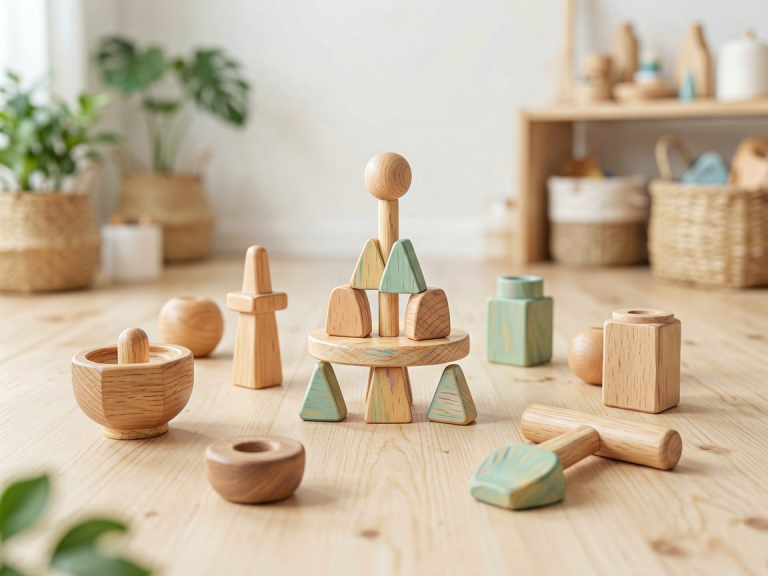
Loose parts are any collection of open-ended materials that children can move, combine, stack, line up, or transform. Think wooden blocks, cardboard tubes, bottle caps, fabric scraps, pinecones, stones, and even old keys. Unlike puzzle toys, which have a single correct outcome, loose parts have infinite outcomes. A set of flat wooden discs can become a tower, a plate, a steering wheel, a coin, or a pretend cookie. A cardboard tube can be a telescope, a tunnel for marbles, or a baton for a parade.
Why Parents Approve
The parent-approved magic of loose parts lies in their low cost and high endurance. You do not need to buy a new set for every age. A two-year-old stacks and knocks down; a five-year-old builds a castle with a working drawbridge; a nine-year-old constructs a marble run using ramps made from folded paper. The same materials grow with the child, which means fewer toys cluttering the closet and less money spent on “next level” puzzles.
More importantly, loose parts build executive function. Because there is no fixed final image, children must plan, test, revise, and collaborate. They learn to tolerate ambiguity—a skill that puzzles, by definition, train away. When a child has thirty random pieces and no picture on a box, they are forced to invent their own structure. That is harder and more rewarding than matching a pre-printed picture. As one teacher put it: “A puzzle teaches a child to follow instructions. Loose parts teach a child to write instructions.”
Occupational therapists also approve. Handling pebbles, nuts, bolts, and fabric textures strengthens the small hand muscles that are critical for writing, buttoning, and using scissors. Unlike plastic puzzle pieces with smooth edges, loose parts offer varied resistance and tactile feedback. This is why Montessori classrooms are filled with raw materials, not puzzle libraries.
Cooperative Board Games: Solving Problems Together
The Shift from “Me vs. The Puzzle” to “Us vs. The Challenge”
Another excellent alternative is the cooperative board game. In a typical competitive game—or a solo puzzle—there is a winner and a loser, or a single finisher. Cooperative games flip the script. All players work toward a shared goal, such as escaping a sinking island, finding a lost treasure before the sun sets, or feeding a dragon with the correct sequence of ingredients. If everyone wins, everyone celebrates. If everyone loses, they lose together and can immediately try again.
Why This Is a Parent Favorite
Parents love cooperative games for a simple, selfish reason: they reduce sibling conflict. Puzzle time often ends in tears when one child places a piece the other wanted. Cooperative games require talking, turn-taking, and joint decision-making. “Wait, if you move the boat to the rocky shore, then I can’t reach the ice cave—let’s switch.” That kind of language is the foundation of negotiation and empathy.
Cognitive benefits are just as strong. Many cooperative games involve a sequences—such as remembering which of three magical creatures eats which colored berry. This is exactly the working-memory training that puzzles claim to provide, but with added verbal rehearsal. Children must narrate their plans, listen to others, and adapt to unforeseen events (like a game card that suddenly floods a tile). This flexible thinking is far more similar to real-world problem solving than completing a static image.
Examples include *Race to the Treasure* (for ages 4+) and *Forbidden Island* (for ages 8+), but even simpler homemade games work. A parent can lay out a “trail” of pillows and have children work together to move a stuffed animal across the living room without letting it touch the floor. The collaborative element is what matters, not the commercial packaging.
Construction with Real Tools: Screws, Nuts, and Gears
Moving Beyond Snap-On Blocks
Snap-on plastic bricks are, in a sense, puzzles with unlimited final images—but they are often still limited by their stud-and-socket system. For children who crave more mechanical thinking, parent-approved alternatives include real—or realistic—tools. A simple set of plastic bolts, screws, and a child-safe screwdriver allows a child to fasten, unfasten, and reassemble in ways that no puzzle piece can mimic. Even better are take-apart toys where a child disassembles a model drill or a toy car and then puts it back together. But the real winner is a “tinker box”: a small tray with actual hex nuts, stainless steel bolts, washers, and a real screwdriver with a blunt tip (for children over 6, under close supervision).
Why This Beats Puzzles
Why is this a better alternative? Puzzles train visual matching, but screw-and-bolt play trains bilateral coordination—using two hands differently at the same time. One hand holds the bolt; the other turns the screwdriver. This is a precursor to many everyday skills: tying shoelaces, using a knife and fork, playing the recorder. Additionally, the sensation of a screw adding grip and then tightening provides intrinsic feedback that a cardboard puzzle piece cannot. When the screw goes in straight, the child feels resistance; if they force it at an angle, they feel it jam. Corrective feedback comes from the material itself, not from an adult saying “no, that piece goes here.”
Makerspaces and STEM educators have long known that engineering thinking starts with physics, not with pre-designed puzzle paths. A child who tries to connect two wooden blocks with a short screw quickly learns about threading, length, and torque. None of those concepts appear in a jigsaw puzzle. And the “mess” of loose screws is manageable if you use a magnetic tray or a large shoe box. Parents approve because this is the kind of play that quietly teaches perseverance—screwing a bolt on and off twenty times without becoming bored, because each turn is slightly different.
Story Cubes and Oral Narrative Kits: Puzzles for the Imagination
The Missing Piece Is a Story
A less obvious alternative is the “story cube” set—dice with pictures of a castle, a key, a shadow, a bird, a broken bridge, and so on. A child rolls several dice and must weave a coherent tale that includes all the images. This is not a visual puzzle but a narrative puzzle. The same mental muscles are used: observing details, making connections, and organizing elements into a meaningful sequence. However, the solution is not predetermined. Two children rolling the same dice will create completely different stories.
Parent-approved narrative kits can be as simple as a basket of small figurines plus a few random household objects. The task: “Use the fox, the thimble, and the blue sock to tell me a story about a sneaky thief.” This requires a child to find a logical link between unrelated items—a higher-order cognitive skill than matching picture pieces. It also builds vocabulary and sentence structure. When a parent writes down the child’s story and reads it back, the child sees that their ideas have value and permanence, far beyond the fleeting satisfaction of a finished puzzle.
Why It Works for Emotional Development
Beyond academics, narrative play helps children process feelings. A puzzle has one correct world; a story can reshape reality. If a child had a frightening day at the doctor, they can use a toy syringe and a stuffed bear to tell a story where the bear comforts the child. That emotional rehearsal is impossible with a static puzzle. Many therapists use narrative toys specifically because they allow children to project anxieties onto objects and then resolve them in a safe, playful context. Parents approve because this alternative fosters communication. Instead of a quiet child silently placing pieces, you have a talking, laughing, debating child who says, “No, the dragon is not evil—he just lost his glasses.”
Sensory Play Kits: Sand, Water, and Kinetic Dough
The Underestimated Power of Tactile Exploration
Finally, the most parent-approved alternative of all may be the simplest: sensory bins. A plastic tub filled with rice, dried beans, kinetic sand, or water beads (with age-appropriate safety) plus scoops, funnels, tweezers, and small animals. Puzzle toys ask children to manipulate pieces with their fingertips; sensory bins ask them to plunge their whole hands into a medium that moves, flows, and resists. This is not just messy fun. It is critical for sensory integration.
The parent-approved perspective is often, “I hate cleaning up rice, but I love how calm my child becomes after twenty minutes of pouring and scooping.” And this is backed by science. Sensory play reduces stress hormones, improves attention, and helps children regulate their arousal levels. For a child who is overstimulated, quieting the brain by running hands through sand is far more effective than solving a maze. For an understimulated child, the bright colors and varying textures provide just enough input to wake up their nervous system.
How This Connects to Puzzle Skills
Do sensory bins build the same skills as puzzles? Yes—but more broadly. Measuring scoops of rice into cups uses estimation and volume concepts. Picking up single grains with tweezers uses pincer grip and fine-motor precision, just like picking up a puzzle piece. Sorting dinosaurs by color in a bin is exactly matching in a richer environment. But sensory bins also allow for failure without frustration. There is no wrong way to play with sand. That lowers the affective filter so children feel safe to experiment—the psychological precondition for all deep learning.
A parent-approved sensory kit does not need to be expensive. A 4-liter container, two cups of dry rice, a few drops of food coloring, and a handful of plastic spoons cost less than a single puzzle book. The clean-up argument can be solved by placing the bin on a large shower curtain or doing it outside. And unlike puzzle pieces that vanish under sofas, rice is easy to vacuum.
Conclusion: Letting Play Be the Puzzle
None of the alternatives above mean you must throw away every jigsaw. But the next time you reach for a puzzle to entertain or educate your child, consider the deeper goal. Do you want them to match a shape, or to invent a shape? To follow an image, or to imagine a world? To sit quietly alone, or to negotiate with a friend?
Parent-approved alternatives to puzzle toys are not just “other things to do with your hands.” They are more challenging, in the best sense. Loose parts demand creativity. Cooperative games demand empathy. Screws and bolts demand persistence. Story cubes demand language. Sensory bins demand self-regulation. A puzzle, once finished, is closed. These alternatives remain open, inviting children to return again and again with new questions, new ideas, and new ways of thinking.
The real puzzle of childhood is not how to fit pieces together. It is how to fit a growing mind into a changing world. And that puzzle has no final image—only endless beautiful possibilities.