Beyond the Puzzle Board: Less-Clutter Alternatives to Puzzle Toys for Modern Minds
Puzzle toys have enjoyed a remarkable renaissance. From wooden brain teasers and 3D mechanical locks to jigsaw sets with a thousand glittering pieces, they promise cognitive stimulation, mindfulness, and a satisfying break from screens. Yet for many households, this enthusiasm has produced a quieter side effect: clutter. Boxes stack on shelves, missing pieces lurk under sofas, and half-finished challenges become permanent dust collectors. The desire for mental challenge has not disappeared, but the tolerance for physical accumulation has. Fortunately, there is a growing universe of less-clutter alternatives to puzzle toys that preserve the intellectual spark while honoring minimalist living. These alternatives prioritize experience over objects, adaptability over inventory, and deep engagement over decorative shelf appeal.
The Hidden Cost of Puzzle Proliferation
Before exploring solutions, it is worth acknowledging why conventional puzzle toys often fail us in the long run. A single jigsaw puzzle can provide hours of pleasure, but the moment it is completed, its future becomes uncertain. Reassembling the same image rarely offers the same thrill. Consequently, puzzle owners accumulate more sets, chasing novelty through consumption. The result is a shelf of one-time experiences, each demanding physical space and emotional attention. Even mechanical puzzle boxes and interlocking challenges suffer from this pattern—once you crack the code, the mystery evaporates. The object remains, but its purpose has vanished. This is the paradox of material puzzles: they are containers for discovery, yet they become inert waste once discovery concludes. To reduce clutter, we must find ways to experience the process of puzzle-solving without permanently acquiring its props.
Reclaiming Space with Modular Play
One of the most elegant less-clutter alternatives to puzzle toys is modular play, in which a single set of simple components can generate infinite variations. Instead of purchasing dozens of specialized puzzles, one can own a small collection of open-ended materials: a set of geometric tiles, interlocking cubes, or even a deck of playing cards. These items occupy a tiny drawer, yet their combinatorial possibilities are virtually limitless. For example, a set of Tangram pieces—seven small polygons—can form hundreds of distinct silhouettes. A standard deck of cards can be used for memory challenges, logic games, or spatial reasoning exercises like building card towers. The key insight is that versatility replaces volume. Modular play satisfies the puzzle craving for novelty without requiring a new acquisition each time. It respects the minimalist principle that fewer, richer objects outperform many shallow ones.
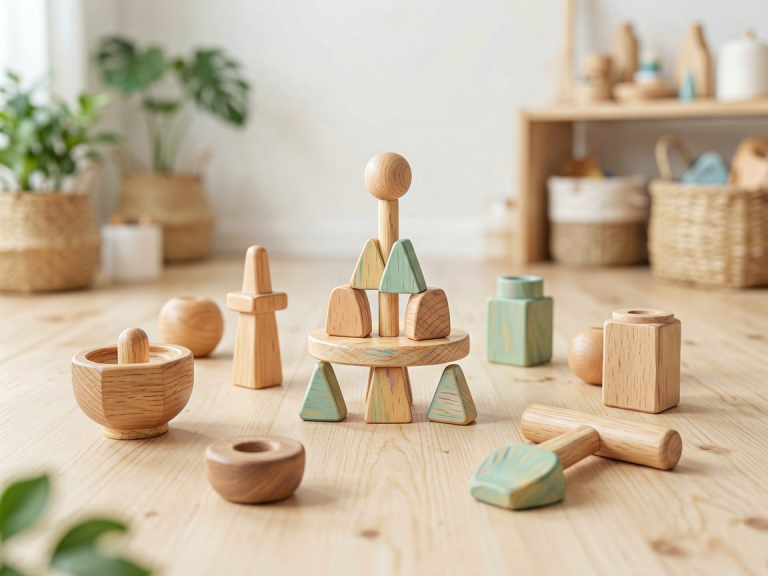
Additionally, modular play aligns beautifully with the growing trend of "open-ended toys," which are well-documented in child development research. Montessori educators have long argued that simple materials allow the mind to impose structure, fostering creativity and problem-solving far better than rigid, single-purpose toys. Adults, too, benefit from this approach. A collection of wooden blocks can become a physics puzzle, an architecture challenge, or an art project, depending on mood. The same physical item renews itself through reinvented use, thus eliminating the need to buy another puzzle toy.
Digital and Hybrid Options: Puzzles Without Pieces
Another powerful category of less-clutter alternatives to puzzle toys is digital puzzling. With a smartphone or a tablet, one gains access to an endless supply of logic games, word puzzles, spatial reasoning challenges, and escape-room simulators. The aesthetic and tactile pleasures of physical puzzles are absent, but the cognitive reward is comparable—often superior. Crucially, digital puzzles produce zero physical clutter. A single device replaces an entire cabinet of boxes, boards, and pieces. And unlike their analog counterparts, digital puzzles can update themselves with fresh content, meaning the novelty never ends. For those who miss the hands-on feel, hybrid options such as digital jigsaw puzzles with stylus interaction or AR-based brain teasers provide a compromise. They deliver sensory feedback without the mess of cardboard or plastic.
The digital route also offers social puzzle experiences that physical objects cannot easily match. Multiplayer cooperative games, where players solve shared riddles across devices, turn puzzle solving into a communal event without requiring anyone to carry a board game. Online puzzle rooms have become popular for team-building, but they need no physical props, no tokens, and no manuals. This is a perfect illustration of how less-clutter alternatives to puzzle toys can actually enhance social connection while reducing material burden. Moreover, digital platforms often include built-in difficulty scaling, allowing solvers to move from novice to expert seamlessly—something that a static physical puzzle cannot do without requiring additional purchases.
Social, Verbal, and Movement-Based Challenges
Puzzles are not inherently object-based. Many of the most rewarding mental challenges exist entirely in language, interaction, and movement. Verbal puzzles—riddles, anagrams, lateral-thinking questions, and storytelling games—require nothing more than a conversation partner. A group of friends can spend an evening solving a "murder mystery" using nothing but printed prompts or spoken clues. These activities exercise the same logical and deductive muscles as mechanical puzzles but leave no trace in the physical world. They are inherently low-clutter. Similarly, movement-based puzzles, such as treasure hunts, navigation challenges, or choreographed memory games, use the environment itself as the puzzle board. One can design a city-wide scavenger hunt using landmarks, photographs, and GPS—no manufactured objects required. These experiences are memorable precisely because they are ephemeral; they exist in time, not on shelves.
In this context, the phrase "less clutter" takes on a broader meaning. It is not only about avoiding physical accumulation but also about reducing mental clutter. Puzzle toys often come with instructions, packaging, and the pressure to complete and collect. Social and verbal puzzles strip away these distractions. They require only attention and imagination. For individuals seeking a minimalist lifestyle, these alternatives are liberating. They prove that puzzlement is a state of mind, not a product category. The purest puzzle is the one we create for ourselves with the materials of our own lives: an unfamiliar map, a cryptic note, a sequence of street names, or a friend’s challenging question. All of these are free, regenerable, and infinitely varied.
Nature and Everyday Objects as Open-Ended Puzzles
The world outside our homes is a treasure trove of less-clutter alternatives to puzzle toys. Nature offers an endless array of organic puzzles: identifying animal tracks, predicting weather patterns, mapping constellations, or navigating by the position of the sun. These activities engage our pattern-recognition and deductive abilities in ways that artificial puzzles often attempt to mimic. A simple walk in the woods can become a botanical riddle—which plant is this, and why does it grow here? A stone skipping across water can become a physics puzzle—what angle and force maximize the number of bounces? These natural puzzles occupy no shelf space and cost nothing. They also deepen our connection to the environment, providing a sense of wonder that manufactured toys rarely replicate.
Everyday objects, too, can be repurposed as puzzle prompts. How many ways can you fold a tea towel to make it stand upright? Can you balance a spoon on a glass rim using only a coin? Can you arrange five books on a table so that the tops form a perfect plane? These improvisational challenges foster a mindset of curiosity and experimentation. They are the essence of less-clutter alternatives to puzzle toys: using what already exists, rather than consuming new items. The minimal aesthetic of a tidy room no longer conflicts with a playful spirit; instead, the room itself becomes the puzzle arena.
A Minimalist Philosophy of Play
Ultimately, the movement toward less-clutter alternatives to puzzle toys is not merely about tidiness. It reflects a deeper philosophical shift in how we relate to objects and experiences. In a world increasingly aware of overconsumption, waste, and the psychological burden of stuff, we are learning to separate the joy of solving from the impulse to own. The finest puzzles are those that challenge us, teach us, and then gracefully disappear, leaving only the satisfaction of growth. They do not accumulate; they transform us.
By embracing modular play, digital platforms, social and verbal challenges, and the natural environment, we can enjoy all the cognitive benefits of puzzle toys without the excess. We can keep our homes minimal and our minds maximal. And in doing so, we rediscover the truth that has always been at the heart of play: the most valuable puzzle is the one we make from the world around us, not the one we buy from a box. The next time we feel the itch for a challenge, we need not reach for another product. We can simply look around, ask a good question, and let the wandering mind begin its work. That is the ultimate less-clutter puzzle—and it never needs to be stored away.