Are Science Kits Safe for 6-Month-Olds? A Comprehensive Safety and Developmental Review
In an era of “Baby Einstein” videos, infant flash cards, and neuroscience-backed toys, it is hardly surprising that science kits have become a popular gift for new parents. The image of a curious infant gazing at a bubbling volcano or touching a glowing circuit board is appealing, yet it raises a serious question: are science kits safe for 6-month-olds? The short answer is no — at least not in any conventional sense. To understand why, we must examine the developmental realities of a six-month-old infant, the physical hazards embedded in typical science kits, and the difference between genuine early learning and marketing-driven anxiety. This article provides a detailed, evidence-based look at the risks, the <a href="https://www.toydecisionguide.com/category/alternatives/”>alternatives, and what parents should know before introducing “science” to a child who can barely sit up.
Understanding the Developmental Stage at Six Months
At six months of age, an infant is a whirlwind of rapid growth, but that growth is not yet aligned with the demands of a traditional science kit. Most babies at this age can roll over in both directions, sit with support, and may begin crawling or scooting. They reach for objects with eager hands but lack fine motor precision. Perhaps most critically, they are in the heart of the oral exploration phase. For a 6-month-old, the mouth is the primary tool for investigation. Every object that enters their hands is quickly redirected to their mouth, where texture, taste, and temperature are decoded. This behavior is essential for learning, but it also means that anything placed near a baby must be able to survive being slobbered on, chewed, and swallowed — safely. Furthermore, a six-month-old’s visual system is still maturing; they see contrasts and bright colors, but their depth perception and ability to track small moving parts are limited. Their attention span lasts seconds or minutes, not the extended periods required for a multi-step experiment. In short, the infant brain is primed for sensory integration, cause-and-effect play, and social interaction — not for following instructions or handling equipment.
What Typical Science Kits Contain
Let us consider what most commercially available science kits actually include. Common examples are crystal-growing sets with chemical powders, volcano kits with baking soda and citric acid, electronics kits with wires and small bulbs, rock and mineral collections, magnifying glasses, test tubes, pipettes, and sometimes even small magnets or batteries. Many kits explicitly label themselves for ages 8 and up, often because they contain sharp items, breakable glass, or chemicals that can cause eye or skin irritation. Even “premium” kits marketed as safe for younger children usually set a minimum age of three years. The reason is clear: the components are not designed for infant exploration. A crystal growth experiment requires mixing a hot solution and waiting for evaporating water — impossible for a baby. An electronics kit requires inserting tiny wires into breadboards — a choking hazard. A rock collection includes small stones that can be swallowed or aspirated. A magnifying glass can become a projectile or a weapon if thrown. Put simply, the very essence of a science kit — its small parts, its chemical substances, its sharp edges, and its intricate tools — is precisely what makes it dangerous for a 6-month-old.
The Risks: Choking, Toxicity, and Injury
The dangers are not theoretical; they are concrete and measurable. The leading risk is choking. At six months, an infant’s airway is about the diameter of a straw. Any object smaller than 1.25 inches in diameter and 2.25 inches in length can easily become lodged in the trachea. Most science kits contain screws, beads, wires, magnets, or small vials that meet this deadly criterion. Even if an object is too large to swallow, it can still cause gagging or become wedged in the esophagus. A second major risk is chemical toxicity. Many science kits include substances that are harmless to an older child who follows instructions but highly toxic to an infant who chews on the packaging or puts a liquid-soaked sponge in their mouth. For example, boric acid (used in some slime kits), potassium ferricyanide (in some crystal kits), or even common household substances like sodium borate can cause vomiting, diarrhea, or more severe poisoning at small doses. A third risk is internal injury from batteries or magnets. Button batteries are found in some electronic science kits, and if swallowed, they can burn the esophagus in under two hours. Multiple magnets can attract each other through intestinal walls, causing perforation and sepsis. Fourth, there are physical cuts from glass test tubes, sharp plastic edges, or scalpels (which appear in dissection kits). A 6-month-old lacks the hand strength to control these tools, but they are strong enough to break glass or poke themselves. Finally, there is the risk of eye injury from powders or flying particles if a baby knocks over a container. In summary, every category of science kit introduces at least one potentially lethal hazard for an infant.
The Problem with “Educational” Marketing
Why, then, do some parents even consider giving a science kit to a 6-month-old? The answer lies in a powerful combination of marketing and parental anxiety. Many toy companies exploit the scientifically valid finding that the first few years of life are a critical period for neural development. They twist this into a message that “stimulation” must be intense, structured, and product-based. “Build your baby’s STEM skills from day one!” screams the advertisement. Yet the American Academy of Pediatrics does not endorse such products. Instead, its guidance emphasizes that young children learn best through unstructured play, caregiver interaction, and real-world experiences. A 2019 study in JAMA Pediatrics found that infant “educational” toys had no measurable benefit on long-term development, and some screen-based products were actually associated with language delays. The only “science kit” a 6-month-old needs is a safe environment with places to explore, people who talk and sing, and objects that offer feedback through simple cause and effect. The marketing of early STEM kits preys on the fear that if you are not doing something extra, your child will fall behind. The truth is that pushing an inappropriate tool onto an infant is not only useless — it can be harmful, as it replaces the kind of floor-based, caregiver-engaged play that truly builds a growing brain.
What Would a Safe “Science Kit” Look Like for an Infant?
If we strip away the market’s definition and think like developmental scientists, we can imagine what a genuinely safe science kit for a 6-month-old might resemble. It would contain zero small parts — every component must be larger than a toilet paper roll. It would contain no chemicals, dyes, or liquids that are not food-grade. All materials would be soft, flexible, and unbreakable, and every item would be washable or disposable. In practice, that means cloth books with high contrast patterns, silicone teething rings with different textures, soft fabric balls that rattle, and unbreakable mirrors. Perhaps a “science kit” could include a set of safe sensory bottles — sealed plastic containers filled with water, vegetable oil, food coloring (non-toxic), or glitter that a baby can observe as they roll them. The key is that these bottles must be ultrasonically sealed or glued shut with no removable caps. Another safe item is a set of organic cotton pouches containing different dried herbs that produce gentle smells when squeezed (but only if the pouch is heavily stitched and cannot be opened). The very best “science kit” is indeed a curated collection of household objects that are safe to mouth and manipulate: wooden spoons, stainless steel bowls, silicone muffin cups, and fabric scraps. These allow a baby to explore gravity, texture, sound, and weight — the building blocks of physical science — without any of the risks associated with commercial kits.
Safer Sensory Activities That Build Scientific Thinking
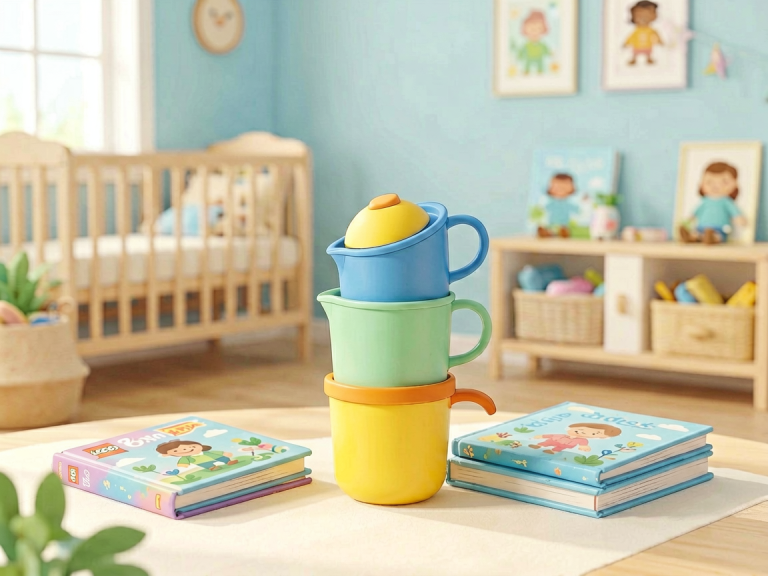
Parents and caregivers need not wait for some expensive product to give their 6-month-old a taste of scientific discovery. In fact, the most developmentally appropriate activities are entirely simple. One classic activity is water play: place a shallow tray of lukewarm water on the floor under close supervision. The baby can splash, pat, and watch the water ripple, learning about causality and liquid dynamics. Even simpler, let the baby hold two plastic cups (wide and unbreakable) and experiment with banging them together or dropping them — this is physics: force, sound, and motion. Tummy time on a textured rug or over a soft blanket lets the baby feel different fabrics — wool, corduroy, silk — all while developing neck and arm strength. A mirror propped safely against a wall allows the baby to investigate the concept of reflection and self-awareness. A rattle made of a sealed plastic container with a few dry beans teaches about sound production and object permanence — when the rattle is shaken, it makes noise; when dropped, it stops. Even the simple act of playing peekaboo with a caregiver teaches cause and effect and social science. These activities are not just “baby stuff”; they are authentic scientific inquiry. The baby is forming hypotheses (“If I hit the bowl, it makes a loud noise”), testing them, and observing the results. This is the foundation of the scientific method, and it requires no harmful materials whatsoever.
When Can Real Science Kits Be Introduced?
While no standard science kit is safe for a 6-month-old, this does not mean that real kits are forever forbidden. As children grow, their developmental capacities and understanding of safety improve. Around age two or three, children can begin to use simple, non-toxic, large-piece science toys under direct adult supervision. For example, a set of large, chunky magnifying glasses can be introduced around age three. Simple sink-and-float experiments using plastic objects in a bin of water are suitable for a three-year-old who can understand the instruction “do not put this in your mouth.” Commercial kits with labeled ages should be respected, but even an age label of 3+ does not guarantee safety; continuous parental supervision is still required. Around age five or six, more complex kits involving non-toxic baking soda volcanoes, simple magnet sets, and basic sensory science can be used. It is only at age eight or older that children can be trusted to handle most chemistry or electronics kits with clear instructions and safety gear. The general rule is: the younger the child, the more adult-led and the less material-based the experience should be. A 6-month-old’s “science” must be 100% about the caregiver’s presence and the environment’s safety, not about the contents of a kit.
Final Verdict: Protect, Don’t Push
Let us return to the original question: are science kits safe for 6-month-olds? Absolutely not — at least not the kits that fill the shelves of toy stores and online retailers. The mismatch between the infant’s oral exploration, immature motor skills, and inability to follow instructions, and the physical, chemical, and mechanical hazards of standard science kits is simply too great. Even a “baby” science kit that claims to be safe may contain hidden dangers such as small parts that detach, or dyes that stain the skin and mouth. The best thing a parent can do is to reject the pressure to accelerate learning and instead embrace the messy, beautiful, unstructured world of infant play. Let the baby chew on a wooden spoon, splash in water, tear a paper bag, or study the shadows on the ceiling. These are the true scientific events of infancy. If you feel compelled to buy a “science kit,” make your own: a basket of silicone cups, a crumpled foil ball, and a soft, high-contrast book. Then sit with your child, talk about what they are doing, and watch them learn. That is safety. That is development. And that, above all, is science at its purest.
Sources and further reading
- American Academy of Pediatrics: How to Buy Safe Toys current age, small-parts, battery, magnet, and supervision considerations.
- U.S. Consumer Product Safety Commission: Recalls and Product Safety Warnings check current recalls before using a product.