Are STEM Kits Safe for 6-Month-Olds? A Developmental and Safety Analysis
Introduction: The Appeal of Early STEM
STEM education—Science, Technology, Engineering, and Mathematics—has become a buzzword in parenting circles. Many manufacturers now market "STEM kits" for children as young as a few months old, promising cognitive enrichment, early problem-solving skills, and a head start in a competitive world. But when you see a vibrant box labeled "STEM for Babies," a crucial question arises: are STEM kits safe for 6-month-olds? The short answer is that most conventional STEM kits are not safe for infants, but certain carefully designed, age-appropriate sensory toys can introduce STEM concepts without risking harm. To understand why, we must examine both the physical safety requirements of a 6-month-old and the true developmental capabilities at this unique stage.
Understanding a 6-Month-Old's Developmental Needs
At six months, an infant is undergoing rapid but specific changes. Most babies can roll over, sit with support, reach for objects, and bring everything to their mouths. This last behavior—mouthing—is not a bad habit; it is their primary method of exploring texture, size, taste, and shape. Their vision is still maturing, and their fine motor skills are limited to palmar grasps rather than precise pincer grips. Cognitively, they are learning cause and effect, object permanence, and sensory contrasts. They do not understand instructions, symbols, or abstract concepts like coding or engineering principles. Therefore, any toy claiming to teach "coding" or "structural engineering" to a 6-month-old is fundamentally misleading. The appropriate STEM experience for this age is purely sensory: feeling different materials, hearing sounds, watching moving parts, and grasping objects that respond to their actions.
Potential Hazards of Conventional STEM Kits
A typical STEM kit designed for preschoolers or older children contains small magnets, LEDs, wires, screws, batteries, gears, and plastic pieces. Each of these poses significant risks for a 6-month-old. The most obvious danger is choking. Small parts, especially those that can pass through a standard toilet paper roll (about 1.25 inches in diameter), can become lodged in an infant's throat. Magnets are particularly hazardous—if swallowed, they can attract each other through intestinal walls, causing perforations, sepsis, and even death. Batteries, especially coin-cell batteries, can cause severe internal burns when ingested or lodged in the esophagus. Wires and sharp edges can cause cuts or strangulation. Additionally, many kits are made of hard, brittle plastic that can shatter into jagged shards. Furthermore, chemical concerns exist: paints and coatings may contain lead, phthalates, or BPA, which are especially dangerous for infants who mouth objects. Even "non-toxic" labels do not guarantee that swallowed plastic pieces are harmless. A 6-month-old cannot recognize danger, cannot communicate distress effectively, and lacks the motor control to avoid hazards. Thus, placing a conventional STEM kit in an infant's hands is not just developmentally pointless—it is a serious safety risk.
Age-Appropriate "STEM" Alternatives for Infants
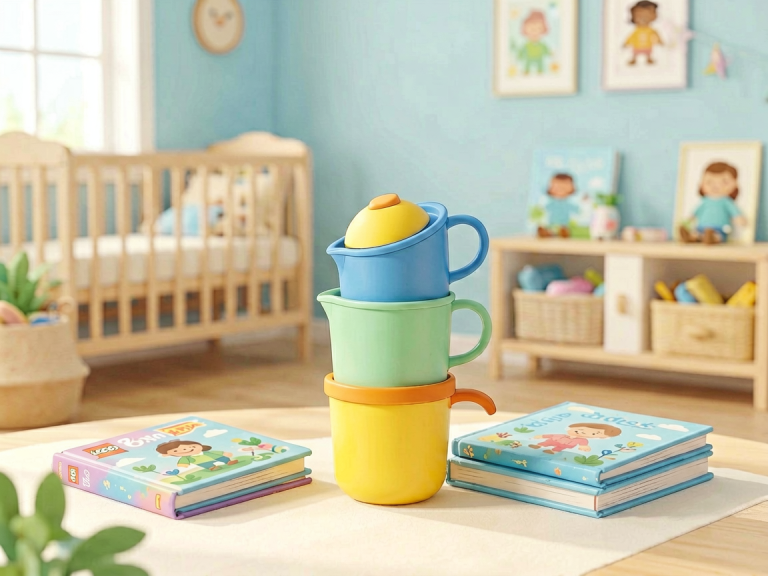
Does this mean STEM is entirely off-limits for 6-month-olds? No—but we must redefine STEM for this age. True science for an infant involves exploring water, sand, and safe natural materials. Technology can be a wind-up toy or a simple flashlight that turns on and off with a physical switch. Engineering is stacking soft foam blocks or fitting rings on a peg. Mathematics is recognizing patterns, counting rhymes, and comparing sizes of soft balls. Several reputable brands manufacture "STEM-inspired" sensory kits specifically for infants, and these can be safe if they meet rigorous standards. Look for toys with large, one-piece designs (no detachable parts), made from food-grade silicone, organic cotton, or untreated wood. They should have smooth surfaces, no sharp edges, and be washable and sterilizable. For example, a set of silicone teething rings with different textures can introduce concepts of shape and texture. A baby-safe mirror helps with visual exploration and self-awareness. Simple cause-and-effect toys, like a pop-up toy that activates when a large button is pressed, encourage early engineering thinking. The key difference is that these items are not "kits" with multiple components; they are individual toys that allow open-ended sensory play. If a "STEM kit" has more than five pieces or any piece small enough to fit in a baby's mouth, it is not suitable for a 6-month-old.
How to Choose Safe STEM-Like Toys
When evaluating any product labeled as a STEM kit for a 6-month-old, parents should follow a strict checklist. First, check the age recommendation—but remember that these are often inflated by marketing. Ignore the label and test the toy physically: can any part be pulled, twisted, or snapped off? Can a piece pass through a toilet paper roll? If yes, reject it. Second, feel the material. Hard plastic with sharp seams is unacceptable. Look for food-grade silicone, which is soft, durable, and safe for chewing. Wood should be solid, with non-toxic, water-based finishes and no splinters. Third, avoid all electronics. Even if a device is enclosed, a 6-month-old may drool into it, causing battery corrosion or short circuits. Passive toys are safer. Fourth, consider the cleaning requirement. Infants mouth everything, so the toy must be able to withstand frequent washing with soap and water or boiling (if silicone). Fifth, look for certifications like ASTM F963 (American standard for toy safety) or EN71 (European standard). These standards test for mechanical hazards, flammability, and toxic substances. However, certification alone is insufficient—a certified toy can still be too small. Finally, supervise all play. No toy replaces active, attentive adult engagement. Even the safest item becomes dangerous when a child is left unattended.
Conclusion: Safety First, STEM Second
So, are STEM kits safe for 6-month-olds? The honest answer is that most are not, and parents should be highly skeptical of any product that promises to teach complex STEM concepts to a baby who cannot even sit up independently. The developmental reality is that a 6-month-old does not need a kit; they need a responsive environment full of safe, varied, and sensory-rich materials. You can foster early science and engineering by offering large, simple, chewable objects that show cause and effect, by narrating your own actions, and by allowing free exploration of textures and sounds. Safety must always come first. Before purchasing anything labeled "STEM," ask yourself: Could this harm my child if it ends up in their mouth? Can my child derive any genuine developmental benefit from it at this age? If the answer to the first question is "yes" or the second is "no," skip it. The best "STEM kit" for a 6-month-old is not a kit at all—it is a safe, loving caregiver who talks, plays, and explores the world alongside the baby, one mouth-safe toy at a time. In early infancy, safety is not a limitation; it is the very foundation upon which all future learning is built. Choose wisely, supervise closely, and remember that your baby’s greatest learning tool is the human interaction you provide, not the expensive plastic box you buy.
Sources and further reading
- American Academy of Pediatrics: How to Buy Safe Toys guidance on age labels, small parts, batteries, magnets, and supervision.
- U.S. Consumer Product Safety Commission: Recalls and Product Safety Warnings official current recall information.