Should I Buy Engineering Kits for 18-Month-Olds? The Surprising Truth About Toddler STEM
If you have spent even five minutes scrolling through parenting websites or toy store videos, you have probably seen them: bright, colorful "engineering kits" for toddlers, complete with chunky gears, giant plastic bolts, and cheerful promises to spark your 18-month-old’s inner inventor. The marketing is powerful. Your child will build, create, problem-solve, and become the next great engineer, starting today. But before you hit "Add to Cart," it is worth pausing. Should you buy engineering kits for 18-month-olds? The short answer is: maybe — but not for the reasons you think. The more honest answer has to do with child development, realistic play, and the fact that an 18-month-old is far more interested in dumping a bag of blocks than in designing a working machine.
What Is an “Engineering Kit” at This Age?
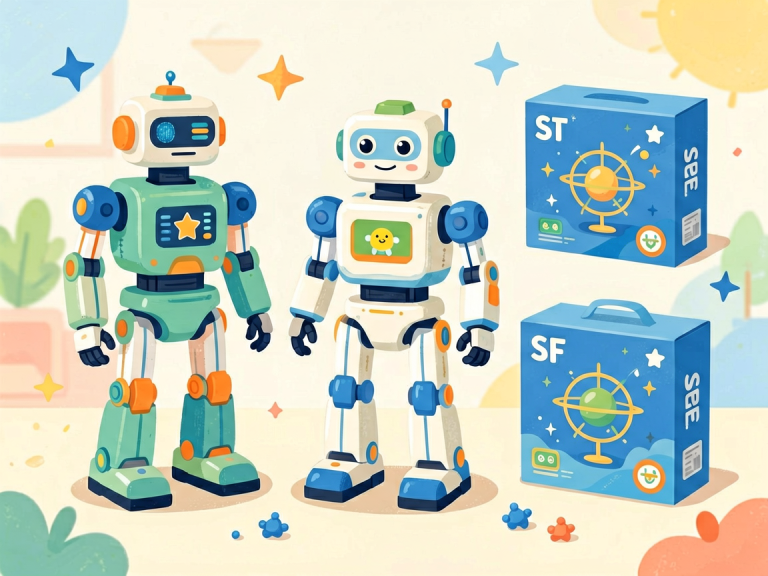
The phrase "engineering kit" sounds precise and technical. For a 12-year-old, an engineering kit might include motors, wires, pulleys, and a detailed instruction booklet. For an 18-month-old, the term is mostly marketing. The actual product is usually a box of oversized, brightly colored plastic parts: stackable blocks, interlocking discs, chunky gears that fit on a pegboard, magnetic tiles with large pieces, or connectable tubes and wheels. Some sets look like a toddler-friendly version of a construction site, with large play tools and pretend bolts. Others are simply sophisticated-looking blocks.
There is nothing wrong with any of these toys in principle. But it is important to understand what they are not: they are not real engineering kits, and they cannot "teach" engineering to a child who has only recently learned to walk. At 18 months, a toddler is not ready to follow multi-step instructions, use actual tools, or understand the physics of gears and levers. What they are ready to do is explore, stack, knock down, mouth, and observe. A high-quality construction toy can support that. A complicated "engineering" theme is just the box’s way of getting your attention.
What an 18-Month-Old Actually Does With Toys
To decide whether to buy an engineering kit, it helps to look at what an 18-month-old can physically and mentally do. At this age, most toddlers can walk, climb stairs with help, and push or pull objects. They have developed a pincer grasp, so they can pick up small items between thumb and forefinger. They can stack two or three blocks, empty containers, fill containers, and throw things with surprising accuracy. They understand cause and effect: if I push this cup, it falls. If I press this button, music plays. They are also intensely curious about how their body interacts with the world.
What they cannot do is also important. An 18-month-old cannot plan a complex structure in advance. They do not have the attention span for a ten-piece assembly sequence. They cannot read diagrams or follow verbal instructions like "connect the red gear to the blue axle." They may still put toys in their mouth, which means small parts are dangerous. And their frustration tolerance is extremely limited — if a piece does not click in, it will be thrown to the ground, not carefully repositioned.
That does not mean building play is pointless. It means the skill of "engineering thinking" looks very different at 18 months. It looks like a child trying to stack a block on top of a wobbly tower, watching it fall, and trying again. It looks like a child pushing a ball down a ramp and wondering why it stopped. It looks like a child testing which objects fit inside a plastic cup. These are genuine learning moments, but they do not require a five-hundred-piece gear set. They require simple, safe, open-ended materials and an adult who can be present.
The Real Benefits — and the Catch
There are real benefits to age-appropriate building toys. When an 18-month-old grasps a chunky block, rotates it, and decides which side to put down, they are developing hand-eye coordination and spatial reasoning. When they stack and knock down, they are learning about gravity, balance, and cause-and-effect. When they see that a curved piece can become a tunnel, they are practicing creativity and symbolic thinking. These are important foundations for later STEM learning. A well-designed, open-ended building set can absolutely support this kind of play.
But here is the catch: the benefits come from the play, not from the packaging. A set of plain wooden blocks, a collection of cardboard boxes, or a stack of plastic cups can provide the same developmental value as an expensive "engineering kit." In fact, simpler materials are often better, because they invite the child to invent their own uses. A toy that has one specific goal, like building a pre-designed car with four wheels and a hood, may actually frustrate a toddler who would rather spin the wheels than assemble the car.
Also, "engineering thinking" is a process, not a product. It is about asking "what if," making predictions, testing ideas, and revising. An 18-month-old can participate in that process, but only with a caregiver who models it: "What happens when I put this big block on top? Oh, it fell. Let’s try the smaller one." The toy itself cannot create that interaction. If you buy an engineering kit and simply hand it to your toddler while you scroll through your phone, most of its value will be wasted. If you sit down together and treat the pieces as loose parts, even an ordinary block set becomes an engineering adventure.
What to Look For (and What to Avoid)
If you decide to buy an engineering kit for an 18-month-old, choose carefully. Not all "toddler" toys are truly appropriate, and some can be actively frustrating. Look for kits that are open-ended, with no fixed right answer. Large, chunky pieces that are easy to grip are essential. Avoid anything with small parts, magnets that can be swallowed, or thin pieces that can break and create sharp edges. Check the age label, but do not stop there: a toy labeled 18 months may still require far more fine motor control than your child has. As a general rule, bigger is safer and simpler is better.
Look for sets with very few pieces to start. Ten or fifteen oversized blocks are plenty. You do not need a 200-piece mega-set. A toddler’s play space should not feel overwhelming. The best toy for this age is something they can handle independently, with just a little support. Avoid kits that include tiny gears, plastic screws and screwdrivers, or parts that need to be aligned exactly. These are design to appeal to parents, not to toddlers. Your child will not "build" the gear mechanism; you will, and then the gears will quickly become the target of a game of "throw and fetch."
Also, be skeptical of any product that promises academic achievement. "Makes your child smarter," "builds a future engineer," "boosts STEM skills from birth" — these are marketing phrases, not scientific facts. At 18 months, the most important brain-building experiences are warm interaction, language, physical play, and exploration. A plastic gear set is not a shortcut to genius. If a kit makes you talk with your child more, it has value. If it merely replaces your interaction with noise, lights, and flashy bits, it is meaningless.
Better Alternatives: You Already Have an Engineering Lab at Home
You do not need to spend money on an engineering kit to give your 18-month-old an early engineering education. Your home is already full of wonderful loose parts. Cardboard boxes of different sizes can be stacked, filled, and climbed into. Tupperware containers with lids encourage dumping and matching. Wooden spoons, plastic bowls, and measuring cups turn into towers, drums, and scoops. Paper towel tubes become tunnels, ramps, or magical speaking horns. Couch cushions and pillows can be used to build an obstacle course. Even laundry baskets can become cars, boats, or treasure chests.
The most important "engineering tool" for your toddler is your voice. When you narrate what is happening, you are building vocabulary and problem-solving language. Say, "That block is too big for this cup. Can we find a smaller one?" Or, "We put the car at the top of the ramp. Now it is rolling down. Why? Because the ramp is tilted." These conversations may feel simple to you, but to your child they are the language of scientific thinking. You are showing them how to observe, predict, and test — the essence of engineering.
If you do want a store-bought toy, choose something with longevity. Wooden blocks, large magnetic tiles (with adult supervision and safety checks), interlocking PVC pipes, or simple shape sorters can grow with the child. A kit that is truly interesting at 18 months will still be interesting at three, four, and five years, albeit used in more complex ways. Before buying, ask yourself: "Will my child still play with this in six months? Can I play with it too? Is it durable, safe, and easy to clean?" If the answer is yes, it may be a good purchase. If you are buying it only because the word "engineering" is on the box, you are probably wasting money.
The Verdict: Should You Buy Engineering Kits for 18-Month-Olds?
So, should you buy engineering kits for 18-month-olds? Yes — with a double condition. If you choose an open-ended, chunky, well-made construction set and use it as a tool for shared play, it can be a lovely addition to your child’s toy collection. It will not turn your toddler into a coding prodigy, but it can support spatial awareness, fine motor development, and creative problem-solving. You and your child can talk about what you are making, knock it down with a laugh, and build it again in a new way. That is genuine early engineering education.
But if "engineering kit" means a set of miniature tools, precise gears, or a single fixed model your child is expected to assemble, wait. At 18 months, your child is not ready for assembly. They are ready for exploration. A flashy kit with lights and sound will be ignored after the novelty fades. A set of simple blocks will be used again and again, in a hundred different ways, because it adapts to the child rather than demanding the child to adapt to it.
In the end, the best STEM investment for an 18-month-old is not a product. It is time: time to explore, time to fail safely, time to see what happens when you push a cup off the edge of the table. It is space: room to move, climb, and build without constant restrictions. And it is you: the adult who asks questions, celebrates mistakes, and shows that curiosity is more important than the correct answer. You are your child’s first engineering kit. Everything else is just a toy.