Are Robot Toys Worth It for 9-Month-Olds? A Developmental Science Perspective
Introduction: The Allure of the Beeping, Buzzing Robot
Walk into any baby store today, and you will find shelves lined with robot toys designed to sing, dance, flash, roll, and even "talk" back. These gadgets promise to stimulate your 9-month-old’s developing brain, boost early STEM skills, and keep your little one entertained while you steal a moment to drink your coffee. But are they actually worth it? For a parent of a 9-month-old, the question is not just about price tags. It is about understanding what your baby truly needs at this critical stage of development, and whether a spinning, beeping plastic companion can deliver any real value. The short answer is: mostly no, with a few cautious exceptions. But to understand why, we need to look closely at how a 9-month-old learns, what robot toys actually do, and what the research on infant play tells us.
The 9-Month-Old Brain: What Is Actually Happening
At nine months, an infant is undergoing one of the most explosive periods of cognitive and motor development in their entire life. This is the age when many babies are perfecting the art of sitting independently, starting to crawl, pulling themselves up to stand, and beginning to understand object permanence — the idea that an object still exists even when it is out of sight. Socially, they are becoming mini-personalities: they laugh, babble, imitate facial expressions, and engage in back-and-forth "conversations" with caregivers. They are also developing what developmental psychologists call "social referencing" — they look to their parents’ faces to figure out whether a situation is safe, scary, or fun.
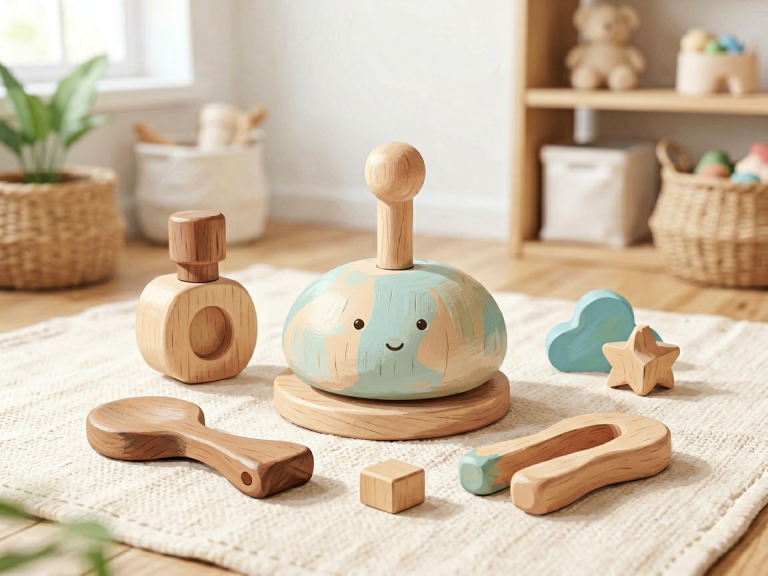
Crucially, a 9-month-old’s learning is not based on passive reception of information. It is based on active, embodied exploration. They learn by putting things in their mouths, banging them on the floor, dropping them repeatedly, and watching what happens. They are little scientists, but their laboratory is the physical world of cause and effect that they can manipulate with their own hands, mouths, and bodies. They learn best through face-to-face interaction with responsive adults, through natural objects like wooden spoons, crinkly paper, and plush blocks, and through repetitive, predictable routines.
The Case For Robot Toys: Potential Benefits
To be fair, robot toys are not inherently evil. There are a few genuine arguments in their favor. First, many robot toys are designed to be multi-sensory: they combine bright lights, varied sounds, textures, and motion. A young infant may be briefly captivated by a robot that flashes colors and plays melodies. This visual and auditory stimulation can help with alertness and orientation, especially during quiet alert states. Second, some robot toys encourage gross motor development. For example, a robot that rolls slowly across the floor may motivate a crawling 9-month-old to chase it, building muscles and coordination. Third, certain robot toys have a "cause-and-effect" component: press a big button, and the robot dances. This can teach a very basic connection between action and outcome, which is an early foundation of problem-solving.
Moreover, if a robot toy is used as a shared play object — with a parent sitting beside the baby, narrating what the robot is doing, taking turns pressing buttons, and responding to the baby’s reactions — it can become a vehicle for social interaction. In that sense, the toy is not replacing adult interaction but is simply a prop within it. A parent might say, "Look! The robot is spinning! Can you pat his head?" This kind of guided play can support language development and joint attention, which are crucial for later learning.
The Strong Case Against: Why Most Robot Toys Fall Short
Despite those potential benefits, the scientific and developmental arguments against robot toys for 9-month-olds are far stronger. The first and most damning issue is the problem of "attention capture" versus "deep engagement." Robot toys are often highly salient — they flash, beep, and move on their own. A 9-month-old’s attention system is still immature, and these features tend to trigger the orienting reflex, causing the baby to stare passively at the toy. But passive staring is not the same as active learning. When a toy acts by itself, the baby may become a spectator rather than an agent. The key question is not "Does my baby look at it?" but "Does my baby learn from it?" Research on infant attention suggests that babies learn more from objects they can vary themselves, rather than from objects that vary on their own. A simple wooden rattle, for instance, produces a sound only when the baby shakes it. The baby controls the noise. In contrast, a robot that beeps randomly, without any action from the infant, sends a confusing message: the world sometimes happens *to* you, not because of you. For a 9-month-old who is just beginning to understand personal agency, this can actually interfere with the development of a sense of control over their environment.
Second, robot toys often overstimulate. A 9-month-old’s nervous system is still learning to regulate arousal. Too many flashing lights, sudden sounds, and jerky movements can lead to cortisol spikes, irritability, and disrupted sleep. Many parents notice that after playing with an electronic toy, their baby gets cranky or has a harder time calming down. This is not a coincidence. The developing brain needs predictable, moderate stimulation to build neural pathways for self-regulation. A pile of soft blocks, a favorite stuffed animal, or a set of silicone cups provides a much calmer and more manageable sensory input.
Third, there is a genuine opportunity cost. Every minute a 9-month-old spends staring at a robot is a minute not spent crawling after a ball, babbling with a caregiver, or squeezing a soft textured book. At this age, the most valuable "toys" are not actually toys at all — they are ordinary household objects, along with the unmeasured but irreplaceable resource of a human face and voice. Researchers who study language development consistently find that the number of conversational turns a baby experiences is a strong predictor of later vocabulary. Robot toys, even "interactive" ones, do not contribute meaningfully to these back-and-forth exchanges. Many robot toys have a fixed vocabulary or play the same songs repeatedly, but they cannot adjust to a baby’s babbling, cannot respond to a smile with an understanding smile, and cannot know when the baby is tired or hungry. A robot may say "I love you!" but it cannot feel love, and a 9-month-old is already sophisticated enough to sense the difference — or rather, to miss the reciprocal warmth of a real caregiver.
What the Research Actually Says
Several studies in developmental psychology have compared the reactions of infants to electronic toys versus traditional toys. A well-known 2015 study published in *JAMA Pediatrics* by Anna Sosa and colleagues looked at parent-infant interactions with electronic toys, traditional toys, and books. The researchers found that when parents played with electronic toys with their infants, they spoke fewer words, responded less to their child’s vocalizations, and used fewer content-specific words than when they played with traditional toys or books. The parents also gave less verbal feedback. In other words, electronic toys, including robot-like gadgets, *suppress* the quality of parent-child communication. The toy itself may be engaging, but it often steals the conversation. For a 9-month-old, whose language development is still in the pre-word stage, this loss of parental input is crucial. The robot may be talking, but it is not listening — and worse, it may make the parent stop talking too.
Another line of research looks at "contingent responsiveness" — the ability of an object to respond in a timely, logical way to the infant’s action. Babies love contingent stimuli: they prefer objects that respond to their actions with consistent, immediate feedback. A robot that rolls when a button is pressed is contingent, but a robot that randomly beeps or moves without any input is non-contingent. Many commercially available robot toys are designed to be "active" even when the baby is not touching them, presumably to hold attention. But this non-contingent activity can be destabilizing for a young infant. The baby cannot build a reliable mental model of "if I do X, then Y happens." Instead, the baby may feel overwhelmed by unpredictable events, which can increase anxiety. A contrast: a simple pop-up toy (where the baby presses a lever and a puppet pops up) is highly contingent and developmentally appropriate. But a robot that spins, flashes, plays music, and then stops on its own schedule? That is a tornado of randomness for a 9-month-old brain.
Practical Guidance: What Should a Parent Do?
Given all this, what is the practical verdict? For a 9-month-old, I would say that most robot toys are not worth the money, the space, or the developmental risk. If you already own one, you do not need to throw it away in a panic. Just use it with extreme care: turn off the auto-play mode, avoid any toy with loud sounds or harsh flashing lights, and use it together with your baby rather than leaving the baby alone with it. Better yet, hide it in a closet for a few months. Many robot toys are more age-appropriate for toddlers aged 18 months to 3 years, when children can understand and enjoy pretend play, storytelling, and more complex cause-and-effect sequences. For a 9-month-old, the optimal play diet is radically simple: your face, your voice, your touch, and a basket of open-ended objects that she can grasp, mouth, drop, shake, and throw. Think wooden rings, cloth books with crinkly pages, nesting cups, ball ramps (but only as you guide them), and soft stackers. These objects support sensory-motor development, hand-eye coordination, and early problem-solving in ways no robot can match.
Conclusion: Invest in the Best "Toy" of All
The real issue with robot toys for 9-month-olds is not that they are harmful in small doses, but that they are a distraction from the true engine of infant development: loving, responsive human interaction. A robot can beep, but it cannot coo back. A robot can roll, but it cannot hold a baby’s hand. A robot can glow, but it cannot glow with pride when your baby takes a first wobbly step. At nine months, your child’s brain is forming one million neural connections per second, a process that is shaped most powerfully by real-world experiences — especially by interactions with you. Before you buy a shiny, expensive robot, ask yourself: will this toy make my baby more curious, more secure, and more engaged with the world, or will it simply make a lot of noise? The answer, for most robot toys, is the latter. Save your money. Spend your time. That is what your 9-month-old truly needs — and that, beyond any gadget, is the one "toy" that will always be worth it.