Beyond Buttons and Screens: The Best Alternatives to Coding Toys for Babies
In recent years, the market has been flooded with so-called “coding toys” for babies—colorful plastic gadgets that promise to teach logical sequencing, cause-and-effect reasoning, and early computational thinking to children as young as six months. While these toys can be engaging, many experts in early childhood development argue that the most powerful learning tools for infants are not electronic at all. Babies’ brains are wired to learn through rich sensory experiences, physical manipulation of real objects, and warm human interaction. Before a child can understand symbolic programming, they must first build a foundation of concrete, real-world knowledge. This article explores the best alternatives to coding toys for babies—activities and playthings that nurture the same cognitive skills (problem-solving, pattern recognition, sequencing, and flexible thinking) in developmentally appropriate, screen-free ways.
Sensory Bins and Loose Parts: The Foundation of Logical Thinking
One of the most effective alternatives to coding toys is sensory play with natural and everyday objects. A simple sensory bin filled with dry rice, beans, sand, or water, combined with scoops, cups, and small figurines, offers endless opportunities for a baby to explore cause and effect. When a baby pours a cup of rice and watches it fall, they are observing a sequence: lift, tilt, pour, spill. When they try to fill a narrow-mouthed bottle with beans, they engage in trial-and-error problem solving—a precursor to debugging in programming.
Loose parts—items like wooden rings, fabric scraps, corks, and large buttons—encourage open-ended exploration. Unlike a coding toy that lights up when a certain button is pressed, loose parts have no single “correct” outcome. This ambiguity forces babies to experiment, hypothesize, and adjust their actions. For instance, a baby might try to stack a round stone on top of a flat block and discover it wobbles. They then try a different placement. This iterative process of test–observe–modify is the very essence of computational thinking. Moreover, sensory play stimulates multiple senses (touch, sight, sound, and even smell), creating dense neural connections that electronic toys often fail to provide.
Open-Ended Building Blocks: Spatial Reasoning and Sequencing
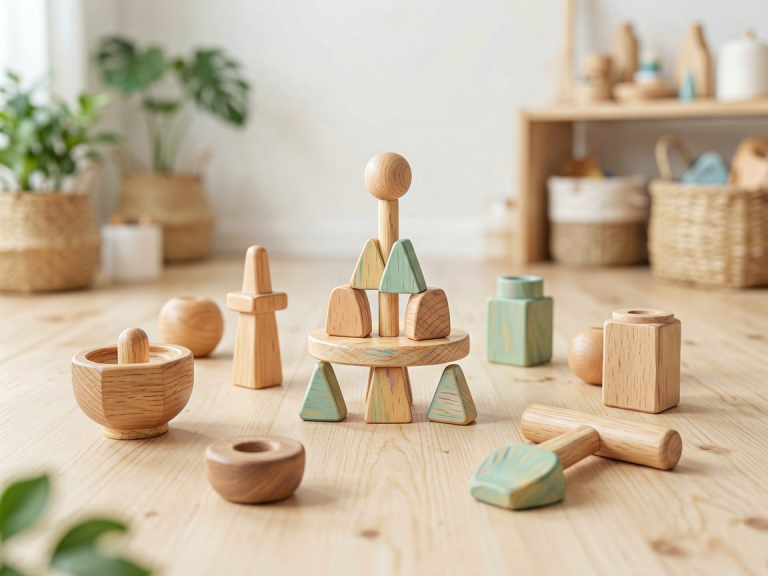
While many coding toys for babies involve arranging blocks in a specific order to make a toy move, traditional wooden blocks or interlocking construction sets offer a far richer experience. A set of simple unit blocks—cubes, cylinders, triangles, and arches—allows a baby to create their own sequences and structures. When a baby places one block on top of another, they are learning about order and stability. When they try to build a tower that doesn’t fall, they are engaging in predictive thinking: “If I put this large block on the bottom, it will be more stable.” This is analogous to writing a stable algorithm.
Furthermore, block play naturally introduces concepts of symmetry, balance, and patterns. A baby might notice that two small cubes stacked together equal the height of one rectangular block. This is an early form of equivalence and modular thinking, which are fundamental to coding. Unlike coding toys that often provide only one correct sequence, blocks allow infinitely many “programs.” The baby becomes the programmer, deciding where each piece goes. This fosters creativity and a sense of agency that no app can replicate.
Cause-and-Effect Toys That Are Simple, Not Simplistic
Many parents assume that coding toys are the best way to teach cause and effect. However, there are classic, low-tech alternatives that are actually more effective for babies. Pop-up toys (where pressing a button, sliding a lever, or twisting a knob makes an animal pop up) are excellent for teaching that a specific action leads to a specific result. Similarly, ball drop ramps—where a baby places a ball at the top of a ramp and watches it roll down—demonstrate a clear, repeatable sequence. The key difference from a coding toy is that the baby must use their own body to initiate the action, strengthening the connection between intention and outcome.
Another outstanding option is the simple wooden peg puzzle. When a baby tries to fit a peg into the correct hole, they are performing a matching task that requires pattern recognition and spatial logic. They must look at the shape, compare it to the hole, rotate it if necessary, and then push it in. This is a multi-step procedure similar to debugging a simple code. Because the feedback is immediate and physical (the peg fits or it doesn’t), the baby learns to self-correct without the mediation of a screen.
Music and Rhythm: Pattern Recognition in a Different Modality
Music is a powerful, often overlooked alternative to coding toys. Simple percussion instruments such as a wooden xylophone, a drum, or a set of bells allow babies to explore patterns through sound. When a baby bangs a drum in a steady beat, they are learning about repetition and rhythm—the temporal equivalent of a loop in programming. When they strike different keys on a xylophone in a sequence, they are creating a pattern (low-high-low) that can be changed at will.
Parents can also engage in call-and-response games: sing a short phrase and then pause for the baby to “answer” with a coo or a bang. This teaches the structure of sequence and turn-taking. Studies in developmental psychology show that rhythmic experiences strengthen the brain’s ability to recognize patterns and predict what comes next—skills directly transferable to understanding the predictable flow of computer code. Moreover, music is inherently joyful and social, reinforcing the emotional connection that babies need for deep learning.
Nature Exploration: Observation and Hypothesis Testing
Another brilliant alternative to coding toys is simply taking the baby outdoors. Nature is the ultimate open-ended learning environment. A baby who watches leaves rustling in the wind is observing a cause-and-effect chain (wind -> leaves move). A baby who tries to pick up a smooth pebble and then a rough pinecone is engaging in comparative analysis. Letting a baby crawl on grass, touch tree bark, or splash in a puddle provides a rich database of sensory inputs that help them build mental models.
Parents can turn a nature walk into a pattern-finding game: “Look, we see a red flower, then a red flower, then a yellow flower.” This is a real-world pattern that a baby can see and touch. Collecting natural objects (with supervision) and arranging them in lines or piles also introduces classification and sequencing—again, core coding concepts. Unlike a plastic coding toy that dictates a narrow range of outcomes, nature presents infinite variables, teaching babies to be flexible and observant thinkers.
Social Interaction: The Most Important “Toy” of All
Finally, it is crucial to remember that babies learn best through face-to-face human interaction. No toy, no matter how sophisticated, can replace the cognitive benefits of a caregiver’s voice, facial expressions, and responsiveness. Simple games like peek-a-boo teach the concept of object permanence and anticipation. Singing nursery rhymes with hand motions (e.g., “Itsy Bitsy Spider”) teaches sequencing of actions and language. Reading board books with repetitive phrases (“Brown bear, brown bear, what do you see?”) helps babies predict what comes next—a foundational skill for understanding how code executes in order.
When a parent models problem-solving by saying, “Oh, the block fell! Let me try placing it more carefully,” the baby witnesses the process of debugging. These interactions build the emotional security that allows babies to take risks and learn from failure. In contrast, many coding toys for babies are isolated, screen-based experiences that limit social engagement. The best alternative, therefore, is always a caring adult who talks, plays, and thinks aloud with the baby.
Conclusion: Let Them Play, Let Them Think
The push for early coding education is understandable in our technology-driven world. However, babies do not need flashing lights and pre-programmed robots to develop logical thinking. The best alternatives to coding toys for babies are the simplest: blocks, sand, water, musical instruments, nature, and loving human interaction. These materials and activities provide a richer, more developmentally appropriate foundation for the cognitive skills that later support coding—pattern recognition, sequencing, cause-and-effect reasoning, and flexible problem-solving. By stepping away from the toy aisle of electronic gadgets, parents can give their babies the gift of open-ended, joyful, and genuinely intelligent play. After all, the most powerful “coding language” a baby can learn is the language of curiosity.