Sound Decisions: Understanding and Managing Toy Noise Levels for 5-Year-Olds
Introduction
Toys are the building blocks of childhood—they spark imagination, encourage social play, and support cognitive development. Yet in recent years, a growing chorus of audiologists, pediatricians, and concerned parents has raised an alarm about one often-overlooked aspect of playthings: noise. For a five-year-old, whose auditory system is still maturing, exposure to excessively loud toys can have lasting consequences. The World Health Organization and many national health agencies have established guidelines for safe noise exposure, but many commercially available toys still exceed recommended limits. This article dives deep into the issue of toy noise levels for five-year-olds: why it matters, what the science says, how to evaluate toys, and what parents and caregivers can do to protect young ears without sacrificing fun. From squeaky rubber ducks to battery-powered police cars, we will explore the decibel dangers hiding in plain sight.
Why Noise Levels in Toys Matter for Five-Year-Olds
Five-year-olds are at a critical juncture in sensory development. They are learning to discriminate between different sounds, to follow complex verbal instructions, and to engage in back-and-forth conversation. Their tympanic membranes (eardrums) are more delicate than those of adults, and their auditory nerve pathways are still being refined. Prolonged or repeated exposure to sounds above 85 decibels (dB) can permanently damage the hair cells in the inner ear, leading to noise-induced hearing loss (NIHL). Unlike age-related hearing loss, NIHL is entirely preventable—yet many parents remain unaware that a seemingly innocent toy siren or a musical keyboard played at full volume can produce levels in the range of 100–120 dB, equivalent to a chainsaw or a rock concert. For a five-year-old who holds a toy directly next to their ear, the risk multiplies. Moreover, noise pollution from toys doesn’t just harm hearing; it can elevate stress hormones, disrupt sleep, and impair concentration. In classrooms and homes, an environment full of noisy toys may overstimulate children and reduce the quality of quiet play, which is essential for creativity and emotional regulation.
The Decibel Danger Zone: How Loud Is Too Loud?
To understand toy noise, one must first understand decibels. The decibel scale is logarithmic, meaning that an increase of just 10 dB represents a tenfold increase in sound intensity. The safe exposure limit for children, as recommended by the American Academy of Pediatrics (AAP) and the World Health Organization (WHO), is an average of 75 dB over eight hours, with peak levels never exceeding 120 dB. For comparison:
- Normal conversation: 60 dB
- Vacuum cleaner: 70 dB
- City traffic: 80–85 dB (the threshold where prolonged exposure becomes harmful)
- A noisy restaurant: 90 dB
- Subway train: 100 dB
- A firecracker at close range: 140 dB
Many toys sold today produce sounds that fall squarely into the hazardous range. A study published in *Pediatrics* in 2014 tested a variety of popular toys and found that 25% of them produced sounds above 90 dB when measured at the ear. Battery-operated toys are the worst offenders: toy sirens, laser guns, and musical instruments often exceed 100 dB. Even a simple squeeze toy that emits a high-pitched squeak can measure 110 dB at a distance of just one inch from the ear. Because five-year-olds often hold toys close to their face or ear—especially when pretending to talk on a toy phone or press buttons—the actual exposure can be far higher than what is listed on the packaging.
International Regulations and Their Gaps
Several countries and regions have established regulations to limit toy noise. The European Union’s Toy Safety Directive (EN 71-1) sets a maximum continuous sound level of 80 dB for toys intended to be held close to the ear, and 115 dB for impulse noises. In the United States, the Consumer Product Safety Commission (CPSC) enforces voluntary industry standards (ASTM F963) that limit toys to 85 dB for continuous sound and 115 dB for impulsive sounds, but compliance is not always strict. Moreover, these regulations only apply to toys that are “intended to be used near the ear,” a vague term that many manufacturers interpret loosely. A toy car that produces a siren sound when pressed may not be classified as a “near-ear” toy, even though a child might hold it up to their ear. Additionally, regulations often ignore the cumulative effect of multiple noisy toys used simultaneously—a common scenario in preschool classrooms or playdates. The gap between regulation and real-world use means that parents must act as the first line of defense.
The Developmental Consequences of Excessive Toy Noise
Beyond hearing loss, loud toys can interfere with a five-year-old’s language acquisition and social development. The ability to perceive subtle differences in speech sounds—such as the distinction between “bat” and “pat”—depends on a healthy auditory system. Chronic exposure to high-frequency noise (common in electronic toys) can degrade this ability, leading to difficulties in phonics, reading, and following directions. A study from the University of California, San Francisco, found that children exposed to elevated noise levels in early childhood scored lower on standardized language tests. Furthermore, noise-induced stress triggers the release of cortisol, which in high levels can impair memory and attention. A five-year-old bombarded by the buzz of a battery-operated toy might become irritable, fatigued, or hyperactive. In contrast, quiet toys—blocks, puzzles, art supplies—promote focus, patience, and deep imaginative play. They also allow children to control the sound environment, a skill that is increasingly important in a noisy world.
How to Choose Safe Toys: A Practical Guide for Parents
Selection is not about banning all noisy toys—it’s about informed choices. Here is a step-by-step approach for parents of five-year-olds:
Check the label. Look for toys that explicitly state compliance with ASTM F963 or EN 71-1 standards. Some manufacturers voluntarily list the decibel level on the packaging. If not, be cautious.
Listen before you buy. Many stores have display models. Hold the toy at arm’s length and activate the sound. If it makes you wince, it is too loud for your child. A good rule of thumb: if you have to raise your voice to speak over the toy, it exceeds safe levels.
Use the smartphone test. Free decibel meter apps are not perfectly accurate, but they give a rough estimate. Place the phone near the toy’s speaker at the distance a child would hold it. Anything above 85 dB is a red flag. Better yet, buy a dedicated sound level meter for about $20–30.
Modify the toy. Many toys have volume controls. If the toy lacks one, consider placing a small piece of clear tape over the speaker to muffle the sound. For plastic toys, poking a tiny hole in the speaker grille (with a hot needle) can diffuse the sound pressure. Never do this with battery compartments or electrical wiring.
Prioritize “quiet” play. Rotate toys so that only a few are available at a time. Encourage activities like building blocks, drawing, reading aloud, and playing with playdough—all of which produce minimal noise. Set aside “silent play time” each day, during which no battery-operated toys are allowed.
Teach your child. Explain to your five-year-old that loud noises can hurt their ears. Use a simple analogy: “Your ears are like flowers—too much loud sound can shake the petals off.” Encourage them to hold toys away from their ears and to lower the volume voluntarily. Children often mimic adult behavior, so model good listening habits yourself.
The Role of Toy Manufacturers and Policy Makers
While parents bear the immediate responsibility, systemic change requires action from manufacturers and regulators. Some progressive companies have begun designing toys with automatic volume limiters that cap sound output at 75 dB—far below the dangerous threshold. For example, the company Lovevery produces wooden instruments with soft, organic tones, and many Montessori-style toy brands deliberately omit electronic sounds. However, the market is still flooded with cheap, mass-produced plastic toys that prioritize visual and auditory flash over safety. Consumer advocacy groups like the Campaign for Safe Toys and the American Speech-Language-Hearing Association (ASHA) regularly publish “naughty lists” of the loudest toys. Policymakers should consider lowering the acceptable decibel limits and closing loopholes for “near-ear” exemptions. Until then, parents must vote with their wallets.
Case Study: The Siren vs. The Storybook
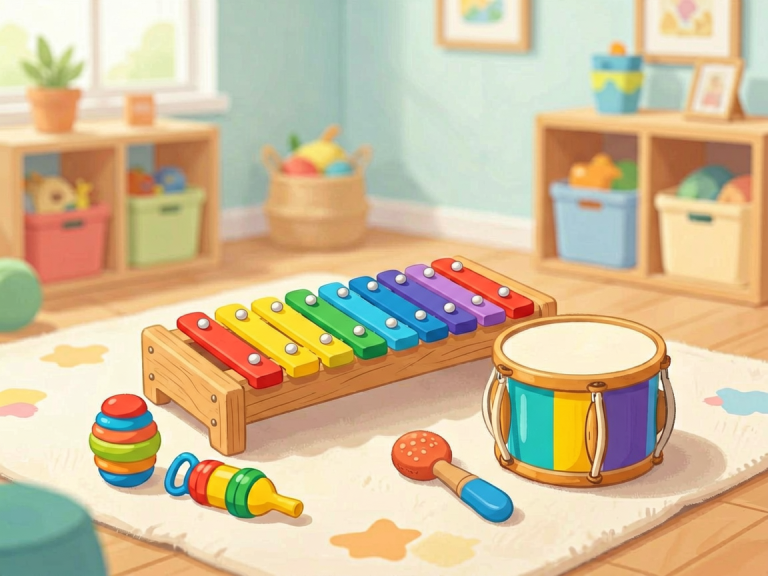
To illustrate the stark difference, consider two common toys for five-year-olds. Toy A is a plastic fire engine with a push-button siren. When tested with a calibrated meter, it produces 105 dB at the ear. The instruction manual says nothing about hearing safety. The packaging features a smiling child holding the toy next to his face. Toy B is a soft cloth book with crinkly pages and a sewn-in rattle that produces 55 dB. Both engage a five-year-old, but one carries a hidden risk. If a child plays with Toy A for just 15 minutes a day, the cumulative noise exposure over a year could damage hearing. Toy B, in contrast, can be used for hours without concern. This doesn’t mean all sound-producing toys are bad—a xylophone or bell set played at a reasonable distance can teach musical concepts and promote fine motor skills. The key is intentionality.
Common Myths About Toy Noise
- Myth: “If my child doesn’t complain, it’s fine.” Children rarely verbalize hearing discomfort because they have no baseline for comparison. They may only show fatigue or behavioral changes.
- Myth: “Toys for older children are louder, but my five-year-old only plays with age-appropriate toys.” Many toys marketed for ages 3+ actually produce adult-level noise. Always test regardless of labeled age.
- Myth: “I can just turn down the volume.” Many toys have no volume control, and even when they do, children may crank it up. Battery-powered toys often lose volume as batteries drain, but the initial high level remains dangerous.
- Myth: “Earplugs are the solution.” Not for play—earplugs can reduce sound clarity and hinder language learning. Instead, address the source.
Conclusion: A Quieter Path Forward
The noise levels in toys for five-year-olds are not merely a matter of preference; they are a public health concern that intersects with child development, education, and family well-being. As parents, we are bombarded with choices—toys that promise to teach letters, numbers, and social skills, often wrapped in flashing lights and shrieking sounds. Yet research consistently shows that the most effective learning tools for a five-year-old are often the simplest: a set of wooden blocks, a box of crayons, a cozy corner with books. These toys do not need batteries or decibels to capture a child’s imagination. By being aware of the risks, testing toys before purchase, and advocating for stricter regulations, we can preserve the gift of hearing for the next generation. Let us choose noise wisely—because once it is lost, silence can never be regained.