The Silent Danger: Understanding Toy Noise Levels and a Comprehensive Safety Guide
Introduction
The laughter of a child playing with a new toy is one of the most joyful sounds a parent can hear. Yet, behind that innocent delight, a hidden hazard may be lurking: excessive noise. Many toys, especially those with electronic sound effects, sirens, music, or repetitive noises, can produce sound levels that are dangerously high for young, developing ears. According to the World Health Organization, prolonged exposure to sounds above 85 decibels (dB) can cause permanent hearing damage. Many popular toys on the market today, from plastic rattles to toy trucks and musical instruments, have been measured at levels exceeding 100 dB when held close to the ear. This article provides a thorough, evidence‑based toy safety guide focused specifically on noise levels, helping parents, caregivers, and educators make informed choices to protect children’s auditory health while preserving the fun of play.
—
1. The Hidden Hazard: Why Toy Noise Levels Matter
Hearing loss is often a gradual, invisible process. Unlike a visible injury, damage to the delicate hair cells in the inner ear accumulates over time without obvious symptoms. Children are particularly vulnerable for several reasons. First, their ear canals are smaller and shorter than adults’, which can amplify sound pressure. Second, young children have a natural tendency to hold toys close to their faces, often directly next to their ears. A toy that seems moderately loud at arm’s length can become dangerously intense when pressed against the ear.
The impact of noise‑induced hearing loss (NIHL) extends far beyond hearing impairment. Research shows that children with untreated hearing loss face challenges in language development, academic performance, and social interaction. Even temporary threshold shifts—a feeling of muffled hearing after a noisy play session—indicate that the auditory system has been stressed. Because hearing damage is irreversible, prevention is the only effective strategy.
Moreover, the problem is not limited to obvious “loud” toys. Some toys, such as squeaky rubber ducks, plush animals with recorded lullabies, or electronic learning tablets, can produce continuous background noise at levels that are not immediately jarring but are still harmful over long periods. The cumulative effect of daily exposure to moderate noise from multiple toys can be just as dangerous as a single loud blast.
—
2. Decibel Danger: How Loud Is Too Loud?
To understand the risk, it helps to know how sound intensity is measured. Decibels use a logarithmic scale, meaning that each increase of 10 dB represents a tenfold increase in acoustic energy. Thus, a 90 dB sound is ten times more powerful than an 80 dB sound, and a 100 dB sound is a hundred times more powerful than 80 dB.
General sound reference levels:
- Normal conversation: 60–65 dB
- City traffic inside a car: 80–85 dB
- Power lawn mower: 90 dB
- Subway train: 100 dB
- Rock concert (front row): 110–120 dB
- Jet engine at takeoff: 140 dB
Safe exposure limits (according to the National Institute for Occupational Safety and Health, NIOSH):
- 85 dB: up to 8 hours per day (with protection)
- 88 dB: up to 4 hours
- 91 dB: up to 2 hours
- 94 dB: up to 1 hour
- 97 dB: up to 30 minutes
- 100 dB: up to 15 minutes
- 103 dB: up to 7.5 minutes
- 106 dB: up to 3.75 minutes
Now consider that many toys tested by independent safety organizations, such as the Sight & Hearing Association in the United States, have produced sound levels between 90 and 120 dB when measured at ear distance. For example, a toy police siren can hit 110 dB, and a toy drum or xylophone can exceed 105 dB when struck vigorously. A child who plays with such a toy for even 15 minutes at close range is at risk of permanent hearing damage.
Importantly, the distance at which a toy is held dramatically changes the exposure. A toy that produces 90 dB at 50 cm away may produce 100 dB at 10 cm away. Since children often hold toys right up to their ears, the actual exposure can be much higher than the manufacturer’s listed “safe” level, which is often measured at 50 cm or more.
—
3. Regulatory Standards and Safety Guidelines
Various countries and regions have established voluntary or mandatory standards for toy noise levels. However, enforcement and awareness vary greatly, and not all toys on the market comply.
United States: The Consumer Product Safety Commission (CPSC) sets guidelines under the Federal Hazardous Substances Act. Currently, the voluntary standard (ASTM F963) requires that toy noise levels not exceed 85 dB when measured at 50 cm for toys intended for children under 14 years. For close‑to‑ear toys like toy telephones, the limit is 65 dB. However, these standards are often poorly enforced, and many imported toys bypass testing. The Hearing Aid Council and the American Academy of Pediatrics (AAP) strongly recommend that parents treat any toy emitting continuous sound above 85 dB as hazardous.
European Union: The European Standard EN 71‑1 (Safety of Toys) also sets a limit of 85 dB for close‑to‑ear toys and 90 dB for other toys at 50 cm. The CE marking indicates compliance, but again, market surveillance is inconsistent.
China and other markets: Standards vary, but many toys are produced without adequate noise control. A 2022 study published in the journal *International Journal of Pediatric Otorhinolaryngology* tested 30 popular toys purchased online from China and found that 73% exceeded 85 dB when held at ear distance, with some reaching 118 dB.
Key takeaway: Relying solely on regulatory labels is insufficient. Parents must adopt a proactive, hands‑on approach.
—
4. Choosing Safe Toys: A Practical Guide for Parents
Ensuring that toys are safe from a noise perspective does not mean banning all electronic or sound‑producing toys. Instead, it requires informed selection and mindful use. Here is a step‑by‑step guide.
4.1. Listen Before You Buy
If possible, test the toy in the store. Hold it at arm’s length and listen. Does it make you want to wince? If the sound is uncomfortable for you, it is definitely too loud for a child. Even better, use a free smartphone decibel meter app to measure the sound level at the distance a child might hold it—about 10–15 cm from the ear. If it exceeds 85 dB, consider a quieter alternative.
4.2. Look for Volume Controls
Many toys now come with adjustable volume settings. Choose toys that have a low‑volume option or a “soft” mode. Avoid toys that have only one, fixed high volume. If the toy has a headphone jack, ensure the child uses headphones that are not themselves too loud—but generally, speakers are safer than earbuds for young children.
4.3. Avoid Toys with Sharp, Continuous High‑Frequency Noises
High‑pitched sounds, such as electronic beeps and whistles, are often more damaging than lower‑frequency sounds at the same decibel level because they resonate more easily in the small ear canal. Toys that produce repetitive, piercing sounds (like some electronic learning toys for infants) are a particular concern.
4.4. Check for Impact‑Sound Toys
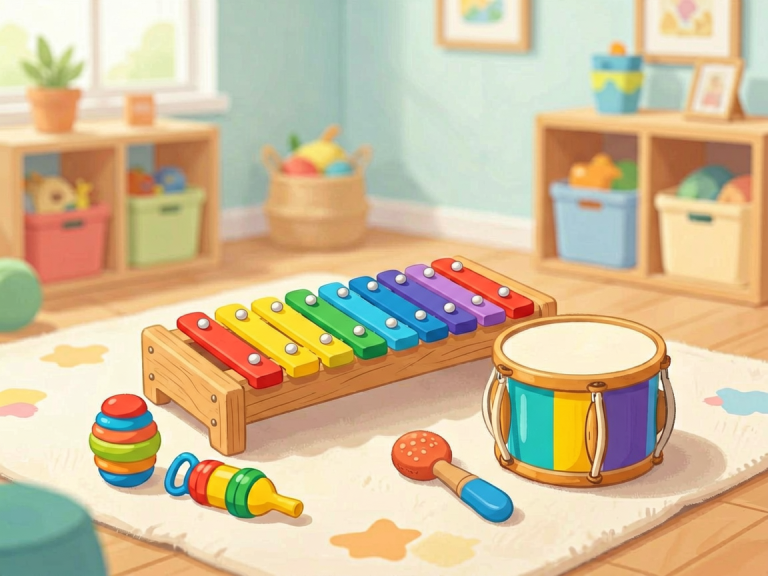
Toys that involve banging, such as drums, xylophones, and toy hammers, can produce impulsive sounds that exceed 100 dB. While playing music is beneficial, choose instruments made of softer materials (e.g., rubber mallets) and encourage children to play on soft surfaces to dampen sound. Some xylophones have foam strikers instead of wood or plastic.
4.5. Read Reviews and Independent Test Results
Organizations like the Sight & Hearing Association (USA), Hearing Loss Association of America, and consumer safety blogs publish annual lists of noisy toys. Before purchasing a popular electronic toy, search for “noise level test” reviews. Many parents have shared their own measurements online.
4.6. Consider the Age of the Child
Infants and toddlers are especially vulnerable because they cannot remove a loud toy from their own ears. For children under three, choose toys that produce soft, natural sounds (e.g., rattles with gentle beads, cloth blocks, or quiet musical mobiles). Avoid any toy with a speaker that can be placed directly against the ear.
—
5. Tips for Reducing Noise Exposure at Home
Even after careful selection, some noise exposure is inevitable. Here are practical strategies to mitigate risk:
- Use the “10‑Centimeter Rule”: Whenever a child picks up a toy, instinctively place your hand between the toy and their ear. This simple barrier can reduce sound levels by 10–15 dB.
- Set Time Limits: If a toy is moderately loud (80–85 dB), limit play to 30 minutes per session. Use a timer and alternate with quiet activities.
- Create a Quiet Play Zone: Designate an area of the home where noisy toys are not allowed. This provides a break for the ears.
- Remove Batteries or Tape the Speaker: For toys that are otherwise loved but too loud, you can often reduce the volume by partially covering the speaker with a piece of tape or by removing one battery to lower power (if safe to do so). Some toys have a small screw that allows you to adjust the internal volume.
- Educate Older Children: Teach children ages five and up about the importance of protecting their ears. Show them how to hold toys away from their faces and encourage them to tell you if a toy sounds “too loud” or hurts their ears.
—
6. Conclusion: Prioritizing Hearing Health in Play
Toys are meant to inspire joy, creativity, and learning—not to cause harm. Unfortunately, the combination of powerful audio components, small ear canals, and a lack of regulation means that many toys on the market pose a real risk to children’s hearing. The good news is that parents and caregivers have the power to significantly reduce this risk through education, careful selection, and mindful supervision.
The toy noise levels safety guide presented here emphasizes that prevention is the most effective tool. By testing toys before purchase, choosing those with volume control, limiting playtime, and teaching children healthy listening habits, we can protect the precious sense of hearing while preserving the pleasure of play. Let us all commit to making “safe sound” as important as “safe materials” in our toy safety considerations. After all, a child’s laughter is the sweetest noise of all—and it should never be drowned out by the danger of a toy that is just too loud.