Safety Checklist for Science Kits for Babies: A Parent’s Essential Guide
Introduction: Why Safety Must Come First
The image of a baby peering curiously at a bubbling test tube or touching a soft, colorful gel might seem adorable, but the reality of science kits for infants and toddlers is far more nuanced. Unlike kits designed for school-age children, science kits for babies—often marketed as “STEM sensory toys” or “first lab sets”—must meet radically different safety standards because the intended user is an infant who explores the world through mouthing, grasping, shaking, and throwing. A baby’s skin is thinner, their immune system is immature, and their airways are smaller. Therefore, a standard chemistry set or a kit with small magnets can become a life-threatening hazard in seconds. This article offers a comprehensive, research-informed safety checklist for parents, caregivers, and gift-givers. By following these guidelines, you can ensure that your baby’s first encounter with science is joyful, curious, and—above all—safe.
1. Material Toxicity and Non-Toxic Certification
1.1 Look for “Non-Toxic” and “Food-Grade” Labels
The single most critical item on any safety checklist is the chemical composition of every component. Babies put everything into their mouths. A science kit for a baby should contain only materials that are explicitly labeled non-toxic, and preferably food-grade or edible-grade. This includes not just the “experiment” substances, but also the packaging, the instruction cards, and the container itself. Check for certifications such as ASTM F963 (the U.S. standard for toy safety), EN71 (European safety standard), and the CE mark. Avoid kits that contain any artificial dyes, fragrances, or preservatives, as these can trigger allergic reactions or toxic effects if ingested in large quantities.
1.2 Beware of Hidden Toxins in Plastics and Rubbers
Even if a kit claims to be “natural,” the plastic components may contain phthalates, bisphenol A (BPA), or lead. Always verify that plastics are BPA-free, phthalate-free, and lead-free. Soft vinyl or rubber parts are particularly suspect. Look for the recycling codes #1 (PET), #2 (HDPE), #4 (LDPE), and #5 (PP) which are generally considered safer. Avoid #3 (PVC) and #7 (other) unless specifically labeled as safe for food contact. A simple litmus test: if it smells strongly of chemical plastic, it is not safe for a baby.
2. Choking Hazard and Small Parts
2.1 The Universal Choking Tube Test
All science kits for babies must be for infants under three years old, which means they must comply with the “small parts” regulation. Any part that fits entirely inside a standard choke tube (a cylinder with a diameter of 1.25 inches or 3.17 cm and a depth of 2.25 inches) is a choking hazard. Before buying, inspect the kit visually. If you see beads, screws, caps, pipettes, or even small measuring spoons, do not buy them. For babies, the entire kit should be one solid, molded piece or composed of large, inseparable components. If a piece can be detached, it can be swallowed.
2.2 Pay Attention to Loose Fibers and Filling
Some sensory science kits include “snow” powder, foam beads, or fibrous materials that expand when water is added. These are extremely dangerous because they can swell in a baby’s airway or stomach. Even if the package says “edible,” avoid any substance that changes volume dramatically. Similarly, avoid kits with loose cotton, wool, or synthetic stuffing that can be pulled apart and aspirated. A safe kit uses one-piece silicone, wood, or hard plastic shapes that are too large to fit in the mouth.
3. Choking and Suffocation – Beyond the Mouth
3.1 Check for Detachable Batteries and Magnets
Many modern “science kits” include electronic elements such as lights, buzzers, or small motors. While these are attractive, they often contain button batteries. If a baby swallows a button battery, it can cause severe internal burns and death within two hours. No science kit for a baby should have a battery compartment that can be opened without a screwdriver. Even better, avoid electronics altogether for babies under 12 months. Similarly, magnets—even small round ones—are catastrophic if swallowed two or more, as they can pinch intestinal walls. The safest rule: zero magnets, zero batteries.
3.2 Suffocation from Plastic Bags and Thin Films
The kit’s packaging is part of the product. Clear plastic bags can cover a baby’s face and cause suffocation. Always remove and discard all packaging before giving the kit to your baby. Additionally, ensure that any instruction booklet or laminated card is not printed on thin, crinkly plastic sheets that could tear into pieces small enough to aspirate. The kit itself should not include plastic film or balloons. Latex balloons are a notorious cause of choking and suffocation deaths in infants.
4. Physical and Mechanical Safety
4.1 No Sharp Edges, Points, or Pinch Points
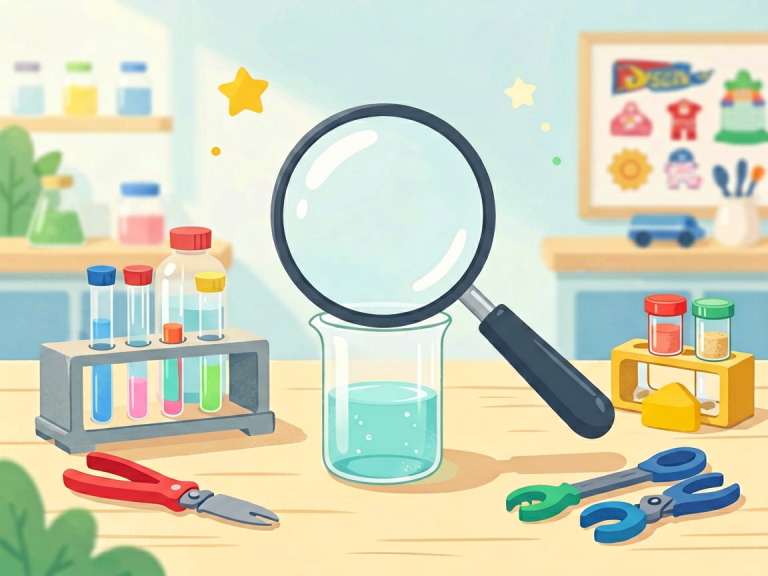
Science kits for babies often feature beakers, magnifying glasses, or “experiment tubes.” Avoid anything made of glass. Glass breaks easily and creates razor-sharp shards. Instead, look for thick, unbreakable polycarbonate or silicone. Additionally, inspect all edges and corners of plastic or wooden components. They should be rounded and smooth, with no burrs or rough seams. Test any moving parts—such as spinning gears or levers—to ensure that a baby’s finger cannot be pinched or trapped. Hinges and lids should have a slow-close mechanism or be too stiff for a baby to open.
4.2 Size, Weight, and Drop Safety
A science kit for a baby will inevitably be thrown on the floor, dropped on a toe, or swung around. The kit must be lightweight enough that it cannot cause injury if dropped from a crib or highchair. A good rule: no component should weigh more than 1% of the baby’s body weight. Also, the kit should be structurally robust—if it cracks or shatters when dropped, it produces dangerous fragments. Test the sturdiness by pressing on the exterior. If it flexes too much or has hollow cavities, it may break.
5. Hygiene and Cleanability
5.1 Molds, Mildew, and Bacteria
Babies will drool on their science kits. They will also put the kit down on the floor, then back into their mouths. Therefore, every part must be washable. Avoid kits with porous materials such as untreated wood, cardboard, or foam that absorb liquid and cannot be fully dried. Mold can grow inside a baby’s toy within 48 hours if moisture is trapped. Look for kits that are explicitly “dishwasher safe” or “top-rack dishwasher safe” or that can be boiled or sterilized. Silicone, food-grade plastic, and sealed hardwood are excellent choices. Never buy a kit with paper or cardboard components that are essential to the “experiment,” as those cannot be cleaned.
5.2 No Liquid Reservoirs That Cannot Be Drained
Some sensory science kits include sealed tubes with glitter, oil, or water. If the seal breaks, the liquid may leak and grow bacteria. Even if the seal holds, the inner liquid can become a breeding ground if the kit is heated or frozen. Check that any liquid-filled component is double-sealed and has no removable plug. If in doubt, skip it. The safest science kit for a baby uses no liquids at all—or only liquids that are added by the parent at the moment of use and discarded immediately.
6. Age Appropriateness and Developmental Fit
6.1 The Difference Between “Toddler” and “Baby”
The label “for babies” is often vague. A kit designed for a 3-year-old is not safe for a 6-month-old. The safety checklist must be calibrated to your baby’s individual stage of motor development. If your baby is at the stage of raking, poking, or pounding, the kit should be very simple: a few large, soft, low-contrast shapes. If your baby can sit up and pull objects, avoid anything with strings, cords, or long ribbons that could wrap around the neck. If your baby can crawl, the kit must be able to survive being used as a stepping stool. Always buy a kit that is specifically labeled for “0–12 months” or that has been third-party tested for “infant” use.
6.2 Supervision Is Not Optional
No checklist can replace active, attentive adult supervision. A science kit for a baby should be used as an interactive activity between parent and child, not as a solitary entertainment device. Even with the safest kit, you must watch for signs of fatigue, frustration, or teething pain—a baby might start chewing on a piece that was previously safe. Set clear time limits and remove the kit immediately if any part shows signs of damage, such as cracks, bite marks, or loose seams. Regularly re-inspect the kit before every use. A damaged safe kit becomes an unsafe kit.
7. Instruction for Parents: The Invisible Component
7.1 Read the Full Manual and Follow Allergy Warnings
Many science kits include a small booklet that describes the “experiment.” This booklet is not just for fun; it will list potential allergens. For example, a kit may include wheat flour, cornstarch, or nut oils to simulate “scientific goo.” If your baby has a known allergy or a family history of food allergies, avoid any kit that contains food-derived ingredients, even if they are “non-toxic.” Also, check the manual for warnings about interactions with lotions, soaps, or medications. Some substances may be safe when swallowed but harmful if they come into contact with broken skin.
7.2 Disposal and Storage Safety
The checklist extends to how the kit is stored and disposed of after use. Store the kit out of reach when not in use, in a lidded container that a baby cannot open. Do not leave the kit in direct sunlight or high temperatures, as some plastics can warp or release chemicals. If the kit uses a consumable substance (like a powder or gel), discard all leftovers in a tightly sealed trash bag, not in a diaper bin that a pet or another child might access. Thoroughly wash your own hands and the baby’s hands after the activity, and wash any fabric surfaces that the kit touched.
8. Third-Party Certification and Recalls
8.1 Check for CPSC Recalls and Independent Tests
Before purchasing, search the Consumer Product Safety Commission (CPSC) recall database or the equivalent agency in your country. Many popular “science kits for babies” have been recalled due to choking or burn hazards. A recall check is fast and can prevent a tragedy. Also, look for seals from independent testing organizations such as Underwriters Laboratories (UL), ASTM, or JPMA. Avoid knockoff brands sold on marketplaces without clear company names. Always read recent customer reviews, but be aware that a product with a few glowing reviews may be new, so check its history.
8.2 Trust but Verify: The “Smell, Feel, Sound” Test
Finally, do your own physical verification when the kit arrives. Smell it—if there is a strong chemical odor, return it. Feel every surface with your fingertips—if you feel a rough edge, a tiny seam, or a protruding screw, return it. Shake the kit near your ear—if there are small loose pieces rattling inside, return it. Squeeze each component—if it crunches, creaks, or deforms excessively, return it. This five-minute test is your last defense against hidden manufacturing defects.
Conclusion: The Joy of Safe Exploration
A science kit for a baby can be a magical gateway to a lifetime of curiosity. It can teach cause and effect, color recognition, and the sheer pleasure of making something happen. But this magic only works when safety is built into every layer of the product. The checklist above is not meant to scare you, but to empower you. In a world of endless consumer choices, a well-informed parent is the baby’s best-protector. Remember: the safest science kit for a baby is not the one with the most flashy lights or the cleverest name—it is the one that survives every test of toxicity, durability, and cleanliness, and that allows you to sit beside your baby, saying “Look what happens!” while both of you stay perfectly, gloriously safe. So read labels, check recalls, run your fingers over every edge, and then enjoy the wonder. That is the true spirit of science: exploration without harm.