Introduction
Article Title: Are Wooden Blocks Worth It for Fine Motor Skills? A Deep Dive into Tactile Learning and Developmental Benefits
In an era dominated by glowing screens, plastic buttons, and digital interfaces, the humble wooden block can seem almost archaic—a relic of a bygone childhood. Yet parents, educators, and occupational therapists continue to advocate for this timeless toy. One of the most frequently cited benefits is the development of fine motor skills. But is this claim supported by evidence? Are wooden blocks genuinely superior to their modern counterparts—like magnetic tiles, LEGO bricks, or even tablet-based stacking games—when it comes to refining the small muscle movements in a child’s hands and fingers? This article explores the neurological, physiological, and developmental underpinnings of fine motor skill acquisition, evaluates the unique properties of wooden blocks, and weighs their worth against alternative options. By the end, you will have a comprehensive understanding of whether investing in a set of wooden blocks is a smart move for your child’s motor development—or just another trend in the crowded world of educational toys.
—
Understanding Fine Motor Skills: More Than Just “Small Movements”
Before we can judge the value of wooden blocks, we must first understand what fine motor skills entail. Fine motor skills refer to the coordination of small muscles—especially those in the hands, fingers, and wrists—in conjunction with the eyes. These skills are foundational for tasks such as writing, buttoning a shirt, using scissors, tying shoelaces, and manipulating small objects. They develop in a predictable sequence, starting with gross motor control (whole-arm movements) and gradually refining into precise, isolated finger movements.
Crucially, fine motor development is not merely about physical dexterity. It is deeply intertwined with cognitive processing, spatial reasoning, hand-eye coordination, and even language development. When a child picks up a small wooden block and attempts to balance it on top of another, the brain is simultaneously calculating weight, gravity, position, and tactile feedback. The hand receives real-time sensory data—pressure, texture, temperature—and adjusts its grip accordingly. This sensorimotor loop is far more complex than it appears, and it is exactly this complexity that makes certain toys more effective than others.
—
Why Wooden Blocks Stand Out: Texture, Weight, and Resistance
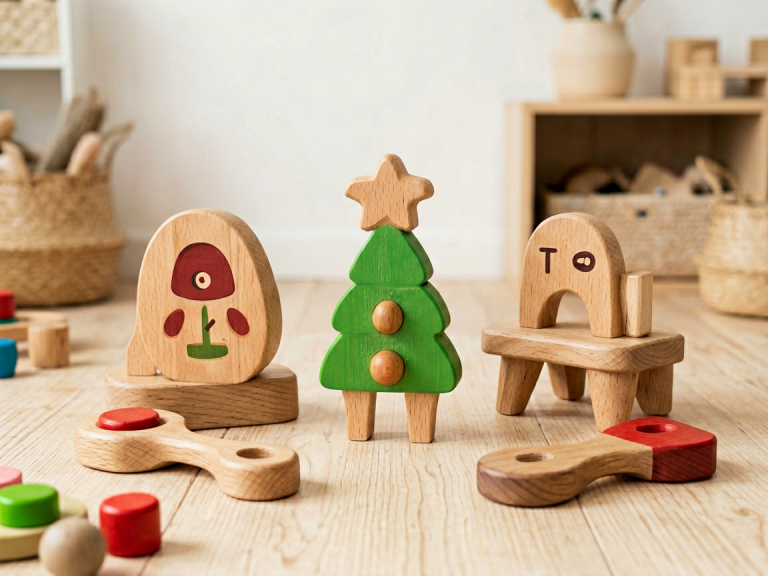
One of the most compelling arguments for wooden blocks lies in their physical properties. Unlike plastic blocks, which are often lightweight, smooth, and uniform, wooden blocks offer a rich sensory experience. Their natural grain provides subtle variations in texture, which stimulate the tactile receptors in the fingertips. This is not a trivial detail; studies in pediatric occupational therapy have shown that varied tactile input enhances neural pathway development in the somatosensory cortex. In other words, the more textures a child’s fingers explore, the more robust the brain’s mapping of touch becomes.
Moreover, wood has a distinct weight. A typical wooden block is denser than a plastic one of the same size. This weight provides meaningful resistance when a child grasps, lifts, stacks, or carries the block. Resistance is crucial for developing the intrinsic muscles of the hand—the small muscles that control finger flexion, extension, and opposition. When a child picks up a lightweight plastic block, the hand barely has to work; the grip can be lax. But a wooden block demands a more deliberate, controlled grip, engaging the thenar and hypothenar eminences, the lumbricals, and the interossei muscles. Over time, repeated exposure to this resistance strengthens the hand, laying the groundwork for more refined skills like pencil grip.
—
Comparative Analysis: Wooden Blocks vs. Popular Alternatives
To determine whether wooden blocks are “worth it,” we must compare them to other common fine motor toys.
1. Wooden Blocks vs. LEGO Bricks
LEGO bricks are undeniably popular and do promote fine motor skills—specifically the pincer grasp needed to press two bricks together. However, LEGO bricks require a very specific, repetitive motion. They snap together with a satisfying click, but this action is largely uniform. Wooden blocks, by contrast, require a wider variety of grasps: palmar grasp for large blocks, pincer grasp for small ones, and even a whole-hand grip for carrying. The lack of a locking mechanism means that stacking involves careful alignment and balance, which demands more precise motor control. Furthermore, the friction between wooden surfaces is different from the tight fit of LEGO. A slight misalignment can cause a tower to fall, teaching the child to adjust their movements in real time.
2. Wooden Blocks vs. Magnetic Tiles
Magnetic tiles are easy to connect—magnets do most of the work. This reduces the fine motor challenge considerably. While magnetic tiles are excellent for teaching geometry and creativity, they offer less resistance and less tactile variety than wood. The magnets also remove the need for precise alignment; tiles can be connected even when placed at a slight angle. For a child who is still developing fine motor control, this ease can actually be a disadvantage. Wooden blocks demand more accuracy, effort, and persistence.
3. Wooden Blocks vs. Digital Stacking Apps
Some parents turn to tablet-based stacking games, arguing that the digital version is more engaging and mess-free. However, from a fine motor perspective, digital interactions are fundamentally different. Tapping a screen uses limited finger movements—usually a single index finger or thumb. There is no haptic feedback, no weight, no resistance, and no need to coordinate multiple fingers. The neural pathways activated by digital manipulation are far narrower than those activated by handling physical objects. Research published in the *Journal of Developmental & Behavioral Pediatrics* indicates that children who spend more time on touchscreens show delayed fine motor development compared to those who engage in hands-on construction play. Wooden blocks, therefore, offer a clear sensory advantage that screens cannot replicate.
—
The Role of Open-Ended Play and Problem Solving
Another dimension where wooden blocks excel is in their open-ended nature. Unlike a puzzle with a single correct solution, wooden blocks can be stacked, sorted, lined up, knocked down, or used as pretend objects (a block can be a phone, a car, or a cookie). This versatility requires the child to constantly adapt their motor plan. For instance, building a bridge involves different hand positions than building a tower. Rotating a block to fit a gap requires wrist pronation and supination—movements that are critical for later skills like using a screwdriver or turning a doorknob.
Moreover, the process of trial and error—where a block falls and must be picked up again—reinforces the development of palmar arches and thumb opposition. Each time a child retrieves a fallen block, they practice the coordinated motion of reaching, grasping, and stabilizing. Repetition is key to motor learning, and wooden blocks naturally encourage repeated attempts because they are forgiving: they won’t break, and they can be stacked indefinitely.
—
Scientific Evidence: What Research Says
Several studies have directly examined the relationship between block play and fine motor outcomes. A 2018 study published in the *American Journal of Occupational Therapy* compared the effects of structured block play versus free play on fine motor precision in preschoolers. The group that engaged in daily block play for 20 minutes showed significant improvements in the Bruininks-Oseretsky Test of Motor Proficiency, particularly in manual dexterity and upper-limb coordination. The researchers noted that the varying sizes and shapes of wooden blocks forced children to adjust their grips continuously.
Another longitudinal study from the University of Denver followed children from age 2 to 5 and found that those who played with blocks (both wooden and plastic) had better fine motor skills at age 5 than those who did not. However, the study also noted that wooden blocks were associated with longer sustained play times and more complex constructions. The authors hypothesized that the natural feel and weight of wood contributed to greater engagement, which in turn led to more practice.
Occupational therapists frequently recommend wooden blocks for children with fine motor delays. The slow slippage caused by a block’s slight roughness provides important proprioceptive feedback. Dr. Emily Klein, a pediatric OT based in Chicago, states: “I often use wooden blocks to help children with weak hand arches. The weight of the wood forces them to use their entire hand, not just their fingers. Plastic blocks just don’t give that same resistance.”
—
Considerations and Potential Drawbacks
No toy is perfect, and wooden blocks do have limitations. They can be expensive compared to plastic alternatives. They are also heavier, which might be a safety concern for very young children who are prone to throwing. Splinters are a risk with low-quality blocks, but high-quality, sanded hardwood blocks are safe. Additionally, wooden blocks are not as colorful or visually stimulating as some plastic sets, which might affect a child’s initial interest. However, in terms of fine motor development, these drawbacks are minor. The natural wood grain actually helps children focus on shape and size rather than superficial color, promoting deeper cognitive processing.
Another consideration is the age of the child. For infants under 12 months, lightweight fabric blocks or soft foam blocks are safer for grasping and mouthing. But from around 12 to 18 months onward, wooden blocks become highly beneficial. For older children (ages 4–7), adding smaller blocks or differently shaped blocks (cylinders, triangles, arches) can continue to challenge fine motor skills as they attempt more intricate constructions, such as building with symmetry or following a pattern.
—
Conclusion: Are Wooden Blocks Worth It?
The evidence strongly suggests that wooden blocks are not only worth it but are arguably one of the most effective toys for developing fine motor skills in children between the ages of one and seven. Their unique combination of weight, texture, resistance, and open-ended play provides a sensory and motor-rich experience that is difficult to replicate with plastic, magnetic, or digital alternatives. While they may not be the only tool needed in a child’s developmental toolbox, they are a foundational one. In an age where children’s hands are increasingly drawn to smooth, passive screens, the active, demanding nature of wooden blocks offers a necessary counterbalance. They teach the hand to work, the eyes to measure, and the brain to adapt—one cooperative, slightly imperfect stack at a time. For any parent or educator wondering whether to invest in a set of wooden blocks, the answer is clear: pick them up. Your child’s fine motor skills will thank you.