Beyond the Screen: Open-Ended Alternatives to Learning Tablets
In classrooms and living rooms across the globe, the learning tablet has become a symbol of modern education. Sleek, portable, and brimming with interactive apps, these devices promise to turn every moment into a learning opportunity. Yet as their popularity has soared, so has a quiet but growing concern among educators, psychologists, and parents: are these digital tutors actually limiting the very skills they claim to foster? Learning tablets often deliver pre‑packaged content with fixed right‑or‑wrong answers, guided by algorithms that nudge children along a linear path. But true learning thrives on ambiguity, experimentation, and the freedom to fail. This essay explores a range of open‑ended alternatives—physical, digital, and experiential—that invite children to ask their own questions, build their own worlds, and discover that the most profound lessons are rarely found behind a glass screen.
The Case Against Learning Tablets
Before we can appreciate alternatives, we must understand what makes learning tablets problematic. Most educational apps are designed around a narrow model of “gamified instruction”: a child taps a correct answer, earns a star, and moves to the next level. This approach excels at drilling rote facts—spelling, math facts, geography trivia—but it rarely nurtures creativity, critical thinking, or deep engagement. The interface is inherently closed: the app defines the problem, the steps, and the acceptable solution. A child who tries to build a bridge out of virtual blocks in a physics app, for instance, can only use the pre‑supplied materials and geometries; there is no way to invent a bizarre contraption that defies the app’s code but works in reality.
Moreover, screen time itself carries well‑documented risks: reduced physical activity, disrupted sleep, and diminished face‑to‑face social interaction. The passive consumption of animated content—even “educational” videos—often replaces the messy, tactile, sensory‑rich experiences that young brains need to develop strong neural connections. Learning tablets also isolate children from one another; two children each staring at their own screen rarely collaborate, argue, or negotiate in the way they do when building a fort or solving a real‑world puzzle together. The tablet is a one‑way conversation, not a dialogue with the world.
What Makes an Alternative “Open‑Ended”?
An open‑ended learning tool is one that has no single correct outcome. It provides raw materials—physical, conceptual, or digital—and invites the user to explore, combine, transform, and create. The process is inherently circular: you try something, observe what happens, adjust, and try again. Failure is not a dead end but a source of data. In open‑ended environments, a child might spend an hour constructing an unstable tower of cardboard tubes, watch it collapse, and then redesign it with a broader base—learning physics through direct, repeated experience. The tool does not measure success by a test score; it measures success by what the child discovers.
Open‑ended alternatives also tend to be low‑tech or no‑tech, though some clever digital tools can be open‑ended as well (we will explore them later). They encourage ownership: the child decides the goal. And they almost always involve the hands, the body, and the senses—touching, smelling, hearing, moving. This multisensory engagement builds deeper memory and understanding than tapping a screen ever can.
Hands‑On Construction: Building Blocks and Beyond
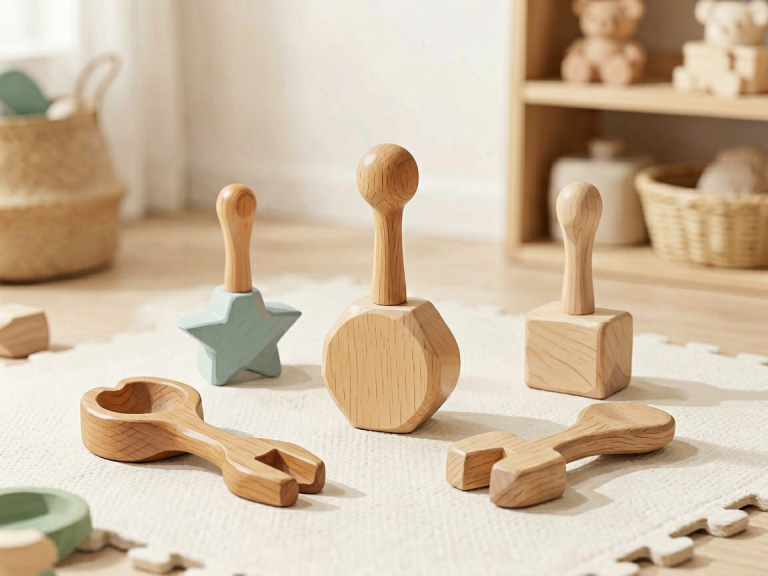
The classic open‑ended learning tool is the building block. Simple wooden unit blocks, LEGO bricks, magnetic tiles, and cardboard construction kits all allow children to design anything from a castle to a spaceship to an abstract sculpture. Unlike a pre‑designed LEGO set that instructs you step‑by‑step to build a specific model, loose blocks are a blank canvas. A four‑year‑old who stacks two blocks and calls it a “dog” is exercising symbolic thinking; a ten‑year‑old who builds a cantilevered bridge is grappling with real structural forces. The beauty of blocks is that they are infinitely reconfigurable. A structure that falls can be rebuilt differently. There is no “game over” screen, no score, no external reward—just the intrinsic satisfaction of making something that stands.
Beyond blocks, consider clay, sand, water, and wood. A bowl of wet sand on a tray becomes a landscape, a dam, a mountain. A lump of clay can be pinched into a bowl, then smashed and re‑formed into a coil pot. Woodworking with safe tools—sandpaper, gouges, soft pine boards—lets children shape a material that resists and yields, teaching patience and persistence. These activities require focus, fine motor control, and spatial reasoning, all of which are under‑developed in screen‑heavy routines. They also produce tangible objects: a child can hold, show, and modify a physical creation, gaining a sense of agency that a digital image cannot provide.
Creative Expression: Art, Music, and Making
Open‑ended creativity flourishes when children have unrestricted access to art materials. A box of markers, watercolors, glue, scissors, recycled paper, fabric scraps, and natural objects like leaves and twigs is a far richer learning environment than a drawing app. Digital drawing tools offer unlimited undo and perfect symmetry, but they rob children of the tactile feedback of a brush on paper, the smell of paint, the frustration of a smudged line that forces a creative detour. In a purely physical art session, there is no “right” way to draw a tree. The child must decide how to mix colors, whether to tear or cut paper, how to assemble a collage. Each decision is a small act of authorship.
Music is another powerful open‑ended domain. A simple xylophone, a set of hand percussion instruments, or even a piano keyboard (acoustic, not a touch‑screen) invites exploration of rhythm, pitch, and composition. Unlike a music‑learning app that directs a child to tap highlighted notes in sequence, real instruments let a child discover that striking a triangle makes a beautiful shimmer, or that pressing a low key on the piano creates a rumble that vibrates through the floor. Improvisation—playing whatever sounds good—builds confidence and an intuitive understanding of musical structure. Similarly, building a cardboard guitar with rubber bands or a rainstick from a tube and seeds combines art and physics in a deeply satisfying way.
Cooking and gardening are also open‑ended learning experiences. Measuring ingredients, watching dough rise, tasting a new herb from the garden—these activities involve science, math, and sensory exploration. A child who bakes bread may ask why yeast makes bubbles, and then experiment with different amounts of sugar and salt. There is no standardized test for bread‑making; the evaluation is whether the loaf is edible and delicious—a wonderfully authentic form of assessment.
Nature and Outdoor Exploration
Perhaps the ultimate open‑ended learning environment is the natural world. A forest, a beach, a backyard, or even a city park is overflowing with variables, patterns, and mysteries. When a child turns over a log to find pill bugs and earthworms, they are not studying a pre‑recorded video about decomposition—they are witnessing it firsthand. They might wonder why the sow bugs curl into balls, then design a simple experiment by dropping a leaf next to them to see if they uncurl. Nature provides no instructions, no levels, no hints. It is relentlessly open‑ended.
Outdoor learning can be structured with simple tools: a magnifying glass, a notebook, a field guide. Children can collect and classify leaves, build a tiny dam in a stream, observe the flight path of a bee, or sketch the clouds. These activities cultivate observation skills, patience, and scientific thinking. They also ground children in the real rhythms of life—seasons, weather, growth, decay—counteracting the artificial, instant‑gratification world of screens. Furthermore, outdoor play is naturally social: children negotiate who gets to hold the butterfly net, collaborate on building a stick fort, and invent games that no app could contain.
Digital Yet Open: Coding and Programming Tools
Not all digital tools are closed. Some platforms are designed to be genuinely creative and open‑ended. Scratch, developed at MIT, lets children program their own stories, games, and animations by snapping together code blocks. Unlike a “learn to code” app that walks a child through a fixed set of tasks, Scratch is a blank canvas. A child can create a simple bouncing ball, or a complex multi‑level game with custom characters, sound effects, and scoring. The only limit is imagination and problem‑solving. Because Scratch runs in a browser and is free, it is widely accessible, but it is best used on a laptop or desktop—not a tablet—because the drag‑and‑drop interface benefits from a larger screen and a mouse.
Similarly, tools like Makey Makey (which turns everyday objects into touch‑sensitive controls) and micro:bit (a programmable microcontroller) bridge the digital and physical worlds. A child can build a banana piano, a cardboard arcade game, or a plant moisture sensor. These projects require troubleshooting, iterative design, and collaboration. They are open‑ended because the child defines the goal, and the technology is merely a medium for expression. The key difference from a learning tablet is that the outcome is not predetermined: a child using a micro:bit might end up building a light‑up costume, a weather station, or a robot that draws spirals.
The Social and Emotional Benefits
Open‑ended alternatives naturally support social and emotional development, which learning tablets often undermine. When two children build a fort together, they must communicate, negotiate roles, share materials, and resolve conflicts. They learn to listen to ideas, offer compromises, and celebrate shared achievements. In a tablet‑based “multiplayer” game, interaction is often limited to short messages or competitive scoring; miscommunication is common, and the physical presence of the other child is absent. Open‑ended physical play, by contrast, requires real‑time empathy and cooperation.
Furthermore, open‑ended activities teach resilience. A child who spends an afternoon constructing a cardboard castle only to have it collapse just before dinner has experienced a genuine setback. There is no “retry” button. But there is the opportunity to reflect, to understand why it fell, and to decide whether to rebuild. This process builds emotional regulation, frustration tolerance, and a growth mindset. The child learns that failure is not shameful but informative. Learning tablets, with their endless hints, easy retries, and instant rewards, rarely cultivate this kind of grit.
Conclusion: Reclaiming the Joy of Discovery
Learning tablets are not without value. They can provide access to information, support children with special needs, and offer practice in specific skills. But when they dominate a child’s learning landscape, they risk turning education into a series of closed transactions. The real world—with its messy, unpredictable, open‑ended possibilities—is a much richer classroom. By choosing blocks over apps, paintbrushes over styluses, and mud puddles over virtual playgrounds, we invite children to become active creators rather than passive consumers. We let them ask their own questions, make their own mistakes, and feel the deep satisfaction of building something that is truly theirs. In an age of algorithms, the most radical gift we can give a child is the freedom to learn without a script.