Beyond the Brick: The Best Alternatives to LEGO-Style Building Blocks for Creative Minds
Introduction: Why Look Beyond LEGO?
For decades, LEGO has reigned supreme in the world of construction toys. Its iconic interlocking bricks, precise engineering, and vast array of themes have captured the imaginations of children and adults alike. Yet, as the brand’s prices continue to rise, licensing deals inflate set costs, and some collectors seek more specialized or challenging building experiences, the search for the best alternatives to LEGO-style bricks has never been more relevant. Whether you are a parent on a budget, a hobbyist craving higher detail, an educator wanting more flexibility, or simply someone who loves the satisfaction of snapping two pieces together but wants to try something new, there is a vibrant universe of building systems waiting for you. This article explores the top contenders that rival, complement, or even surpass LEGO in specific areas, examining their unique features, quality, and value.
1. Mega Construx (formerly Mega Bloks): The Top All-Round Challenger
When discussing alternatives, Mega Construx (owned by Mattel) is often the first name that comes to mind. Originally launched as Mega Bloks, the brand underwent a significant rebranding and quality overhaul, positioning itself as a direct competitor to LEGO in the licensed construction segment.
- Compatibility and Quality: Mega Construx bricks are largely compatible with LEGO bricks, though the clutch power (the grip between bricks) is slightly different. The plastic is marginally softer, which some builders find easier to press together, especially for small hands. The color palette is vibrant, and the mini-figures—particularly those based on *Halo, Masters of the Universe, Pokémon,* and *Call of Duty*—are highly detailed with multiple points of articulation.
- Unique Strengths: Where Mega truly excels is in its licensed miniature figures. For example, their *Halo* line includes incredibly detailed Spartans with interchangeable armor and weapons, often surpassing LEGO’s own figure design in realism. The *Masters of the Universe* sets are beloved for their nostalgia and sculpted pieces.
- Weaknesses: The instruction manuals can occasionally be less clear than LEGO’s gold standard. The bricks themselves, while durable, may lose clutch power over multiple rebuilds faster than genuine LEGO. However, for the price—often 30–50% less than comparable LEGO sets—Mega Construx remains the strongest direct alternative.
2. COBI: The Precision Choice for Military and Historical Builders
For those who demand sharp historical accuracy and a unique building experience, COBI (a Polish manufacturer) has carved a niche that LEGO has largely avoided. COBI focuses almost exclusively on military, naval, and historical subjects, operating under licenses from manufacturers like Jeep, Mercedes-Benz, and even the Polish Army.
- Design Philosophy: Unlike LEGO’s often whimsical or science-fiction approach, COBI bricks are designed to replicate real-life vehicles and scenes with stunning fidelity. Their tanks, aircraft carriers, and vintage cars feature printed bricks (no stickers!) with exquisite detail. The building system uses a unique “click” mechanism that feels slightly tighter than LEGO.
- Quality and Stiffness: COBI bricks are noticeably stiffer than both LEGO and Mega. This is intentional: their models are built to be display pieces that do not fall apart easily. The mini-figures have a distinct design with longer legs and more realistic facial expressions, which some collectors love and others find less charming.
- Target Audience: COBI is the best alternative for adults and older children interested in history, engineering, or military dioramas. Their sets include detailed instructions, often with historical context. The brand has also begun producing civilian vehicles (like the *Fiat 126p* or the *VW Beetle*), making it a strong option for car enthusiasts. The downside? The price point is comparable to LEGO, and the stiffness can be frustrating for younger builders.
3. Oxford Blocks: The Affordable Korean Alternative with Educational Roots
Originating from South Korea, Oxford Blocks (from the company Oxford) has been a household name in Asia for decades. It offers a unique blend of affordability and educational focus.
- Market Position: Oxford is the largest construction toy manufacturer in South Korea, and its sets often emphasize buildings, landscapes, and traditional structures alongside vehicles. The bricks are compatible with LEGO, though the clutch power tends to be slightly looser.
- Educational Value: Many Oxford sets come with added STEM elements, such as simple motors, gears, and light bricks, at a fraction of the cost of LEGO’s Technic or Power Functions. Their “City” and “Farm” series are excellent for young children learning spatial logic.
- Specialty: Oxford produces a range of “mini blocks” (smaller than standard LEGO) and “jumbo blocks” for toddlers, covering a broad age spectrum. The quality is solid but not premium; some bricks may have minor flash (excess plastic) or color inconsistencies. However, for budget-conscious families or educators needing bulk building materials, Oxford Blocks provides unbeatable value.
4. Nanoblock: The Micro-Scale Master for Detail-Oriented Builders
If you have ever felt that LEGO’s standard bricks are too large for intricate details, Nanoblock—a Japanese brand by Kawada—offers the ultimate challenge. Nanoblock bricks are about half the size of standard LEGO bricks, allowing for incredibly detailed miniatures.
- Building Experience: Nanoblock sets are famous for their complexity. A typical model, like a famous world landmark (the Taj Mahal, the Eiffel Tower) or an animal, may contain hundreds of tiny pieces that require tweezers and immense patience. The ratio is roughly 4 Nanoblocks to 1 LEGO brick in volume.
- Aesthetics and Display: The finished models are stunningly precise and make excellent desktop decorations. The bricks do not float or sink easily, so careful construction is essential. The instruction manuals are purely pictorial, based on Japanese graphic design, which some find intuitive and others confusing.
- Drawbacks: Nanoblock is not compatible with LEGO. The bricks are too small for most children under 10, and the pieces are easily lost. The cost per piece is high, and the build time is disproportionately long compared to the final size. However, for those seeking a zen-like, meditative building experience, Nanoblock is unmatched.
5. Plus-Plus: The One-Shape Wonder for Open-Ended Creativity
Perhaps the most radical departure from LEGO-style bricks is Plus-Plus. This Danish company created a system based on a single, simple shape: a plus sign (+) with two flat sides. Builders connect these pieces in layers to create 2D mosaics or 3D structures.
- Philosophy: Plus-Plus is the ultimate open-ended toy. There are no specialized pieces, no hinges, no gears—just endless repetition of the same shape. It encourages mathematical thinking, pattern recognition, and pure creativity. Because there are no instructions for most sets (unless you buy a specific build set), children must invent everything themselves.
- Texture and Feel: The pieces are made of recyclable plastic and have a slightly rubbery, satisfying texture. They are easy to connect and disconnect. The lack of a locking mechanism means structures can be somewhat fragile, but the simplicity allows for incredibly complex geometric forms, including spheres and curved surfaces.
- Best For: Parents and educators who want a toy that promotes free play rather than following a manual. Plus-Plus is also excellent for travel, as a small pouch can contain hundreds of pieces. It is not a direct replacement for LEGO if you want to build cars or houses with windows and doors, but it is the best alternative for developing spatial and design skills.
6. Wooden Building Blocks (e.g., Kapla, Grimm’s, or Tegu): The Timeless Analog Experience
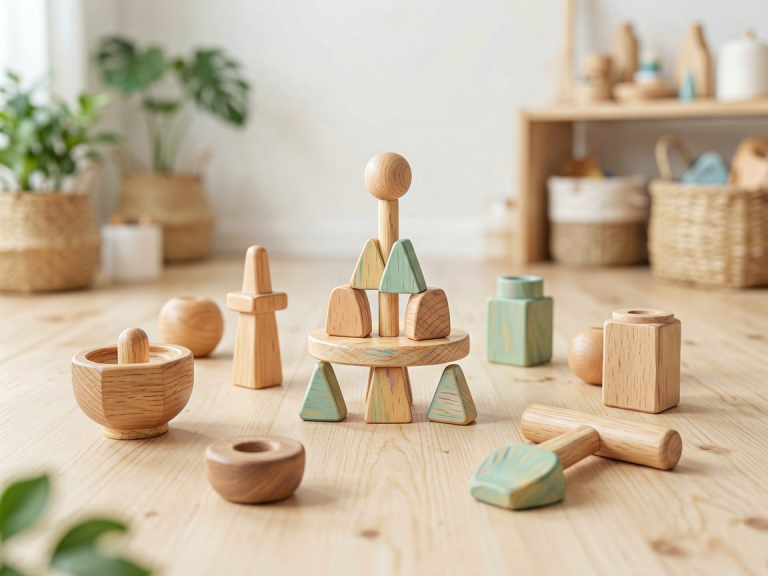
While not interlocking in the LEGO sense, high-quality wooden block systems deserve mention as the best alternative for the youngest builders or for those who prefer natural materials. Brands like Kapla and Grimm’s rely on simple, precisely cut wooden planks that stack without any locking mechanism, relying solely on gravity and balance.
- Kapla: Consists of identical pine planks in a 3:1 proportion. They can be stacked to form stunning architectural structures, from pagodas to bridges. The challenge lies in balance—each block placed without glue requires perfect weight distribution. This teaches physics and patience in a way no plastic brick can.
- Tegu: A magnetic wooden block system where small magnets are embedded inside the wood. This allows blocks to stick together in ways impossible with plain wood, enabling dynamic, cantilevered structures that are surprisingly sturdy.
- Why Choose Wood? Wooden blocks are sustainable, beautiful, and silent. They do not break, and they develop a pleasing patina over time. For a parent looking for a Montessori-friendly, screen-free toy that fosters fine motor skills and architectural thinking, wooden blocks are the ideal alternative to LEGO.
7. K’Nex: The Rod-and-Connector System for Budding Engineers
Finally, for builders obsessed with mechanics and movement, K’NEX offers a completely different system: plastic rods and connectors that snap together to create working machines, roller coasters, and even buildings with moving parts.
- Different from LEGO: K’Nex builds are typically larger, more skeletal, and structurally different. They do not look like brick models; rather, they resemble scaffolding or cranes. The system excels at creating functional mechanisms: gears, pulleys, and chain drives.
- Best Applications: K’Nex is the best alternative for children (ages 7+) who want to understand how things work. The roller coaster sets, with real working tracks and cars, are among the most thrilling construction toys on the market. The sets encourage STEM learning and problem-solving.
- Limitations: K’Nex pieces are not compatible with LEGO or any brick system. The finished models are often less visually appealing as static display pieces, and the rods can be difficult for small hands to connect. However, as a construction system that prioritizes function over form, K’Nex ranks highly.
Conclusion: Choosing the Right Alternative for You
The “best” alternative to LEGO-style bricks depends entirely on your priorities. If you seek a drop-in replacement with excellent licensed sets and lower prices, Mega Construx wins. For historical accuracy and display-quality military models, COBI is unbeatable. Educational institutions on a budget should look at Oxford Blocks. Detail-oriented hobbyists will adore Nanoblock, while those craving pure creativity and minimalist design should try Plus-Plus. For the youngest builders or those who love natural materials, wooden blocks offer a timeless alternative. And for the engineering-minded, K’Nex provides a distinct and rewarding experience.
The world of construction toys has never been more diverse. While LEGO remains a giant, these alternatives prove that innovation, specialization, and affordability flourish beyond the brick. So go ahead—dare to build something different. Your imagination will thank you.