Beyond the Box: The Best Alternatives to STEM Kits for 18-Month-Olds
STEM kits have become a staple in modern parenting, promising to turn toddlers into little engineers, chemists, and mathematicians. But when it comes to an 18-month-old, those glossy boxes filled with plastic gears, magnetic tiles, and circuit boards often miss the mark. At this age, a child’s brain is developing at an astonishing rate, but not through structured, goal-oriented activities. Instead, they learn through sensory exploration, cause-and-effect trials, and repetitive, open-ended play. The best alternatives to STEM kits for 18-month-olds are not found on a store shelf—they are found in everyday objects, natural materials, and parent-led interactions that invite curiosity without frustration. Below, we explore several categories of alternatives that nurture the same foundational STEM skills—observation, problem-solving, spatial awareness, and cause-and-effect reasoning—in ways that are developmentally appropriate and joyfully messy.
The Power of Sensory Play: Why Sand, Water, and Goo Trump Gears
A typical STEM kit might include a set of interlocking plastic pieces designed to build a specific model. For a toddler, the frustration of not being able to snap two pieces together can quickly lead to tears. Sensory play, on the other hand, offers immediate, tactile feedback that doesn’t require any “right” outcome. Fill a shallow bin with dry rice, uncooked pasta, or kinetic sand, and provide a few scoops, cups, and spoons. An 18-month-old will instinctively pour, scoop, and sift, exploring concepts of volume, gravity, and texture. Water play—with cups, funnels, and waterproof toys—teaches the basics of fluid dynamics in a way no plastic kit can match. Even simple finger painting with non-toxic, washable paint allows a child to experiment with mixing colors, pressure, and pattern formation. These sensory experiences build neural connections that underpin later scientific thinking: comparing, classifying, and observing changes over time.
Open-Ended Building: Simple Blocks Over Pre-Designed Kits
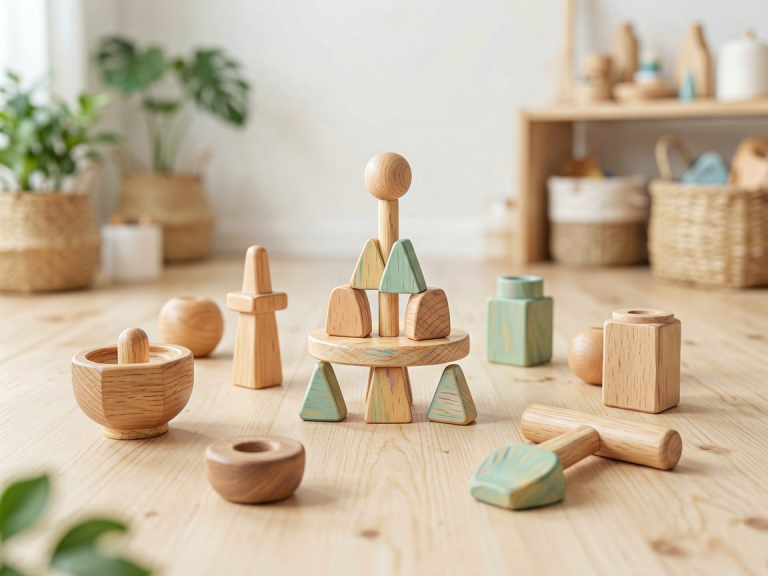
Many STEM kits for older children rely on instructions and predetermined outcomes. For an 18-month-old, open-ended building materials are far superior. A set of basic, unpainted wooden blocks in various shapes—cubes, cylinders, triangles—offers endless possibilities. A toddler can stack them, knock them down, line them up, or place them inside a container. Each action teaches spatial relationships, balance, and cause-and-effect: “If I put this block on top, will it stay?” These blocks also encourage gross motor development as the child reaches, bends, and grasps. Alternatively, large cardboard boxes, plastic containers, or even empty yogurt tubs can serve the same purpose. The lack of a “right” way to play means the child leads the learning, which is exactly how STEM curiosity flourishes. Unlike a kit that might restrict creativity with a single intended design, open-ended materials adapt to the child’s developmental stage and interests.
Cause-and-Effect Toys That Inspire Real Inquiry
At 18 months, a child is fascinated by the concept that an action can produce a reaction. Many commercial STEM kits include buttons that light up or play sounds, but these can be overstimulating and passive. A better alternative is a simple set of nesting cups or stacking rings. When a toddler puts a smaller cup inside a larger one, they discover size seriation. When they drop a ball into a cardboard tube and watch it roll out the other end, they learn about gravity and trajectories. A classic wooden hammer-and-peg bench—where a child pounds pegs through holes—teaches force and motion. These activities are far more effective than a battery-operated toy because they require the child’s own physical effort and provide immediate, natural feedback. The child learns that they are the agent of change, which builds confidence and a desire to experiment further.
Nature as the Ultimate STEM Laboratory
Perhaps the most powerful alternative to any store-bought STEM kit is the great outdoors. A walk in the park or a few minutes in the backyard offers an infinite array of learning opportunities. Let your 18-month-old pick up leaves, pinecones, stones, or sticks. Encourage them to drop a pebble into a puddle and watch the ripples. Sit on the grass and let them touch the blades, dig in the dirt, or blow a dandelion seed head. These experiences teach observation, classification, and the beginnings of physics and biology. You can create a simple “nature treasure basket” at home, collecting safe natural objects and placing them in a small basket for independent exploration. The variety of shapes, textures, weights, and smells engages all the senses and invites questions that a parent can answer in simple terms: “Yes, that rock is smooth. This one is bumpy. Do you feel the difference?” No plastic gear set can replicate the complexity and richness of the natural world.
Everyday Household Objects: The Ultimate STEM Toolkit
You don’t need to buy a single educational toy to provide a rich STEM alternative. The kitchen is a treasure trove of learning materials. Give your toddler a set of plastic measuring cups and a bowl of dry oatmeal—they will practice pouring, scooping, and comparing sizes. Let them hold a wooden spoon and bang on an upturned pot: they are learning about sound waves and vibrations. A simple cardboard tube from a roll of paper towels can become a telescope, a horn, or a ramp for a small ball. Empty plastic bottles of different sizes can be filled with beads or rice to make shakers that teach rhythm and cause-and-effect. Even bath time is a STEM lesson: floating toys sink or float depending on density, and a cup that pours water teaches volume and flow. The key is to offer these objects in a safe, supervised environment and to allow the child to use them in any way they choose. This kind of play honors the child’s natural curiosity and places them in the driver’s seat of learning.
Books and Language: Building the Foundations of Scientific Thinking
While STEM kits often focus on hands-on manipulation, the foundation of scientific inquiry is language. By reading simple board books with clear, repeating patterns, you help your 18-month-old develop the vocabulary and cognitive structures needed to describe the world. Books like “Brown Bear, Brown Bear, What Do You See?” introduce sequencing and classification. “Dear Zoo” teaches cause-and-effect (lifting a flap reveals an animal). Books with tabs, mirrors, or textures engage fine motor skills and sensory exploration. Even more importantly, talking to your child about what you are doing during everyday activities—narrating the steps of making a sandwich or folding laundry—models the kind of analytical thinking that STEM skills rely on. Drop a toy and say, “Uh oh, it fell. Let’s see if it rolls or stays still.” This kind of simple, conversational science is far more impactful than any packaged activity.
Conclusion: Trusting the Process Over the Package
The best alternatives to STEM kits for 18-month-olds are not more complicated products; they are opportunities for free, unstructured, and sensory-rich exploration. By choosing open-ended materials, embracing nature, repurposing household items, and engaging in language-rich interactions, parents can provide a foundation for future STEM learning that is deeper and more authentic than any kit could deliver. At this tender age, the goal is not to teach your child to build a robot or memorize the periodic table—it is to nurture a sense of wonder, a willingness to try and try again, and the joy of discovering how the world works. That is the most powerful STEM education of all.