The Art of Play: Selecting Toys for Emotional Learning in 18-Month-Olds
Introduction
At 18 months old, a toddler stands at a remarkable crossroads of development. They are no longer passive infants but active explorers, taking their first unsteady steps, uttering their first recognizable words, and, most importantly, beginning to experience a whirlwind of emotions. This is the age when a child’s emotional landscape expands dramatically—from sheer joy at a familiar face to intense frustration when a toy is out of reach. For parents and caregivers, choosing toys for an 18-month-old is about far more than entertainment or cognitive stimulation. It is a profound opportunity to nurture emotional learning, which lays the foundation for empathy, self-regulation, and social connection later in life.
Emotional learning at this stage refers to the child’s ability to recognize, express, and begin to manage their feelings, as well as to understand the emotions of others. Toys are the medium through which these skills are practiced. The right toy can teach a toddler that anger is temporary, that sadness can be soothed, and that shared laughter deepens bonds. The wrong toy—overly complex, overstimulating, or developmentally inappropriate—can lead to meltdowns, frustration, and missed opportunities for growth. This article provides a comprehensive, research-based guide on how to choose toys for 18-month-olds that actively foster emotional learning.
—
Understanding the Emotional World of an 18-Month-Old
Before diving into toy selection, it is essential to understand what an 18-month-old is emotionally capable of—and what they are not. At this age, children are in the midst of what developmental psychologists call the “terrible twos” precursor, though it is more accurately described as the “toddler emotional awakening.” Key emotional milestones include:
- Emerging Self-Awareness: The child recognizes themselves in a mirror and begins to use personal pronouns like “me” or “mine.” This newfound sense of self often triggers possessive behavior—they may cry when another child touches “their” toy.
- Intense Emotions, Limited Regulation: Joy, excitement, anger, fear, and sadness come in rapid, unpredictable waves. The prefrontal cortex, which governs impulse control, is still largely undeveloped. Therefore, a toddler cannot “calm down” on command.
- Social Referencing: They look to caregivers for cues about how to react to unfamiliar situations or people. If a parent smiles and says, “It’s okay,” the child learns to trust and regulate their fear.
- Early Empathy: While limited, they may offer a pacifier to a crying peer or pat a parent’s leg when they see them upset. This is the root of prosocial behavior.
Toys for this age must respect these emotional boundaries. They should not demand advanced social skills or abstract thinking. Instead, they should provide a safe, predictable environment where emotions can be explored and named.
—
Key Principles for Choosing Emotion-Enhancing Toys
When selecting toys for emotional learning, three guiding principles should always be kept in mind: safety, simplicity, and scaffolding. Safety is non-negotiable—no small parts that could be swallowed, no toxic paints, no sharp edges. Simplicity means that the toy has one or two clear functions, avoiding overwhelming lights, sounds, or too many moving parts. Scaffolding refers to the toy’s ability to grow with the child, offering challenges that are just slightly beyond their current ability to encourage learning without causing frustration.
Beyond these, here are specific emotional learning criteria to evaluate any potential purchase:
- Opportunities for Naming Emotions: Does the toy depict faces or situations that naturally lead to labeling feelings? For example, a doll with a happy face and a sad face.
- Causal, Controllable Outcomes: Can the child make something happen intentionally—like pressing a button to hear a lullaby? This builds a sense of agency, which combats helplessness and frustration.
- Interactive and Responsive: Does the toy react to the child’s actions in a consistent way? A wooden car that rolls when pushed teaches cause and effect; a stuffed animal that plays a soft song when hugged can be a comforting ritual.
- Role-Playing Potential: Even at 18 months, simple pretend play—feeding a doll, putting a teddy bear to sleep—allows the child to act out caregiving scenarios, which builds empathy and emotional understanding.
- Calming vs. Stimulating: Some toys should encourage active, joyful play (balls, push toys). Others should serve as tools for soothing (soft blankets, weighted stuffed animals). A good collection balances both.
—
Top Toy Categories for Emotional Development
1. Soft Dolls and Stuffed Animals
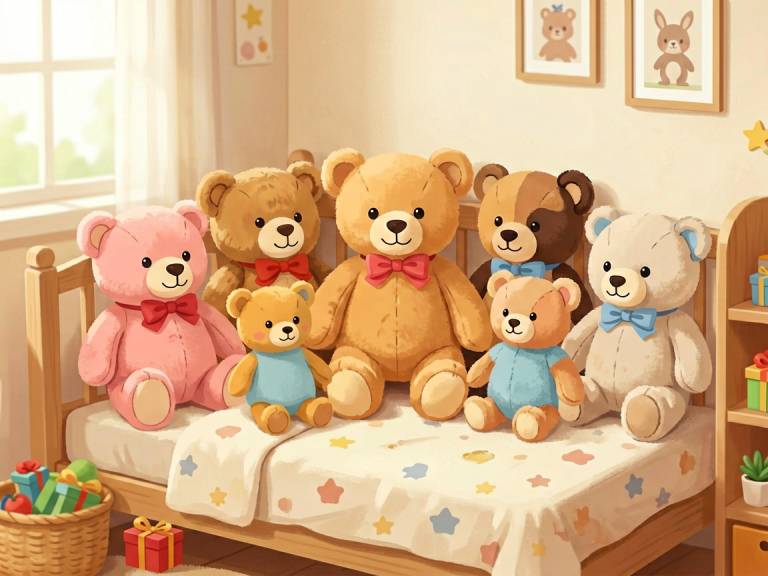
Soft dolls and plush toys are perhaps the most powerful emotional learning tools for an 18-month-old. Unlike action figures or rigid plastic toys, a plush friend invites cuddling, hugging, and caregiving. Choose dolls with simple, expressive faces—a neutral expression is actually better than an exaggerated smile, as it allows the child to project their own emotions onto the toy.
How they support emotional learning: A child can “feed” the doll, “rock” it to sleep, or wrap it in a blanket during their own bedtime routine. This parallel play reinforces self-soothing behaviors. When a toddler feels angry or sad, they may hand the doll to a parent and pat its back, mimicking the comfort they themselves receive. This is an early form of empathy and perspective-taking.
What to look for: Machine-washable materials, no detachable buttons or ribbons, and a size large enough that the child cannot put the entire toy in their mouth. Avoid dolls with hard plastic accessories. A simple soft-bodied baby doll with a removable, soft diaper is ideal.
2. Emotion-Facing Mirror and Emotion Cards
At 18 months, self-recognition is a major emotional milestone. A unbreakable, toddler-safe mirror—ideally one with handles or a stand—allows the child to see their own facial expressions. Pair this with large, laminated cards featuring simple cartoon faces showing happy, sad, angry, and surprised expressions.
How they support emotional learning: Sit with the child in front of the mirror. Make a happy face and say, “Look! Happy!” Then point to the card with the happy face. Encourage the child to imitate. When the child is crying, gently bring them to the mirror and say, “You look sad. It’s okay to be sad.” This direct, visual, and verbal labeling helps the child connect internal feelings with external expressions. It also validates their emotions, reducing the need to act out.
What to look for: Mirrors made of acrylic or shatterproof glass, with rounded edges. Emotion cards should be thick, laminated, and large enough (at least 5×7 inches) to hold easily.
3. Push and Pull Toys
At 18 months, many toddlers are walking confidently or cruising along furniture. Push toys—such as a wooden shopping cart, a lawn mower, or a small wagon—give them purpose and direction. Pull toys, like a wooden animal on a string, add an element of problem-solving.
How they support emotional learning: Mastering a new gross motor skill generates a tremendous sense of pride and accomplishment. When a child successfully pushes a cart across the room, they feel joy and self-efficacy. On the flip side, when the cart tips over, the child may feel frustration. A caregiver can model emotional regulation: “Uh-oh, it fell. Let’s fix it together. Take a deep breath. There.” This teaches the child that difficult emotions can be managed with help.
What to look for: Stable bases that won’t tip easily, wheels that roll smoothly, and a handle that the child can grip comfortably. Avoid toys with loud or jarring sounds; a gentle clicking or wooden rattle is fine.
4. Stacking and Nesting Blocks
Classic stacking cups or nesting blocks made of wood or thick cardboard are staples for this age group. They are simple, predictable, and offer endless variations.
How they support emotional learning: Stacking requires patience and precision. When a tower falls, the child experiences disappointment. The caregiver’s response—“That’s okay; we can try again!”—reinforces resilience. Additionally, stacking toys can be used for simple emotion games: place a small stuffed animal inside a cup and cover it, then uncover it and say “Peek-a-boo! Happy!” This introduces the concept that emotions can be temporary and that joy can reappear after surprise or disappearance.
What to look for: Blocks with smooth edges, non-toxic paint, and nesting cups that are graduated in size. Avoid blocks with sharp corners or complex interlocking mechanisms.
5. Simple Musical Instruments
Drums, maracas, xylophones, and rain sticks are wonderful for emotional expression. At 18 months, a child can bang a drum with both hands or shake a maraca rhythmically.
How they support emotional learning: Music is a direct channel for emotion. A child who is angry may pound a drum hard—a healthy, non-destructive release. A child who is tired may listen to a gentle rain stick. Caregivers can model “happy music” (fast, loud) and “calm music” (slow, soft), helping the child differentiate between energetic and soothing states. Playing together also fosters connection: when you shake a maraca and smile, the child may mimic and feel joy.
What to look for: Instruments made of durable, non-toxic materials. Avoid electronic instruments with pre-recorded sounds; child-powered instruments are better for cause-and-effect learning. A simple wooden xylophone with a mallet attached by a string is ideal.
—
Practical Tips for Parents and Caregivers
Choosing the right toy is only half the equation. How you engage with the child during play determines whether emotional learning truly occurs. Here are actionable strategies:
| Strategy | How to Apply |
|———-|————–|
| Name Emotions in Real Time | When playing with a pull toy that gets stuck, say, “You are frustrated because the string is caught. That’s hard. Let’s fix it together.” |
| Model Regulation | If a tower falls and the child starts to cry, take a slow, exaggerated breath. Say, “I see the blocks fell. I feel a little upset too. But look, we can make a new tower!” |
| Follow the Child’s Lead | If the child wants to carry the doll around instead of feeding it, go with that. The autonomy itself is emotionally empowering. |
| Limit Choices | Offer two or three toys at a time. Too many options overwhelm the toddler’s decision-making capacity and can trigger meltdowns. |
| Create Emotional Routines | Use a specific stuffed animal for naptime and a different toy for calm play after meals. Consistency helps the child predict and regulate their emotions. |
| Avoid Over-Praising | Instead of saying, “Good job,” try, “You worked so hard to stack those blocks. You must feel proud!” This focuses on the child’s internal emotional experience. |
Conclusion
Selecting toys for an 18-month-old is an act of love and intentionality. The best toys are not the brightest, the loudest, or the most advertised. They are the ones that whisper to the child: “I understand you. You can be happy here. You can be sad here. You are safe to feel everything.” Soft dolls teach care, mirrors teach self-recognition, blocks teach patience, and musical instruments teach release. Each play session is a micro-lesson in emotional literacy.
As your toddler grows, their emotional needs will evolve. But the foundation built during these first 18 months—through simple, meaningful play—will last a lifetime. Choose wisely. Play warmly. And remember: every time you hand a child a toy that respects their heart, you are giving them a gift far greater than entertainment. You are giving them the language of their own soul.