Selecting Toys for 1-Year-Olds: A Guide to Fostering Language Development
Introduction
The first year of life is a whirlwind of growth, and by the time a child turns one, they are entering a phase of extraordinary cognitive and linguistic change. Between 12 and 24 months, toddlers typically transition from babbling to uttering their first meaningful words, and they begin to understand far more than they can say. The environment in which a child develops plays a critical role in this process, and among the most influential environmental factors are the toys they interact with. However, not every toy marketed for one-year-olds is equally beneficial for language development. Choosing the right toys requires an understanding of how play, interaction, and language acquisition are intertwined. This article provides a comprehensive guide for parents and caregivers on how to select toys that actively support language development in one-year-olds, while also ensuring safety, engagement, and age-appropriate challenge.
The Science Behind Play and Language
To understand why toy selection matters, we need to look at how language develops in the toddler brain. At around 12 months, children shift from pre-linguistic communication—such as pointing, gesturing, and eye gaze—to symbolic representation. They begin to associate words with objects, actions, and people. This process is heavily dependent on social interaction. According to Vygotsky’s sociocultural theory, language emerges through joint attention and collaborative activities with more knowledgeable partners (usually parents). Toys are the props in this collaborative play. A well-chosen toy can prompt a parent to narrate, ask questions, and label, thereby providing the rich linguistic input that babies need. Conversely, a poorly chosen toy—such as one that plays loud, repetitive sounds independently—may actually discourage conversation because it replaces human interaction with machine noise. Research shows that the sheer quantity of adult speech directed at a child, especially in a responsive and contingent manner, predicts vocabulary growth. Therefore, the best toys for language development are those that encourage back-and-forth interaction, require parental involvement, and offer opportunities for naming, describing, and sequencing.
Language Milestones for One-Year-Olds
Before diving into toy categories, it is helpful to review the typical language milestones for children aged 12 to 24 months. At one year, most children:
- Say a few single words (e.g., “mama,” “dada,” “ball”).
- Understand simple commands (“give me the cup”).
- Use gestures (waving, pointing).
- Enjoy imitating sounds and words.
By 18 months, vocabulary expands rapidly (often to 50+ words), and children begin combining two words (“more juice,” “go car”). They also start to use words to request, label, and comment. By 24 months, many children use two- to three-word phrases and understand simple questions. Toys must be selected to meet the child where they are and stretch them slightly beyond—a zone of proximal development. For a child who only babbles, a toy that elicits vocal imitation is ideal. For a child already saying ten words, a toy that encourages combining those words with actions or new nouns is appropriate.
Core Principles for Toy Selection
When walking through a toy store or browsing online, keep these five principles in mind:
1. Prioritize Interactive, Open-Ended Toys
Open-ended toys are those that can be used in multiple ways, without a single “correct” outcome. Blocks, stacking cups, shape sorters, and simple dolls allow the child to explore and impose their own narrative. These toys promote problem-solving and language because the parent can narrate the child’s actions (“You put the red block on top!”) or ask questions (“Where does the triangle go?”). In contrast, closed-ended toys (like a light-up button that plays one song) tend to elicit less language because they limit creativity and do not require verbal exchange.
2. Ensure Parent-Child Interaction is Encouraged
Some electronic toys are designed to replace the parent, but research has found that infants learn language better from live, responsive humans than from pre-recorded sounds. Choose toys that you, as a caregiver, can use together with the child. A simple ball, for example, requires you to roll it back and forth and say “roll,” “catch,” “your turn.” A push toy that makes noise might be fun, but it does not inherently prompt conversation. If you buy an electronic toy, use it as a prop: turn off the sound and narrate the action yourself.
3. Look for Toys that Promote Joint Attention
Joint attention occurs when both child and adult focus on the same object or event. This shared focus is a critical foundation for language. Toys that have interesting textures, sounds, or moving parts—like a spinning top, a pop-up toy, or a soft book with flaps—naturally draw the child’s gaze. The parent can then point to the toy, say its name, and wait for the child to look. This simple sequence—look, label, wait—is enormously powerful for vocabulary building.
4. Choose Realistic, Functional Toys
At one year old, children are beginning to understand that objects represent real things. Toy telephones, plastic fruits, small animal figures, and toddler-safe mirrors help them connect words to real-world referents. A plastic apple allows you to say “apple” and pretend to take a bite, building both vocabulary and symbolic thinking. Avoid overly abstract toys (e.g., abstract rattles that don’t resemble anything) unless they are part of a larger play set.
5. Consider Sensory Variety, Not Overstimulation
Sensory play is important, but too much stimulation can overwhelm a toddler and reduce the opportunity for focused conversation. A toy with one or two sensory features (e.g., a crinkle sound and a soft texture) is better than one with flashing lights, multiple songs, and five textures. The goal is to give the child something to talk about, not to distract them into passive watching.
Recommended Toy Categories for Language Development
Based on these principles, here are specific types of toys that are particularly effective for one-year-olds, along with guidance on how to use them to support language.
Realistic Animal Figurines and Farm Sets
Animal figures (durable, non-toxic plastic or soft fabric) are excellent for language development. They are small, easy to hold, and allow for naming (“cow,” “duck”), imitation of animal sounds (“moo,” “quack”), and simple storytelling. For a one-year-old, a set of 3–5 common animals is ideal. Encourage your child to hand you the “dog” or “horse,” and make the sounds together. As they get older, you can add a simple barn or fence and act out scenes, introducing verbs like “sleep,” “eat,” “run.” Avoid sets with tiny choking hazards.
Interactive Board Books with Flaps, Touch-and-Feel Elements
Books are arguably the most language-rich toys for toddlers. For a one-year-old, board books with thick pages, flaps to lift, and textures to feel are perfect. Books that feature simple, repetitive language (“Where is Baby’s Belly Button?”) or clear photographs of everyday objects (animals, food, clothing) help build vocabulary. When reading, point to pictures, name them, and pause for your child to point or babble. Lift-the-flap books encourage anticipation and the language of “peek-a-boo,” “open,” “find.” Avoid books with long paragraphs; at this age, the interaction matters more than the story.
Stacking Cups, Nesting Blocks, and Simple Puzzles
These classic toys are open-ended and promote both motor skills and language. While building a tower, you can say “up,” “down,” “fall,” “big,” “little.” For a one-year-old, use a simple shape sorter with only two or three large shapes. Narrate each attempt: “You have the square. Where does the square go? In the hole! Yes!” This helps the child learn spatial language and action words. Puzzles with knobs and single-piece cutouts are also useful for labeling (“circle,” “dog,” “boat”).
Push and Pull Toys
Toys that your child can push while walking (a small cart, a stroller, a wooden animal on wheels) promote gross motor skills and offer rich language opportunities. As your child pushes, you can follow and say “push,” “go,” “stop,” “faster,” “slow.” If the toy has a string to pull, that adds the word “pull.” Because these toys involve movement, they naturally elicit action verbs—a critical part of early language that goes beyond just nouns.
Musical Instruments (Safe, Simple)
Drums, xylophones, maracas, and bells that your child can hold and shake are wonderful for language because they encourage turn-taking and imitation. Play a simple rhythm and say “boom boom,” then hand the drumstick to your child. Say “your turn.” Sing songs like “Twinkle, Twinkle” while shaking a maraca. The shared musical experience strengthens social bonding and introduces new vocabulary (loud, soft, fast, slow). Be careful to choose instruments that are not too loud; soft wooden or plastic rattles are better than electronic screaming toys.
Baby Dolls and Soft Puppets
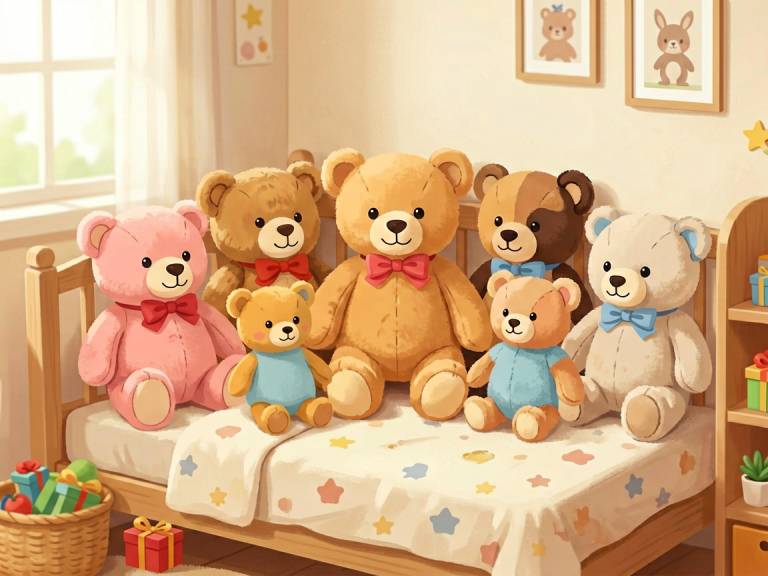
A simple cloth doll or a small hand puppet can be a powerful tool for language development. At one year, children begin to imitate caregiving actions: feeding, hugging, putting to sleep. Use the doll to model simple phrases: “Dolly is hungry. Eat, dolly.” Then hand the doll to your child and say “You feed dolly.” This pretend play builds not only vocabulary but also social understanding and turn-taking. Puppets can be used to have “conversations” with the child, encouraging them to respond with sounds or gestures.
How to Use Toys to Maximize Language Growth
Having the right toy is only half the battle; the way you play matters just as much. Here are practical strategies to incorporate during toy time:
Narrate Your Actions
When playing together, describe what you are doing in simple, short sentences. Instead of saying “Look, I am putting the block on top of the tower,” say “Block on top.” Use present tense and repeat key words. This “self-talk” gives the child a model for linking language with action.
Use Expansion and Recasting
If your child says “ball,” you can expand it: “Yes, that’s a big red ball!” If they babble “ba-ba” for ball, you can recast: “Ball. You want the ball.” This gently corrects and adds information without pressure.
Ask Open-Ended and Closed Questions
Even if your child cannot answer verbally, asking questions teaches them the rhythm of conversation. Point to a toy and ask “What is that?” Wait a few seconds. Then answer yourself: “It’s a cow! Moo.” As they get older, ask “Where is the cow?” and watch them point. Use simple “yes/no” questions (“Do you want more blocks?”) and model the response (“Yes!” with a nod).
Follow the Child’s Lead
If your child is fascinated by the red block, talk about the red block. Do not force a different topic. This responsive interaction builds trust and encourages the child to initiate communication. The best language learning happens when the adult is attuned to the child’s focus of attention.
Safety and Other Considerations
While language development is the priority, safety and age-appropriateness cannot be overlooked. For one-year-olds:
- Avoid small parts that can be swallowed or choked on. Use a choke tube test: if a toy part fits inside a toilet paper roll, it is too small.
- Ensure all materials are non-toxic (BPA-free, lead-free paint). Mouthing is still common at this age.
- Check for sharp edges, loose strings, and magnets. Avoid toys with long cords that could be a strangulation risk.
- Do not overwhelm the child with too many toys at once. Rotate a small selection (4–6 toys) every few weeks. This keeps interest high and reduces overstimulation.
Additionally, remember that screen-based toys (tablets, phones) are not recommended for language development in one-year-olds. The American Academy of Pediatrics advises no screen time other than video chatting for children under 18 months, as interactive human interaction is far superior for language learning.
Conclusion
Choosing toys for a one-year-old is not about buying the most expensive or the most high-tech option; it is about selecting items that will serve as tools for connection, conversation, and discovery. The best toys for language development are those that invite a parent to sit down, look into the child’s eyes, and talk. Simple blocks, soft animals, board books, and musical instruments far outperform flashing, electronic gadgets in fostering vocabulary, comprehension, and the joy of communication. By prioritizing open-ended, interactive toys that promote joint attention and allow for rich verbal modeling, caregivers can create a play environment that naturally accelerates language milestones. Remember that every moment of play is an opportunity for language—the toy is just the stage, and you are the star of the show.