Beyond the Rattle: The Surprising World of Puzzle Toys and Board Games for 18-Month-Olds
Introduction
The first eighteen months of a child’s life represent a period of staggering cognitive, motor, and social growth. By the time a toddler turns a year and a half, they are no longer a passive infant but an active explorer – walking (or toddling), pointing, babbling, and beginning to understand cause and effect. Parents and caregivers often wonder what types of playthings can meaningfully engage this burgeoning mind without causing frustration. The obvious choices—soft blocks, stacking rings, shape sorters—are well known. But what about puzzle toys and board games? At first glance, these categories seem reserved for older preschoolers. Yet, when carefully designed and thoughtfully introduced, puzzle toys and simple board games offer profound developmental benefits for 18-month-olds. This article explores why these activities are not only appropriate but essential for toddlers, how to select the right ones, and what specific skills they nurture. By understanding the unique characteristics of this age group, we can transform playtime from mere entertainment into a rich learning experience.
The Developmental Landscape at 18 Months
Before diving into specific toys, it is crucial to understand what an 18-month-old is capable of and what they are striving to master. At this age, a toddler typically exhibits:
- Gross motor skills: Walking independently, squatting to pick up objects, climbing onto low furniture.
- Fine motor skills: Grasping with thumb and forefinger (pincer grip), turning pages of a board book, scribbling with a crayon, and – crucially – placing objects into containers.
- Cognitive abilities: Object permanence (knowing that a hidden object still exists), simple problem-solving (e.g., pulling a string to get a toy), imitation of actions, and understanding of simple instructions (“Give me the ball”).
- Language development: A vocabulary of about 10 to 50 words, understanding of many more, and early word combinations like “more milk.”
- Social-emotional growth: Separation anxiety may still be present, but parallel play (playing alongside others) emerges. They show pride in accomplishments and may have temper tantrums when frustrated.
Given these abilities, a puzzle toy or board game designed for an 18-month-old must avoid overwhelming demands while tapping into their natural curiosity and drive for mastery. The key is to match the challenge precisely to the child’s current zone of proximal development – not too easy, not too hard.
What Makes a Puzzle Toy Suitable for an 18-Month-Old?
Traditional jigsaw puzzles with many small, interlocking pieces are obviously inappropriate: they require advanced spatial reasoning, fine motor precision, and patience that a toddler lacks. Instead, puzzles for this age fall into several categories:
1. Chunky Wooden Shape Sorters and Peg Puzzles
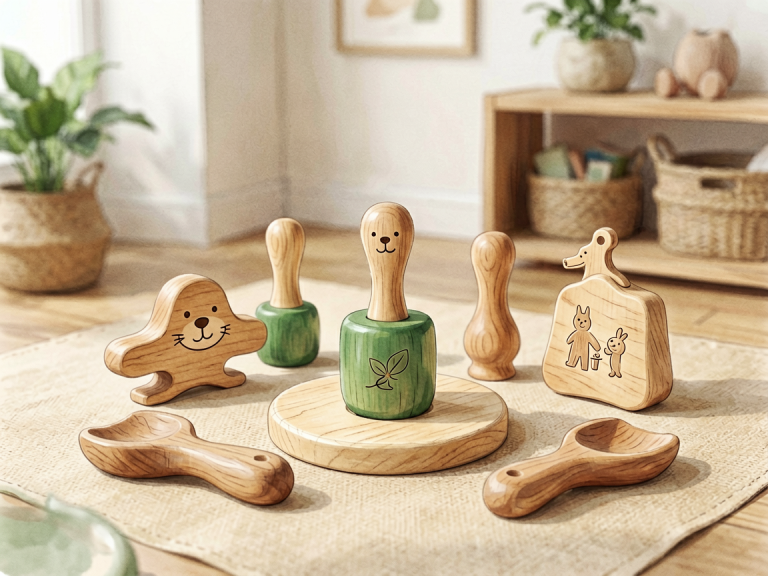
These are the classic entry-point puzzles. A typical shape sorter has a base with cut-out holes and chunky wooden shapes (circle, square, triangle) that fit into corresponding holes. Peg puzzles feature a board with recessed images (e.g., a dog, a cat, a ball) and each piece has a large peg for gripping. Why are they perfect? They reinforce object permanence, shape recognition, and spatial relationships. The chunky pieces are easy for small hands to grasp and manipulate. Importantly, the feedback is immediate: either the piece fits or it doesn’t. This clear cause-effect relationship is deeply satisfying for a toddler’s developing brain.
2. Single-Piece “Immediate Success” Puzzles
Some puzzle toys are designed so that a child can successfully complete them in one or two moves. For example, a board with a single cut-out for a large wooden car – the child simply lifts the car and places it back. This may seem too simple, but for an 18-month-old, the act of matching the shape and inserting it is a cognitive triumph. Multiple repetitions build confidence and neural pathways.
3. Sound and Texture Puzzles
Adding sensory components elevates puzzle play. A puzzle where a wooden piece, when correctly placed, makes a gentle click, plays a sound (e.g., animal noise), or reveals a textured surface underneath engages multiple senses. This multisensory integration is crucial at this age because learning is not compartmentalized – toddlers learn through seeing, hearing, touching, and moving.
4. Magnetic or Snap-Together Puzzles
Some manufacturers produce puzzles where pieces attach with magnets or simple snap fasteners. These require slightly more force and coordination, which can be excellent for strengthening hand muscles. However, magnets must be securely enclosed to prevent swallowing hazards.
Board Games for Toddlers: A Contradiction in Terms?
The phrase “board game for an 18-month-old” may sound like an oxymoron. Traditional board games involve complex rules, turn-taking, counting, and strategy – all far beyond a toddler’s capacity. However, a new genre of “first board games” has emerged, specifically designed for ages 18 months and up. These games strip down the concept to its bare essence: shared activity, simple actions, and immediate rewards.
The Anatomy of a Toddler Board Game
A true board game for an 18-month-old shares these characteristics:
- No reading required. All instructions are conveyed visually.
- Minimal or no waiting. Traditional turn-taking is replaced by simultaneous or near-simultaneous actions. For instance, all players might place their animal figures on a spinner at the same time.
- One simple action. The entire game might involve spinning a large, easy-to-grasp spinner and then placing a piece of food into a toy animal’s mouth.
- Short duration. A session should last 2 to 5 minutes, matching the toddler’s attention span.
- Physical, not mental. The challenge is motoric, not strategic. For example, a game called “Roll & Play” (by ThinkFun) has a large fabric cube that the child rolls; whichever color comes up, the child does an action like “roar like a lion” or “pat your head.” This is a game in the sense of structured play with a clear outcome.
Examples of Developmentally Appropriate Games
- “The Sneaky, Snacky Squirrel” (by Educational Insights, adapted for toddlers): The original game is for ages 3+, but the company also produces a “My First” version with larger pieces and simplified rules. The child simply uses a squirrel-shaped “tongs” to pick up acorns and drop them into a log. This develops pincer grip and hand-eye coordination.
- “Hoot Owl Hoot!” (by Peaceable Kingdom, toddler version): In this cooperative game, players work together to move owls toward their nest before the sun rises. For 18-month-olds, the rule is simplified: they just place a wooden owl on a color-matched spot on the board. There is no competition, no losing – only collective success.
- “Acorn Soup” (by Eeboo): A game where toddlers use a wooden spoon to “stir” a bowl and then add wooden ingredients (acorns, leaves, berries) as shown on recipe cards. This combines pretend play with visual matching and motor planning.
- “First Orchard” (by HABA): A classic cooperative game for ages 2+. With modifications (e.g., letting the child simply pick fruit and place it in the basket without worrying about the “crow” piece), it becomes accessible at 18 months. The chunky fruit pieces are perfect for grasping.
Developmental Benefits: Why Bother with Puzzles and Games?
At 18 months, every interaction shapes the architecture of the brain. Puzzle toys and board games offer targeted benefits that free play with generic toys may not provide.
1. Fine Motor Precision and Hand-Eye Coordination
Picking up a chunky puzzle piece, rotating it to match the hole, and pressing it into place requires a series of refined movements. Over time, these repeated actions strengthen the small muscles of the hand and fingers, laying the groundwork for future tasks like writing, buttoning, and using utensils. Board games that involve picking up small objects (acorns, fruit, animal tokens) offer similar practice in a social context.
2. Cognitive Skills: Problem-Solving, Categorization, and Memory
When a toddler attempts to fit a square peg into a square hole, they are engaging in trial-and-error problem-solving. They learn that not all shapes will fit, and they must select the correct one. This is the beginnings of logical reasoning. Memory also gets a workout: in a game where a card shows a certain animal, the child must recall which toy animal matches that picture.
3. Language Development
Puzzles and games create natural opportunities for language. As you play together, you can narrate: “You found the cow! Where does the cow go? Moo! Yes, it fits right there.” This repetitive, contextual language is far more effective for vocabulary building than flashcards. Studies show that children learn words best when they are embedded in meaningful, interactive experiences.
4. Social and Emotional Growth
Even though 18-month-olds are mostly egocentric, structured play with a caregiver introduces early social concepts: waiting, sharing, and turn-taking (even if only for a few seconds). Cooperative board games, in particular, teach that play can be a joint effort rather than a competition. Successfully completing a puzzle together elicits pride and a sense of accomplishment, boosting self-esteem. On the flip side, when a piece doesn’t fit, the child learns to manage minor frustration with caregiver support.
5. Persistence and Attention Span
A puzzle or game has a clear endpoint – all pieces placed, all animals fed, all owls home. This goal-oriented structure encourages a toddler to stay engaged for slightly longer periods than open-ended play. Each small success (placing one piece) motivates the next attempt. Over weeks, attention span lengthens.
How to Choose the Right Puzzle or Game for Your 18-Month-Old
Given the vast array of products marketed for “toddlers,” it’s essential to be discerning. Here are practical criteria:
- Safety first: All pieces must be large enough to prevent choking (at least 1.25 inches in diameter). Avoid paints or finishes that may contain lead or toxins. Wooden toys should be splinter-free and have rounded edges. Magnets must be fully enclosed.
- Durability: Board games may involve throwing, dropping, or even mouthing pieces. Look for sturdy materials: thick cardboard, solid wood, and non-toxic, washable surfaces.
- Simplicity: The fewer pieces, the better. A puzzle with three to five pieces is ideal. A game with one action (spin, place, match) is perfect. Avoid anything with small cards that can be easily bent or lost.
- Interest alignment: Does your child love animals? Vehicles? Food? Choose themes that capture their current fascination. This increases motivation.
- Open-ended potential: Even within structured toys, look for opportunities for creative play. A puzzle that can also be used as a stacking toy or a game with pieces that double as pretend food adds longevity.
Tips for Introducing Puzzle Toys and Board Games
Even the best toy will fail if introduced poorly. Here are strategies to ensure a positive experience:
- Model the activity first. Sit down with the puzzle and demonstrate slowly. Narrate your actions: “I’m looking for the circle. Here it is! It fits in the round hole. See?” Then hand the child a piece and guide their hand gently if needed.
- Start with the easiest variation. If the puzzle has five pieces, begin by only offering two. Once the child masters those, add a third. This builds confidence.
- Celebrate effort, not just success. Cheer when they try, even if they put the piece in the wrong hole. Avoid correcting immediately; let them experiment. If frustration builds, step in to help or redirect to another activity.
- Keep sessions short and sweet. Two minutes of focused puzzle play is a triumph at this age. Do not force it. End on a positive note, perhaps after the child places the last piece.
- Incorporate into daily routine. Place the puzzle or game on a low shelf where the child can access it independently. They may choose to play with it on their own – and that self-directed exploration is invaluable.
- Use board games as a social ritual. Set aside a few minutes each day for “game time” with the whole family. This creates positive associations and models turn-taking, even if the baby only participates for 30 seconds.
Common Pitfalls to Avoid
- Buying age-inappropriate toys. A puzzle labeled “2+” may have pieces too small or a mechanism too complex. Always check the recommended age, but also evaluate with your own knowledge of your child.
- Expecting too much, too soon. Some 18-month-olds will delight in puzzles; others will prefer to throw the pieces. That’s normal. Development is not linear.
- Over-stimulating with too many choices. Having one or two well-chosen puzzle toys and one simple board game is better than a closet full that overwhelms.
- Using electronic or screen-based “games.” At this age, hands-on, tactile, social play is far superior for brain development. Avoid apps or digital puzzles that replace real manipulation.
Conclusion
Puzzle toys and board games for 18-month-olds are not a luxury or a premature academic push – they are tools that align perfectly with a toddler’s natural drive to explore, understand, and master their world. A chunky wooden peg puzzle teaches shape recognition and fine motor control while offering a moment of quiet connection between parent and child. A simple cooperative board game like “First Orchard” introduces the joy of shared goals and turn-taking in a form so simple that a toddler can grasp it. The key is to choose toys that are safe, simple, and engaging, and to introduce them with patience and enthusiasm. As you watch your 18-month-old concentrate on fitting that circle into its hole, or gleefully place a wooden apple in a basket, you are witnessing not just play, but the fundamental architecture of learning being built. So go ahead – open that box of chunky puzzles, unroll that game board, and enter the delightful world of structured play. Your toddler is ready, and the rewards are immense.