Beyond the Brick: Exploring Educational Alternatives to LEGO-Style Construction Toys
Introduction
For decades, LEGO bricks have reigned supreme as the quintessential educational toy. Their interlocking precision, endless combinability, and cross-generational appeal have made them a staple in classrooms, therapy sessions, and living rooms worldwide. Educators and parents alike praise LEGO for fostering spatial reasoning, fine motor skills, creativity, and even early engineering concepts. Yet, as our understanding of child development and pedagogy deepens, a growing chorus of voices is questioning whether LEGO-style bricks are *always* the best option. Are they truly inclusive for all learning styles? Do they inadvertently limit creative expression by forcing adherence to a rigid grid system? And are there other, perhaps more effective, alternatives that better serve specific educational goals?
This article explores the rich landscape of educational alternatives to traditional LEGO-style bricks. While LEGO remains a powerful tool, it is by no means the only one. From magnetic tiles that defy gravity to programmable robots that breathe life into code, each alternative offers unique cognitive, social, and emotional benefits. By examining these options in depth, we hope to equip educators, parents, and curriculum designers with a broader toolkit—one that acknowledges the diverse ways children learn, create, and problem-solve.
1. Magnetic Building Tiles: Fluidity and Geometry
One of the most popular and educationally rich alternatives to LEGO bricks is the magnetic tile system (e.g., Magna-Tiles, PicassoTiles, Magformers). Unlike LEGO’s friction-based stacking, magnetic tiles use embedded magnets along their edges, allowing pieces to snap together effortlessly, even at angles. This seemingly simple difference unlocks a dramatically different learning experience.
- Geometric and Spatial Awareness: Magnetic tiles are inherently two-dimensional until assembled into three-dimensional structures. Children must mentally rotate and connect faces, edges, and vertices—a process that strongly reinforces geometric understanding. Whereas LEGO builds upward from a base plate, magnetic tiles encourage children to think about symmetry, balance, and polyhedral shapes. A five-year-old who builds a cube from six square tiles is unconsciously learning Euler’s formula and the properties of orthogonal faces.
- Gravity and Structural Engineering: Because magnetic tiles do not rely on interlocking friction, they introduce a different set of challenges. A tall tower built from magnetic tiles may collapse if the magnetic force is insufficient to counteract gravity at the joints. This forces children to experiment with weight distribution, triangulation, and the concept of center of mass—principles that are universal in structural engineering but less obvious with LEGO’s tight clutch power.
- Accessibility for Younger and Differently-Abled Children: The magnets provide a satisfying “click” without requiring fine motor precision. Children with motor delays, arthritis, or even very young toddlers can successfully connect magnetic tiles, unlike LEGO bricks which demand precise alignment and moderate finger strength. This inclusivity makes magnetic tiles a powerful tool for early childhood classrooms and occupational therapy.
- Open-Ended Creativity Without a Grid: LEGO bricks’ stud-and-tube system inherently forces a orthogonal, Cartesian coordinate system. While this is excellent for teaching patterns and arrays, it can be creatively limiting. Magnetic tiles, by contrast, can be joined at any edge, allowing for curved, organic, and non-grid-based forms. This freedom encourages more divergent thinking and artistic expression.
2. Wooden Unit Blocks: The Timeless Foundation of Physics and Social Play
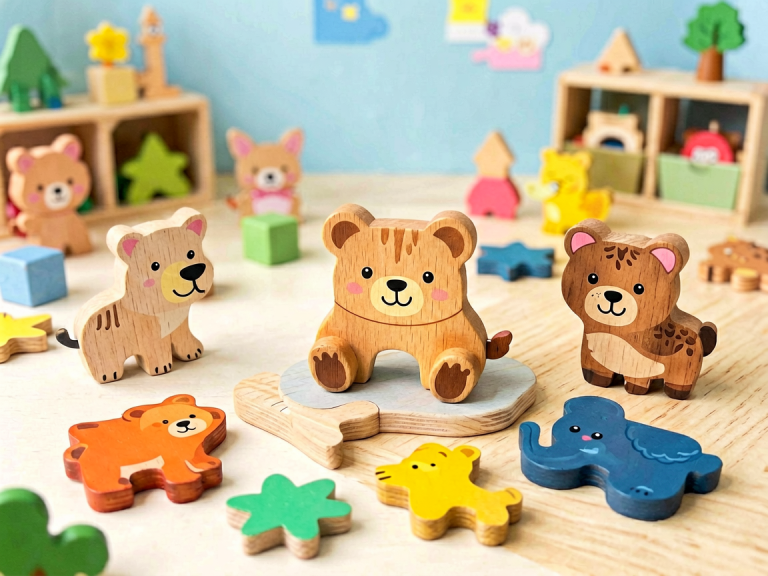
Long before plastic dominated the toy aisle, wooden unit blocks (such as those made by Melissa & Doug, Kapla, or traditional Froebel “gifts”) were the gold standard for constructive play. Even today, many early childhood experts argue that no other material rivals their educational depth.
- Natural Sensory Experience: The weight, texture, and grain of wood provide rich sensory input. Children learn about mass, friction, and balance through direct physical feedback. A LEGO brick feels consistent; a wooden block can have subtle variations in density and smoothness. This grounding in natural materials is particularly valuable in an increasingly digital world.
- Building Without Connectors: Unlike LEGO, which relies on mechanical interlocking, wooden blocks stack solely through gravity and friction. This means that any structure is inherently unstable if not balanced correctly. The immediate consequence of poor engineering—a crashing tower—teaches lessons in physics that are visceral and memorable. Children learn about load-bearing walls, buttresses, and the importance of a wide base. These are not abstract concepts but lived experiences.
- Social and Dramatic Play: In a classroom setting, wooden blocks often become props for collaborative storytelling. A group of children building a castle together must negotiate space, share materials, and coordinate their designs. This social dimension is less pronounced with LEGO, where each child often builds their own model individually. Wooden blocks naturally encourage cooperative problem-solving and language development through descriptive dialogue: “Your block is wobbling—let’s put a smaller one underneath.”
- Mathematical Concepts: Unit blocks are typically designed in standard proportional sizes (e.g., a double unit is twice the length of a single unit). This allows children to subconsciously grasp fractions, ratios, and volume. A child who discovers that four small blocks equal one large block has made a fundamental mathematical insight—one that is more intuitive than the abstract numerals of a worksheet.
3. Open-Ended Construction Kits: Straws, Connectors, and Flexible Systems
Not all construction toys rely on rigid bricks. Systems like Strawbees, K’NEX, Tinkertoys, and Zometool offer entirely different mechanical principles based on rods, struts, and flexible connectors. These alternatives excel in teaching elasticity, tension, and articulated movement.
- Understanding Force and Motion: Strawbees, for instance, combine plastic straws with flexible connectors that rotate. This allows children to build mechanisms with real hinges, levers, and crank arms—features that are difficult or impossible with standard LEGO bricks. A child can build a working crane, a catapult, or even a rudimentary robot arm, thereby internalizing concepts of mechanical advantage and torque.
- Lightweight and Large-Scale Structures: Because these systems use hollow tubes or thin rods, children can quickly build life-sized structures—a dome large enough to crawl inside, a giant spider web, or a bridge that spans a classroom aisle. This scale shift changes the nature of the play: children experience their creation as an architectural space rather than a miniature model. This is particularly powerful for kinesthetic learners who need to move their bodies through their creations.
- Failure as Feedback: LEGO bricks rarely break, and they hold tight once snapped together. Straw-and-connector systems, by contrast, can be fragile. A poorly designed joint may snap or collapse. This “high friction for failure” is actually a pedagogical asset: children learn to iterate rapidly, to test hypotheses, and to view failure not as a setback but as valuable data. This mindset aligns with the “fail fast, learn fast” ethos of modern engineering.
4. Programmable Robotics Kits: Coding, Sensors, and Computational Thinking
While LEGO has its own robotics line (Mindstorms, SPIKE Prime), many educators seek alternatives that offer lower entry barriers or more authentic programming experiences. Kits like Sphero, Ozobot, Micro:bit, and littleBits (now part of Sphero) provide hands-on coding and electronics education without the proprietary constraints of LEGO.
- Screen-Free Coding Options: Ozobot and similar small robots can be programmed using color codes drawn with markers—no screen required. This makes them accessible to pre-readers and aligns with the growing movement for “unplugged” computer science. Children learn sequencing, conditionals, and loops by simply drawing lines and colored patterns. The immediate, tactile feedback is far more engaging than a block-based coding app.
- Open-Source and Universal Compatibility: Unlike LEGO Mindstorms, which uses proprietary software and specialized parts, many alternative robotics kits are built on open-source platforms like Arduino or MicroPython. This means that children (and teachers) are not locked into a single ecosystem. They can add sensors, motors, and displays from third-party vendors, and they can write code in industry-standard languages. This is a critical advantage for older students who are transitioning from toy-based learning to real-world engineering.
- Cross-Disciplinary Learning: A robotics kit that includes an accelerometer, light sensor, and motor can be used to teach physics (acceleration and force), biology (mimicking animal behavior), art (creating light patterns), and mathematics (algorithmic geometry). For example, building a line-following robot requires understanding reflective light, proportional control (PID algorithms), and coordinate systems—all in one engaging project.
5. Loose Parts and Natural Materials: The Ultimate Unstructured Alternative
Perhaps the most radical departure from LEGO’s structured system is the concept of “loose parts”—a collection of diverse, open-ended materials such as pinecones, stones, bottle caps, fabric scraps, rope, shells, and recycled containers. This approach, championed by educators like Simon Nicholson, argues that the most creative and educational play emerges from materials that can be combined, moved, and transformed in unlimited ways.
- Divergent Thinking and Innovation: With LEGO, a “correct” way to build exists (e.g., bricks must align with studs). With loose parts, there is no “wrong” connection. A pinecone can become a tree, a monster’s head, or a roof tile. This freedom stimulates divergent thinking—the ability to generate many different solutions to a problem. Research in cognitive psychology suggests that divergent thinking is a stronger predictor of creative achievement than IQ or spatial reasoning.
- Sensory and Emotional Regulation: Natural materials offer varied textures, temperatures, and weights. For children with sensory processing difficulties, manipulating sand, water, pebbles, and fabric can be calming and grounding. The absence of any prescribed outcome removes performance anxiety. A child who struggles with the perfectionism of building an exact LEGO model may feel liberated when playing with loose parts.
- Sustainability and Cost-Effectiveness: Loose parts are often free or very cheap. Schools and families can gather them from nature walks, recycling bins, and donations. This democratizes access to high-quality educational materials, especially in under-resourced communities. Moreover, teaching children to repurpose and value natural objects fosters environmental stewardship from an early age.
Conclusion
LEGO bricks are undeniably valuable educational tools; they have taught millions of children the joys of engineering, pattern recognition, and persistence. However, the educational landscape is richer and more diverse than any single toy can encompass. By exploring alternatives such as magnetic tiles, wooden unit blocks, flexible connector systems, programmable robotics kits, and loose natural materials, we open doors to different modes of learning—kinesthetic problem-solving, collaborative storytelling, computational thinking, and unbounded creativity.
The best educational approach is not to abandon LEGO but to curate a balanced toolkit that respects individual learning styles and developmental stages. A child who struggles with fine motor control may thrive with magnetic tiles. A group that enjoys dramatic play may prefer wooden blocks. A budding engineer may find a robotics kit more inspiring. And every child benefits from the unstructured wonder of a box of pinecones and string.
Ultimately, the goal of educational construction play is not to replicate a specific toy’s success, but to empower every child to build—not just with bricks, but with ideas. In this broader sense, the best alternative to LEGO is any material that invites imagination, supports discovery, and celebrates the creative process over the final product.