Selecting Toys for 18-Month-Olds: A Blueprint for Boosting Hand-Eye Coordination
Introduction: The Magic of the Milestone
At eighteen months, a toddler stands at the crossroads of infancy and early childhood. This is a period of explosive growth — motor skills sharpen, language begins to blossom, and curiosity knows no bounds. Among the many developmental leaps taking place, few are as captivating or as foundational as hand-eye coordination. The ability to see an object, process its location, and direct the hands to interact with it accurately is not just a motor skill; it is the bedrock of future learning, from writing to sports to independent self-care. Choosing the right toys during this window can accelerate this coordination in a joyful, pressure-free way. Yet, with store shelves overflowing with flashing, buzzing, and brightly colored options, how does a parent, caregiver, or educator make informed choices? This article provides a detailed, research-informed guide to selecting toys for 18-month-olds that specifically nurture hand-eye coordination, ensuring that playtime is both delightful and developmentally potent.
Understanding Hand-Eye Coordination at 18 Months
Before diving into toy selection, it is essential to understand what hand-eye coordination looks and feels like for an 18-month-old. At this age, most toddlers have moved beyond the crude, reflexive grasping of infancy. They can now:
- Pick up small objects using a pincer grasp (thumb and forefinger).
- Stack two to four blocks (though towers may tumble frequently).
- Scribble with a crayon using a whole-hand grip.
- Turn pages of a board book, sometimes several at once.
- Throw a ball (usually without aim) and attempt to catch it with arms straight out.
However, their coordination is still imprecise. Depth perception is improving but not fully mature. Fine motor control of the wrist and fingers is still developing. Moreover, the part of the brain responsible for integration — the cerebellum — is rapidly forming new neural connections but requires repeated practice. Therefore, the best toys for this age group are those that offer clear visual targets, require deliberate hand movements, and provide immediate, satisfying feedback. They should not be so challenging that they frustrate the child, nor so simple that they bore the child. The sweet spot is what developmental psychologists call the “zone of proximal development” — tasks that are just slightly beyond the child’s current ability level, with gentle support from a caregiver or the toy itself.
Key Principles for Choosing Toys: Safety, Simplicity, and Feedback
When evaluating any potential toy for an 18-month-old, three non-negotiable principles must guide every decision.
Safety First – At eighteen months, everything goes into the mouth. Toys must be made of non-toxic materials (BPA-free plastic, untreated wood, water-based paints). Avoid small parts that can fit inside a toilet paper roll (a standard choke-tube test). Edges should be rounded, and strings or cords longer than 12 inches present a strangulation hazard. Batteries must be secured with screws. Additionally, avoid toys that are overly loud; the American Academy of Pediatrics warns that toys producing sounds above 85 decibels can damage young ears.
Simplicity Over Stimulation – Many modern toys overwhelm infants with flashing lights, loud music, and multiple buttons. While such toys may hold attention briefly, they often teach passive watching rather than active coordination. The child’s eyes may follow the light, but the hands do not need to engage precisely. Instead, choose toys that require the child to focus visually on a static or slowly moving target and then use their hands to achieve a goal. Simple cause-and-effect toys — where a specific manual action produces a clear outcome — are ideal.
Immediate and Clear Feedback – For hand-eye coordination to improve, the child needs to see the result of their movement. If they push a button and a light flashes, that is feedback. If they fit a shape into a hole and it drops with a satisfying clunk, that is feedback. If they tap a drum and hear a sound, that is feedback. Toys that provide instant, consistent responses help the developing brain map the relationship between vision and action.
Specific Toy Categories That Boost Hand-Eye Coordination
Now we move into the practical selection. Below are five categories of toys that research and developmental specialists consistently recommend for 18-month-olds targeting hand-eye coordination.
1. Stacking and Nesting Toys
Stacking rings, nesting cups, and block towers are classic for a reason. An 18-month-old must visually align the ring with the peg, then release it at the correct angle. This requires eye-hand coordination, as well as wrist rotation and graded force (not too hard, not too soft). Nesting cups offer an added dimension: the child must judge relative size — which cup goes inside which? — and then coordinate the hands to place them without tipping. Modern variations include wooden rainbow stackers or silicone stacking toys that are soft and chewable. Look for sets with a wide, stable base to reduce frustration.
2. Shape Sorters and Puzzle Boards
Shape sorters are arguably the gold standard for hand-eye coordination at this age. The child sees a shape (circle, square, triangle) and a corresponding hole. They must rotate the shape in their hand to align it, then guide it into the opening. Initially, toddlers will use trial and error — banging the square against the triangle hole — but over time they learn to visually match. Choose sorters with chunky pieces and large openings. Avoid those with many shapes at once; three or four is sufficient. Similarly, wooden puzzle boards with large knobs on each piece allow the child to lift and place shapes into corresponding recesses. The knobs support the developing pincer grasp while the visual-spatial challenge strengthens coordination.
3. Push, Pull, and Ride-On Toys
Hand-eye coordination is not limited to stationary fine-motor activities. Gross motor movement also relies on visual guidance of the hands. Push toys (such as a wooden cart with blocks, or a lawn mower that pops bubbles) encourage the child to keep their gaze on the moving toy while steering it with both hands. Pull toys (a string attached to a wooden animal on wheels) require the child to look back and adjust their path to avoid obstacles — a sophisticated coordination task. Small ride-on toys that propel via foot power (without pedals) also demand that the child steer with their hands while controlling speed with their legs. These toys integrate whole-body coordination with eye-hand control.
4. Cause-and-Effect Activity Cubes and Boxes
Activity cubes — wooden or plastic cubes with different mechanisms on each face — are excellent. One side might have a sliding bead maze, another a set of spinning gears, another a shape sorter, and another a latch or door. The child must visually target a specific mechanism and then use their hands to manipulate it. For example, moving a bead along a wire track requires careful eye-hand tracking. Pressing a button that makes a pop-up animal appear requires a precise pincer press. These toys often keep a child engaged for extended periods because each face offers a different challenge. When choosing, ensure the cube is stable (won’t tip over) and that all parts are securely fastened.
5. Art and Sensory Tools: Crayons, Chalk, and Play Dough
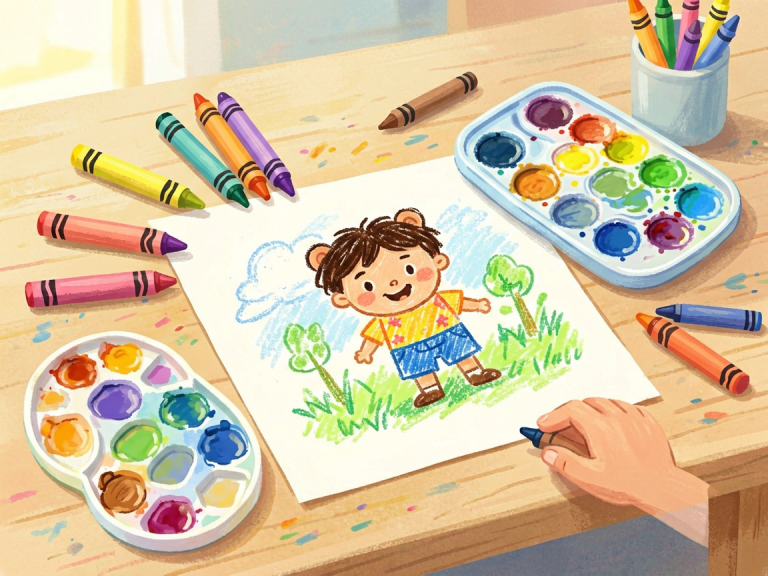
While not traditional “toys,” art materials are powerful tools for hand-eye coordination. Chunky crayons or egg-shaped crayons fit easily in a small hand. The child sees the mark they make on paper and adjusts their grip and pressure accordingly. Finger paints spread on a flat surface encourage the child to track their own hand movements. Play dough rolled into balls or pressed with cookie cutters requires visual targeting and hand strength. Even simple activities like dropping clothespins into a jar or placing pom-poms into an empty water bottle with tongs (supervised) work on the same neural pathways. The key is that the child is in control of the outcome, which builds persistence and coordination.
What to Avoid: Toy Traps That Undermine Development
As important as knowing what to choose is knowing what to avoid. Many toys marketed for 18-month-olds actually hinder hand-eye coordination development.
- Overly Automated Toys – Toys that do everything for the child (e.g., a toy that makes sounds when the child simply touches it anywhere, or a robot that moves on its own) teach passive observation. The child does not need to coordinate vision and hand action; they just need to tap randomly.
- Small, Loose Parts – Toys with many tiny pieces (like beads for stringing, or small plastic animals) are choking hazards and too demanding for a child who still lacks fine-motor precision. Save these for age three and up.
- Electronic Screens – Tablets and phones with “educational” apps are not recommended for 18-month-olds. Looking at a screen does not engage the same three-dimensional coordination as manipulating physical objects. The American Academy of Pediatrics recommends no screen time for children under 18 months (except video chatting). Screens can displace the hands-on play that builds coordination.
- Toys That Are Too Complex – A toy with ten different functions, multiple buttons, and intricate rules will confuse an 18-month-old. Frustration leads to throwing or abandoning the toy. Simplicity is your ally.
Tips for Playing Together: Scaffolding Coordination
The toy itself is only part of the equation. How a caregiver interacts with the child during play can dramatically enhance hand-eye coordination outcomes. Here are several evidence-informed strategies:
- Model Slowly – Show the child how to use the toy by performing the action slowly and narrating it: “I am putting the round shape into the round hole. Look, it fits!”
- Hand Over Hand – If the child is struggling, gently place your hand over theirs and guide the movement. Over time, reduce support as the child gains confidence.
- Positioning Matters – Place the toy at a comfortable height. A shape sorter should be on a low table or the floor. For art activities, use a high chair tray or a small table so the child does not have to reach awkwardly.
- Limit Distractions – Play should occur in a relatively quiet environment without a blaring TV or multiple competing toys. The child’s brain needs to focus on the visual and motor demands.
- Celebrate Effort, Not Just Success – When the child nearly fits the shape but drops it, clap and say, “Good try! You almost got it.” This encourages persistence, which is crucial for the repetitive practice needed to master coordination.
- Rotate Toys – Do not offer all toys at once. Keep a small selection (three to four) and swap them every few days. Novelty maintains interest, and repeated practice with a limited set deepens neural pathways.
Conclusion: Play as the Engine of Development
Choosing toys for an 18-month-old is not about buying the latest trend or the most expensive gadget. It is about understanding the remarkable work happening inside that little brain — the billions of neural connections being forged every time a hand reaches for a ring, a shape, or a crayon. Toys that prioritize safety, simplicity, and responsive feedback, and that fall into categories like stacking, sorting, pushing, or creating, provide the ideal training ground for hand-eye coordination. Moreover, when a caring adult sits beside the child, modeling, guiding, and celebrating, the toy becomes a tool not just for motor skills but for connection. The next time you stand in a toy aisle, remember: a simple wooden block can do more for an 18-month-old’s hand-eye coordination than a thousand flashing lights. Choose wisely, play enthusiastically, and watch the magic of coordination unfold — one grasp, one stack, one laugh at a time.