Screen-Free or Screen-Based? Choosing the Right Learning Tools for 18-Month-Olds
Introduction: The Crucial Developmental Window
At 18 months old, a child's brain is undergoing an extraordinary transformation. Neural connections are forming at a rate of over one million per second, laying the foundation for language, motor skills, social understanding, and emotional regulation. During this critical window, the toys and activities a toddler engages with are not merely entertainment—they are powerful sculptors of cognitive architecture. The debate between learning tablets and screen-free toys is therefore not a trivial parenting preference; it is a conversation about how we shape the developing mind. This article explores the developmental needs of an 18-month-old, evaluates the promises and pitfalls of learning tablets, and makes the case that screen-free toys offer more robust, research-backed benefits for this age group.
Understanding the 18-Month-Old Brain and Learning Style
An 18-month-old is a sensorimotor explorer. According to Jean Piaget's theory of cognitive development, children at this stage learn primarily through direct physical interaction with their environment. They grasp, shake, drop, stack, and mouth objects. They observe cause and effect in tangible ways: when a block is pushed, it falls; when a ball is rolled, it moves away. This hands-on learning is not a random activity—it is how the brain builds internal models of gravity, object permanence, spatial relationships, and physical causality.
Moreover, social learning is paramount. At 18 months, toddlers are intensely attuned to adult caregivers. They look to faces for emotional cues, mimic gestures, and respond to tone of voice. Language acquisition depends on contingent, back-and-forth communication—an adult saying "Look, a red ball!" and the toddler pointing, babbling, or reaching. This interactive loop is essential for vocabulary growth and pragmatic language skills.
Any learning tool for this age must align with these developmental realities: it must be hands-on, multisensory, and socially interactive. It must allow for trial and error, for messy exploration, and for the unpredictable joy of discovery that comes from physical manipulation.
The Allure of Learning Tablets: Promises and Pitfalls
Learning tablets marketed for toddlers promise a world of interactive education. They feature bright animations, animal sounds, letter recognition games, and touch-sensitive screens that reward taps with immediate feedback. Many parents are drawn to these devices because they appear to offer structured learning, independent play, and exposure to early academic concepts like numbers and letters.
However, the evidence for their effectiveness at 18 months is weak at best. The American Academy of Pediatrics recommends avoiding all screen media for children under 18 months, and for children 18–24 months, it advises only high-quality programming with a co-viewing adult. Why? Because at this age, children do not transfer learning well from two-dimensional screens to three-dimensional reality. A toddler who watches a video of a cat meowing may not connect that image to the real cat in the living room. This is called the "transfer deficit."
Furthermore, learning tablets often replace the very interactions that drive development. When a toddler taps a screen to hear a duck quack, the cause-and-effect is immediate and simplified. In contrast, when a toddler squeezes a rubber duck in the bathtub, the sound is produced by physical action, the texture is felt, the water splashes, and the caregiver might say, "Quack! The duck is wet!" This real-world experience is far richer in sensory, motor, and social dimensions.
Another pitfall is the impact on attention. Fast-paced screen animations can overstimulate a young brain, leading to shorter attention spans and difficulty engaging with slower, real-world activities. A 2022 study published in *JAMA Pediatrics* found that greater screen time at 12 months was associated with lower language scores at 24 months, even when controlling for socioeconomic factors. While correlation is not causation, the pattern is concerning.
Finally, learning tablets can disrupt parent-child interaction. A child absorbed in an app may not look up to share a moment of discovery with a caregiver. The device becomes a third party in the relationship, reducing the quantity and quality of joint attention—a key predictor of language development.
The Case for Screen-Free Toys: Rich, Multidimensional Learning
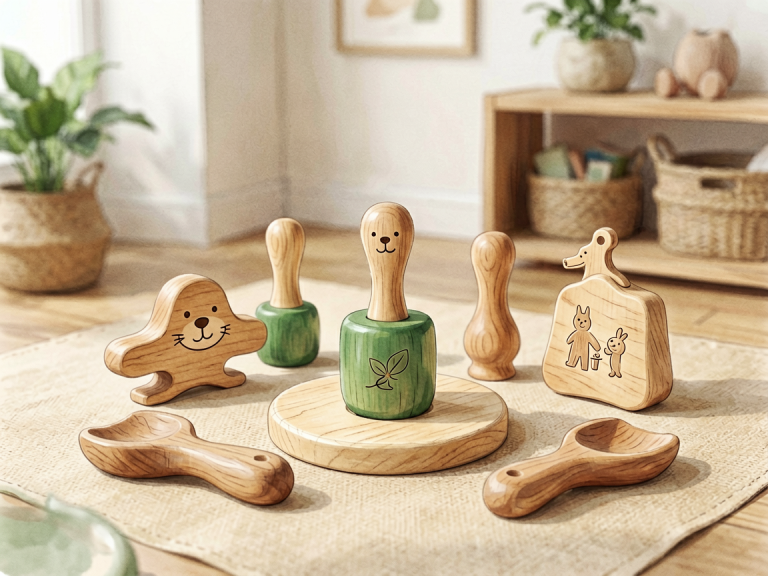
Screen-free toys for 18-month-olds are not "low-tech" or "old-fashioned"—they are neurologically appropriate tools. The best ones are open-ended, meaning they can be used in multiple ways without dictating a single outcome. Consider a set of wooden stacking cups. A toddler can nest them, stack them, knock them down, use them as drums, fill them with sand, or pretend they are hats. Each action teaches something different: nesting teaches size relationships; stacking teaches balance; knocking down teaches cause and effect; drumming teaches rhythm; filling teaches volume and weight. There is no screen to dictate "correct" or "incorrect" play—only the child's curiosity and imagination.
Sensory and Motor Development
Screen-free toys engage all the senses. A textured fabric ball offers visual, tactile, and even olfactory information. A set of plastic keys jingles and has varying shapes. A wooden puzzle with knobs requires fine motor precision to place each piece. These experiences build the neural pathways for hand-eye coordination, grip strength, and bilateral coordination. An 18-month-old who repeatedly tries to fit a square peg into a square hole is not failing—she is encoding the concept of shape matching into her brain through repeated physical effort. On a tablet, the same task might be solved with a swipe, bypassing the motor learning entirely.
Language and Social Interaction
Screen-free toys naturally invite conversation. A caregiver sitting on the floor with blocks can say, "Let's stack the red one on top. Uh-oh, it fell! Can you pick it up?" This interaction is rich in vocabulary, turn-taking, and emotional attunement. A learning tablet might have a voice that says "Red block!" but it cannot respond to the toddler's babble, adjust its pace based on the child's mood, or share a laugh when the tower crashes. Language is a social dance, and screens cannot dance with a toddler.
Creativity and Problem-Solving
Open-ended screen-free toys foster divergent thinking—the ability to generate multiple solutions to a problem. A toddler with a set of shape sorters learns that the triangle fits one hole, but the circle fits another. With a tablet, the app might present a single correct answer and move on. Real toys allow for failure and iteration. The toddler who tries to put a square peg into a round hole and fails, then tries again, is learning persistence and spatial reasoning in a way that a digital game cannot replicate.
Practical Recommendations for Parents and Caregivers
Given the developmental evidence, the most effective "learning tool" for an 18-month-old is a caring, engaged adult combined with simple, screen-free toys. Here are concrete suggestions:
- Prioritize simple, open-ended materials: Wooden blocks, stacking rings, nesting cups, shape sorters, cloth balls, push-and-pull toys, and board books with real photographs. Avoid toys that have a single function or require batteries.
- Limit screen time to video calls with family: The only screen activity strongly supported for this age is live video chat with a familiar person, because it involves real-time social interaction.
- Rotate toys to maintain novelty: Rather than overwhelming a child with many toys, rotate a small selection every few weeks. This encourages deeper exploration and reduces overstimulation.
- Join the play: The toy itself is only half the equation. Sit on the floor, follow the child's lead, narrate their actions, and celebrate their discoveries. This is far more powerful than any app.
- Beware of "educational" marketing: Many tablet apps claim to teach reading or math to toddlers, but these claims are not supported by research. No amount of digital flash cards can replace real-world conversation and manipulation.
Conclusion: The Best "Screen" Is a Human Face
The debate between learning tablets and screen-free toys for 18-month-olds often frames the choice as modernity versus tradition. But the real issue is developmental appropriateness. A tablet is a tool designed for older children and adults—it compresses rich, multidimensional experiences into a flat, simplified interface. A screen-free toy, by contrast, respects the toddler's need to move, touch, explore, and connect with a loving caregiver. The most advanced learning technology available to an 18-month-old is not a tablet; it is the human brain, and the best way to nourish that brain is through real-world play. When we choose a set of wooden blocks over a glowing screen, we are not rejecting technology—we are choosing to build the kind of mind that can later master technology with creativity and critical thinking. For an 18-month-old, the future is best built in the hands, not on the glass.