Navigating the Playroom: A Guide to Following Toy Trends for 9-Month-Olds
Introduction
The first year of a baby’s life is a whirlwind of rapid development, and by nine months, infants have transformed from helpless newborns into curious, mobile explorers. They sit independently, pivot on their tummies, crawl (or scoot, roll, or army-crawl), and many are beginning to pull themselves up to stand. This stage, often called the “little mover” phase, is a golden window for learning through play. Parents and caregivers who follow toy trends for nine-month-olds are not just buying into marketing hype—they are strategically selecting tools that support emerging motor skills, cognitive leaps, and sensory integration. However, the landscape of modern baby toys can be overwhelming. From Montessori-inspired wooden rainbows to high-tech interactive cubes, the options are endless. This article unpacks the most meaningful trends for nine-month-olds, grounded in developmental science, safety standards, and real-world practicality. Understanding these trends helps you cut through the noise and choose toys that truly engage, challenge, and delight your little one.
Understanding the 9-Month-Old Milestone: What Toys Should Support
Before diving into trends, it is essential to recognize what a nine-month-old is capable of and working toward. At this age, a baby is typically:
- Gross motor: Sitting without support, crawling (often in a cross-pattern), pulling to stand while holding furniture, and beginning to cruise sideways.
- Fine motor: Using a raking grasp to pull objects closer, transferring toys from hand to hand, banging two objects together, and beginning to use a pincer grasp (thumb and forefinger) for smaller items.
- Cognitive: Understanding object permanence (knowing that a hidden toy still exists), imitating simple actions, exploring cause and effect (e.g., dropping a spoon to watch you pick it up), and showing intentionality.
- Sensory and social: Mouthing objects to explore texture, responding to their name, showing stranger anxiety, and enjoying interactive games like peek-a-boo.
Toy trends that align with these milestones prioritize open-ended play, sensory diversity, and scaffolding—meaning the toy can be used in increasingly complex ways as the baby grows. Let’s explore the most notable trends.
Trend 1: The Rise of Open-Ended, Natural Materials
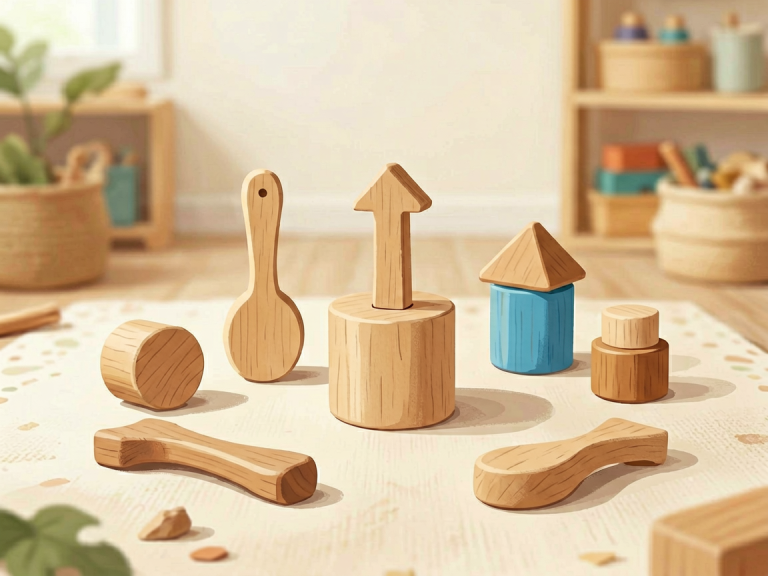
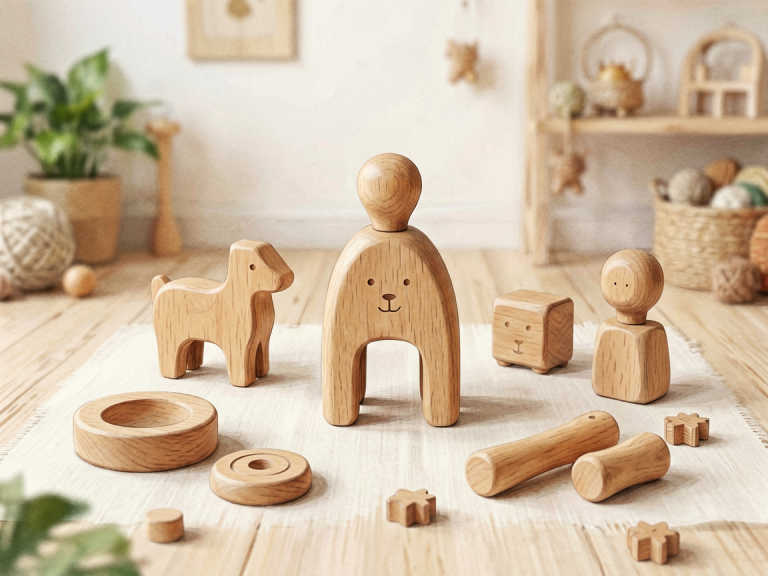
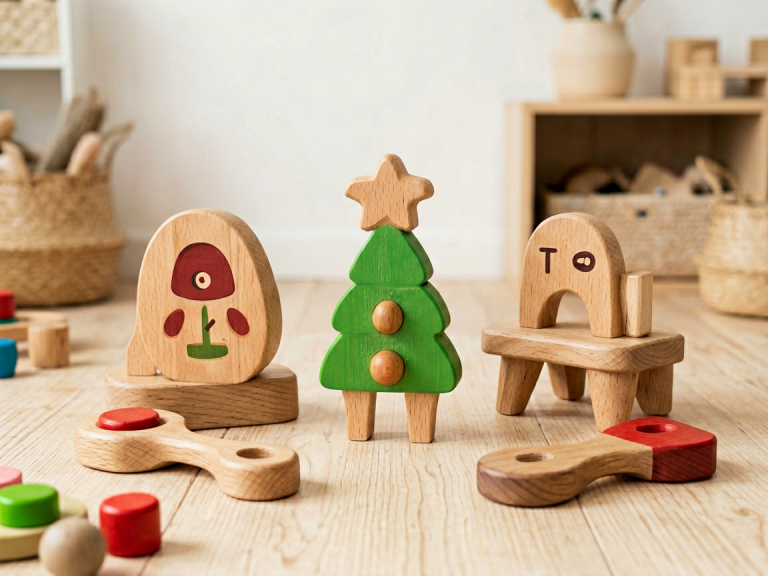
One of the strongest trends among mindful parents and early childhood educators is the shift away from plastic, battery-operated toys toward open-ended playthings made from natural materials like wood, organic cotton, and silicone. For nine-month-olds, this translates into items such as simple wooden stacking rings, rattles with different grains, and cloth blocks filled with crinkle paper.
Why it matters: At nine months, babies are actively mouthing objects—their primary way of exploring texture, temperature, and hardness. Natural materials offer richer sensory feedback than uniform plastic. A smooth maple ring feels different from a rough pine block; a cotton fabric tag engages touch differently than a hard plastic edge. Moreover, open-ended toys like a set of wooden cups or a simple set of balls do not dictate a single “correct” way to play. A nine-month-old can bang two cups together, drop one into another, or mouth the rim. As they approach twelve months and beyond, the same set becomes a stacking tower, a sorting game, or a pretend-play teacup. This long usability aligns with the growing trend of slow parenting and sustainability, reducing consumer waste.
Developmental psychologist Dr. Amanda Gummer, a leading voice in toy research, notes that “simple toys often support more complex cognitive development because the child must actively create the play scenario, rather than passively reacting to flashing lights.” For a nine-month-old, a wooden block that does not do anything on its own invites the baby to discover what *they* can do with it—a powerful lesson in agency.
Trend 2: Cause-and-Effect Toys with Real Feedback
While purists prefer all-natural toys, a counter-trend also dominates the market: smart, sensor-based cause-and-effect toys. However, the current iteration has evolved from the obnoxious, overstimulating plastic gadgets of the past. Today’s trend emphasizes intentional feedback that mimics real-world consequences. Examples include a wooden hammering bench where the pegs pop up when struck (a classic), a musical ball that produces a note when rolled, or a simple pop-up toy with switches, buttons, and levers that require deliberate motor control.
Why it matters: Nine-month-olds are delighted by their ability to make things happen. The brain’s prefrontal cortex is developing the neural pathways for contingency learning—“If I push this button, a sound comes out.” This lays the foundation for problem-solving and logical thinking. The key trend here is that the feedback should be predictable and gentle. Avoid toys with loud, jarring sounds or frantic flashing lights, which can overstimulate a developing nervous system and lead to avoidance or sensory overload. Instead, look for toys that produce a single, clear effect: a gentle chime, a bubble that appears, or a block that wobbles. This type of feedback teaches the baby that their actions have reliable consequences, fostering a sense of mastery.
Another subtrend within this category is mirror play. Simple, unbreakable acrylic mirrors angled on the floor or attached to activity gyms are extremely popular. At nine months, babies become fascinated with their own reflection, recognizing themselves (though full self-recognition typically develops later). They experiment with facial expressions, touch the mirror, and explore the concept of cause and effect when they wave and the reflection waves back. This social-emotional learning is a powerful low-tech trend.
Trend 3: Stacking, Nesting, and Simple Construction Sets
The classic stacking ring is a staple for good reason, but the trend has expanded into more sophisticated forms. Today’s stacking and nesting toys for nine-month-olds often feature asymmetric shapes, weighted bases, and multiple textures. For example, a set of silicone cups that can be nested inside each other, stacked into a tower, or used in the bath. Another popular item is a set of soft foam blocks with different cutouts, which allows the baby to practice grasping, releasing, and eventually fitting shapes into holes.
Why it matters: Around nine months, infants are developing what is called means-end behavior. They learn that stacking a ring on a peg requires a specific sequence: hold, aim, release. This builds hand-eye coordination and spatial reasoning. The trend toward nesting toys (which fit inside each other) also supports the concept of object permanence—a baby can watch a smaller cup disappear into a larger one and then dump it out, reinforcing the understanding that objects continue to exist even when out of sight. Many modern nesting sets include numbers or patterns, introducing early math concepts in a tactile way.
Parents often worry that their nine-month-old cannot yet stack correctly—they may only knock over a tower built by an adult. This is perfectly appropriate! Knocking over is actually an early form of cause-and-effect play and a sign of developing motor control. The trend encourages process over product: allow the baby to demolish your carefully balanced tower, and laugh together. This social interaction is far more valuable than the baby achieving perfect stacking.
Trend 4: Movement and Pull-Toys for New Crawlers
As nine-month-olds become increasingly mobile, toys that encourage movement are highly on trend. This includes lightweight push/walker toys—not the traditional baby walkers that are banned in many countries due to safety risks, but rather sturdy, sit-to-stand activity centers or simple wooden carts that a crawling baby can push from a kneeling position. Another movement trend is the pull toy with a short string. A nine-month-old can learn to pull a wooden animal on wheels while crawling backward or forward, which teaches motor planning and visual tracking.
Why it matters: The American Academy of Pediatrics strongly discourages the use of baby walkers with wheels, but a stationary activity center or a push toy that the baby can use while standing (and under close supervision) supports the development of leg strength and balance. Pull-toys, meanwhile, encourage trunk rotation and strengthening of the core muscles needed for sitting and crawling. The trend also includes ramps and inclined surfaces—such as a wooden ramp with a ball that rolls down, which a baby can crawl after. This combination of gross motor and visual tracking is excellent for cross-hemisphere brain development.
Many parents also report success with obstacle courses made from pillows, tunnels, and soft wedges. While not a single “toy,” this DIY trend aligns with the idea that the best play space for a nine-month-old is one that invites movement. Simple items like a yoga ball for supervised bouncing or a low wooden bar for pulling up are trending among attachment parenting communities.
Safety and Selection: How to Vet Trends for Your Baby
Following trends is only helpful if you filter them through a safety lens. At nine months, babies are oral explorers—anything they pick up goes directly into their mouths. The following guidelines are crucial:
- No small parts: Any toy or component that can fit inside a toilet paper roll (approx. 1.25 inches in diameter) poses a choking hazard. Avoid toys with buttons, eyes, or removable pieces that are not securely attached.
- Avoid strings longer than 12 inches: A pull toy string must be short enough that it cannot wrap around the baby’s neck. Better yet, choose toys with rigid handles rather than cords.
- Check for paint and finishes: Look for non-toxic, water-based paints and finishes (e.g., ASTM F963 or European EN71 certified). Avoid shiny finishes that may peel.
- Battery compartments: For any electronic toy, the battery compartment must be secured with a screw driver. Learn to spot brands that use welded seams or safety screws.
- Cleaning ease: Nine-month-olds drool profusely and often share toys with siblings. Choose toys that can be wiped down with mild soap and water or tossed in the washing machine.
Trend-wise, many eco-conscious brands like Lovevery, Grimms, and PlanToys have surged in popularity precisely because they prioritize safety standards and developmental appropriateness. However, do not feel pressured to buy expensive sets. A cardboard box, a set of wooden spoons, and a soft cloth ball can be just as effective as a $60 sensory board—the trend is about the *type of play*, not the price tag.
Conclusion: Trends as Guides, Not Rules
Following toy trends for nine-month-olds is less about chasing the latest Instagram-famous item and more about understanding the underlying developmental principles. The most meaningful trends today—natural materials, cause-and-effect feedback, stacking play, and movement encouragement—all stem from a deeper appreciation for how babies learn: through repetitive, hands-on, sensory-rich experiences that respect their individual pace. As a caregiver, you are your baby’s first and best toy. Your face, voice, and attentive interactions are more stimulating than any gadget. Use toy trends as a tool to enhance, not replace, that connection. When you observe that your nine-month-old is obsessed with dropping a spoon off the high chair for the hundredth time, you now know that this is not just mess—it is a profound lesson in gravity, object permanence, and social interaction. The trend to follow? Follow your baby’s lead. The best toy in the world is the one that sparks their unique curiosity, and the only trend that truly matters is one that brings joy, safety, and growth into your home.