Selecting Toys for Two-Year-Olds: A Guide to Boosting Hand-Eye Coordination
Introduction: The Playful Path to Development
At age two, a child is no longer a passive baby but an active explorer, a tiny scientist testing the limits of their own body and the physical world. One of the most critical skills they are developing during this period is hand-eye coordination – the ability to process visual information and use it to guide the hands in a precise, purposeful action. Whether it's stacking a block, fitting a shape into a hole, or scribbling with a crayon, these seemingly simple activities lay the neural groundwork for future writing, self-feeding, dressing, and even athletic performance. Choosing the right toys for a two-year-old is therefore not merely a matter of entertainment; it is a form of environmental design that can accelerate or hinder this delicate developmental process. This article provides a practical, research-informed framework for selecting toys that specifically nurture hand-eye coordination while honoring the unique needs of the toddler brain.
Why Hand-Eye Coordination Matters at Age Two
The second year of life is characterized by a tremendous leap in fine motor control. At twenty-four months, most children can build towers of four to six blocks, turn pages of a board book, and manipulate large knobs. By thirty months, they are often attempting to use a spoon with less spillage, unscrew a jar lid, and thread large wooden beads. These milestones are not automatic; they emerge through repeated, varied practice. Hand-eye coordination is not an isolated skill but an integration of vision, proprioception (body position awareness), and fine motor dexterity. When a toddler reaches for a toy, his brain calculates distance, angle, and force, then sends a cascade of commands to the small muscles of his fingers. Every successful or failed attempt strengthens these neural pathways. Toys that demand voluntary, goal-directed eye-hand engagement provide the ideal training ground. Conversely, toys that are overly passive – such as electronic gadgets that light up without requiring a physical response – often fail to build the same robust sensorimotor connections.
Core Principles for Toy Selection
Safety and Size: Non-Negotiables
Before considering educational value, inspect any toy for physical safety. For a two-year-old, all parts must be larger than a standard toilet paper roll to prevent choking. Avoid toys with sharp edges, toxic paints, or easily detachable magnets. Remember that two-year-olds often explore with their mouths, so materials should be non-toxic and washable. A good hand-eye coordination toy is one that the child can comfortably grasp with two hands – not so heavy that it causes frustration, not so small that it poses a hazard.
Match the Toy to the Zone of Proximal Development
The best toys are neither too simple (causing boredom) nor too complex (causing rage). A toy that is slightly above the child's current skill level – but achievable with effort – is the sweet spot. For instance, if a child has just mastered stacking rings on a cone, a more challenging toy might be a hammer-and-peg set where they must aim a mallet at dowels. The goal is to encourage sustained attention, which in turn develops bilateral coordination (using both hands together) and visual tracking. Watch your child play for a few minutes. If they continuously miss a target, provide a simpler version or demonstrate the action first. If they complete the task effortlessly, upgrade to a toy with more complex demands, such as threading beads with a slightly smaller hole.
Top Toy Categories That Train Eye-Hand Skills
Stacking and Nesting Toys
Classic stacking rings, cups, and nesting boxes are unsurpassed for two-year-olds. They require the child to visually estimate the size of the ring relative to the peg, then aim and release at the correct angle. This is a sophisticated spatial task. Stacking also teaches cause and effect, balance, and early mathematical concepts like top-bottom and big-small. Choose sets with a rocking or wobbling base for an extra challenge – these force the child to adjust their movements in real time, refining their coordination.
Shape Sorters and Peg Puzzles
Shape sorters are a staple for good reason. A two-year-old must rotate the triangle or star to align with the corresponding hole, using visual cues to adjust the orientation. This is a high-level executive function task combined with precise hand movements. Start with a simple sorter that has only three or four shapes, and gradually increase the number of shapes and the similarity between them (e.g., square vs. rectangle). Peg puzzles with large knobs are equally valuable. They train the pincer grasp, the same grip used later for holding a pencil. When choosing a peg puzzle, look for wooden pieces with a clear background image behind each piece, so the child receives visual feedback about where each piece belongs.
Stringing and Lacing Toys
Threading beads onto a shoelace or stringing oversized pasta tubes onto a cord is an excellent bilateral activity. One hand holds the string; the other stabilizes the bead; the eyes guide the tip of the string through the hole. This requires midline crossing, visual focus, and patience. For a two-year-old, choose beads with holes at least half an inch in diameter and a stiff, stiffened lace (or a wooden needle with a blunt tip). Always supervise this activity to prevent any accidental ingestion. Lacing cards – where a child pushes a lace through prepunched holes in a sturdy animal-shaped card – are another wonderful choice that can be done on a tray or lap.
Building Blocks and Interlocking Toys
Large, light wooden blocks are unmatched for developing spatial awareness and motor control. The child visually measures the distance between two stacked blocks, then carefully places a third block without knocking the tower. This is an exercise in visual-motor precision and impulse control. Magnetic tiles are also a favorite, as they click together with satisfying ease and require less force than traditional blocks, making them easier for small hands. However, avoid magnetic sets with tiny magnets that can be swallowed. Interlocking plastic bricks (like duplo, which are larger than standard bricks) are appropriate as well, but ensure the pieces fit together with moderate pressure – not too stiff for a two-year-old.
Art Supplies: Crayons, Markers, and Chalk
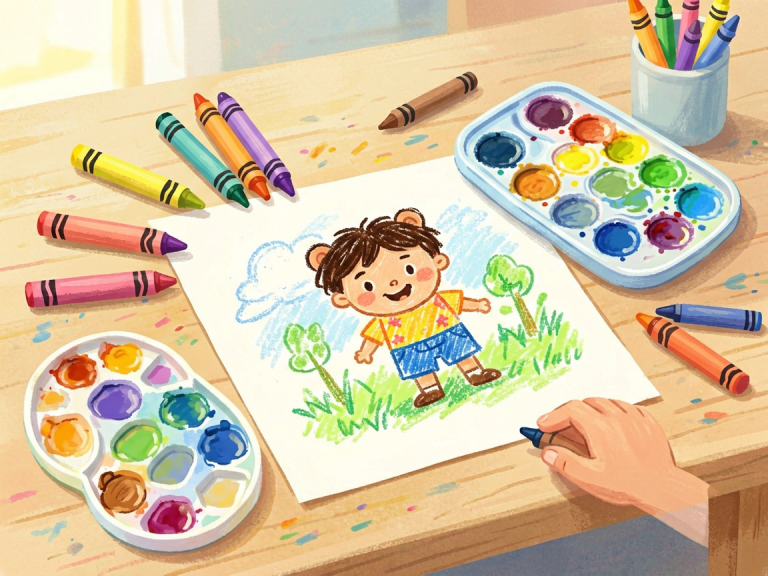
Art is wonderfully open-ended and reinforces hand-eye coordination more subtly. At two, children are learning to make controlled scribbles – dots, lines, and circular loops. These marks are direct translations of visual-motor planning. Provide chunky triangular crayons that naturally guide the fingers into a tripod grip, as well as washable markers with broad tips. Large sheets of paper taped to a table or an easel allow the child to draw with full-arm movements. Beyond drawing, give them child-safe scissors that only cut paper (with rounded blades) – supervised cutting is an exceptional skill builder, as the child must open and close the blades while watching the intended line. Start with snipping strips of paper, then move to cutting along thick lines.
Toys That Promote Movement and Aim
Throwing, catching, and rolling balls are profoundly important for hand-eye coordination at this age. A soft, lightweight ball (8 to 10 inches in diameter) that is easy to grasp helps a two-year-old learn to throw underhand and attempt to catch. Rolling a ball back and forth on the floor trains visual tracking and timing. Another fantastic category is "pounding" toys – for example, a wooden bench with pegs that you hit with a mallet. Hitting a peg squarely requires the child to visually locate the peg and swing the mallet with controlled force. Whack-a-mole style games where the child moves a mallet to hit a popping character are even more dynamic. These toys provide immediate audiovisual feedback that reinforces the correct motor pattern.
What to Avoid: The Hidden Foes of Coordination
While many toys on the market make grand claims, several types may hinder rather than help. First, avoid "no-fail" electronic toys that light up and play sound merely when a button is touched, without requiring aim, force, or visual tracking. These are passive experiences; the child does not need to adjust their hand based on visual feedback to succeed. Second, avoid toys with screens – tablets and phones – for prolonged play. Screen time at two has been linked to delays in fine motor development in several studies, largely because it replaces active, physical exploration. Third, avoid toys that require trivial precision, such as tiny jigsaw puzzles or small beads meant for jewelry making. These pose a choking risk and cause frustration. Finally, steer clear of toys that move unpredictably without parental control, like some remote-operated cars that might zoom away faster than a toddler’s eyes can follow, defeating the purpose of sustained visual-motor matching.
Put It All Together: Creating a Rich Play Environment
Selection is only half the battle; presentation matters too. Arrange toys on low, open shelves so the child can see and choose independently. Rotate toys every week or two to reintroduce novelty and challenge. More importantly, play alongside your two-year-old. Sit on the floor, model how to stack, encourage when they miss, and celebrate when they succeed. Your presence provides social motivation and emotional security, which boosts persistence. Time your play sessions when the child is well-rested and not hungry. Incorporate movement breaks – jumping on a cushion or dancing – to reset attention. And remember, the best toy may be an empty cardboard box that the child can push, climb into, or use as a house. A box encourages imaginative play that integrates whole-body coordination, which is the foundation of fine motor precision.
In conclusion, choosing toys for a two-year-old with hand-eye coordination in mind does not require a huge budget or the latest gadget. It requires an understanding of developmental milestones, a critical eye for safety, and a readiness to engage. Stacking rings, shape sorters, simple puzzles, lacing beads, large building blocks, and chunky crayons are timeless because they genuinely work. They challenge a toddler to look, aim, reach, grasp, and release – and to try again. When you select toys that invite those repeated efforts, you are not just providing a plaything; you are constructing a scaffold for lifelong learning. So the next time you stand in a toy aisle, ask yourself: What must my child's eyes and hands do together to play with this? If the answer involves careful looking and deliberate movements, you have made the right choice.