The Ultimate Parent Guide to Buying Pretend Play Sets for 18-Month-Olds
Introduction: Why Pretend Play Matters at 18 Months
At 18 months old, your toddler is standing at the thrilling threshold between babyhood and early childhood. They are likely taking their first confident steps, babbling with increasing purpose, and beginning to understand that objects in their world can represent something else entirely—a wooden block becomes a phone, a plastic cup becomes a drum, and a soft toy becomes a trusted friend. This is the magical dawn of pretend play, and choosing the right pretend play sets can profoundly nurture your child’s cognitive, social, emotional, and motor development.
However, the market is flooded with toys claiming to be “educational” or “age-appropriate,” and navigating this landscape as a parent can be overwhelming. This comprehensive guide will walk you through everything you need to know: the developmental benefits of pretend play for 18-month-olds, crucial safety considerations, the best types of pretend play sets to look for, features to prioritize, common pitfalls to avoid, and practical tips for introducing these toys into your toddler’s daily routine. By the end, you’ll feel confident and empowered to select pretend play items that will delight your child and support their growth during this pivotal stage.
The Developmental Power of Pretend Play for Toddlers
Cognitive Growth Through Imitation and Symbolism
At 18 months, a child’s brain is developing at an astonishing rate, forming about 700 to 1,000 new neural connections every second. Pretend play is one of the most effective ways to strengthen these connections. When your toddler picks up a toy telephone and babbles into it, they are practicing symbolic thinking—the ability to use one object to represent another. This is a foundational skill for later abstract reasoning, language development, and mathematical understanding. A simple play kitchen, for instance, allows your child to mimic actions they observe in real life (like stirring a pot or putting a toy plate in a sink), reinforcing memory, sequencing, and cause-and-effect learning.
Language and Communication Boost
Between 18 and 24 months, most children experience a vocabulary explosion, going from about 20 words to over 200 words in some cases. Pretend play sets natural create opportunities for dialogue, even if your child is only using single words or gestures. A toy doctor kit, for example, might prompt you to say, “Let’s check the bear’s temperature,” and your child might respond with “hot” or “boo-boo.” This back-and-forth interaction builds listening skills, turn-taking, and the understanding of narrative structure. Pretend play sets that include common household items like phones, keys, or cooking tools are particularly valuable because they connect directly to words your toddler hears daily.
Social-Emotional Learning and Empathy
Pretend play is a safe rehearsal space for real-life emotions. An 18-month-old might “feed” a doll, “put it to bed,” or “comfort” a stuffed animal that has fallen. These actions demonstrate early empathy and caregiving behavior. They also help toddlers process experiences that might be confusing or anxiety-provoking, such as a visit to the doctor, a bath, or a meal. By acting out these scenarios with toys, your child gains a sense of control and understanding. Furthermore, if you join in the play, you model cooperation, sharing, and emotional vocabulary—all critical social skills that will serve your child in daycare, playgroups, and beyond.
Fine Motor Skills and Coordination
Manipulating pretend play props—turning a faucet knob on a toy sink, fitting a puzzle piece into a play food item, or grasping a small plastic spoon—demands precision and dexterity. These activities strengthen the small muscles in your toddler’s hands and fingers, which are essential for later tasks like writing, buttoning, and using scissors. Look for sets that include pieces requiring pinching, stacking, twisting, or pressing (within safety limits) to maximize fine motor practice.
Essential Safety Considerations for 18-Month-Olds
Safety is non-negotiable for this age group. 18-month-olds are notorious for putting everything in their mouths, and their investigative nature means they will test the durability of any toy. When evaluating any pretend play set, keep these criteria in mind:
- No small parts: The general rule is that any toy or component should be larger than a standard toilet paper tube (about 1.25 inches in diameter) to avoid choking hazards. For 18-month-olds, err on the side of caution—avoid sets with removable buttons, beads, or tiny food items that could break off.
- Non-toxic materials: Ensure all paints, plastics, and fabrics are labeled as non-toxic and free from BPA, phthalates, and lead. Opt for toys that meet ASTM (American Society for Testing and Materials) or EN71 (European safety standard) guidelines.
- Durability: 18-month-olds are active and sometimes rough. Check that seams are reinforced, plastic edges are smooth, and wooden pieces are splinter-free. Avoid anything with sharp points or protrusions.
- No strings or cords longer than 12 inches: Long cords pose a strangulation risk. Some pretend play sets (like toy stethoscopes or telephone cords) may have strings; ensure they are either too short to wrap around a neck or completely detachable from the main toy.
- Battery compartments: If the play set has lights or sounds (and many do), the battery compartment should be secured with a screw—not a latch that a small hand can open. Loose batteries are both a choking and a chemical burn hazard.
Top Pretend Play Set Categories for 18-Month-Olds
1. Play Kitchens and Food Sets
A mini play kitchen—even a simple wooden one with a stove and sink—is a timeless favorite. Look for sets that are low to the ground (child-height) and have rounded corners. For this age, avoid sets with real small accessories like tiny plastic carrots or peas; instead, choose chunky, one-piece play food items such as a whole wooden apple, a plastic banana that is large enough to grip, or a set of sturdy felt vegetables. A few basic pots and pans with lids that fit snugly (but not too tightly) are excellent for stacking and banging. Avoid play knives or any sharp-edged utensils.
2. Toy Telephones and Communication Devices
18-month-olds love imitating adults on the phone. A classic play telephone with buttons that make sounds or light up is perfect—but ensure the buttons cannot be pried off. Alternatively, a simple wooden “phone” shaped like an old rotary dial (with no small dial parts) is safe and encourages speech. Some toy sets include a pretend tablet or remote control; if you choose these, verify that the “screen” is not a removable piece and that all edges are smooth.
3. Doctor and Medical Kits
Pretend medical play can help toddlers overcome fear of checkups. The best kits for this age feature oversized, soft, or wooden instruments. For example, a toy stethoscope that is one solid piece (no separate earpieces) and a wooden syringe (no needle) that your child can press. Avoid any kit that includes small plastic bandages, thermometers with mercury-like liquid, or tiny medicine bottles. A simple set with a pretend bandage that wraps around a stuffed animal’s leg is great—but the bandage itself should be a single strip of cloth with no adhesive parts.
4. Tool Sets and Construction Play
Many 18-month-olds are fascinated by watching parents use tools. A toddler-friendly tool set typically includes a toy hammer, screwdriver, and wrench made of soft, chunky plastic or wood. Pieces like toy “nails” or “screws” must be oversized (at least 2 inches long) and attached to a base board so they can’t be swallowed. Look for sets where tools are thick and rounded; avoid any piece that could be used as a weapon (like a saw or drill with realistic edges). Wooden peg pounding benches are a classic alternative that combine pretend play with fine motor practice.
5. Dolls, Stuffed Animals, and Accessories
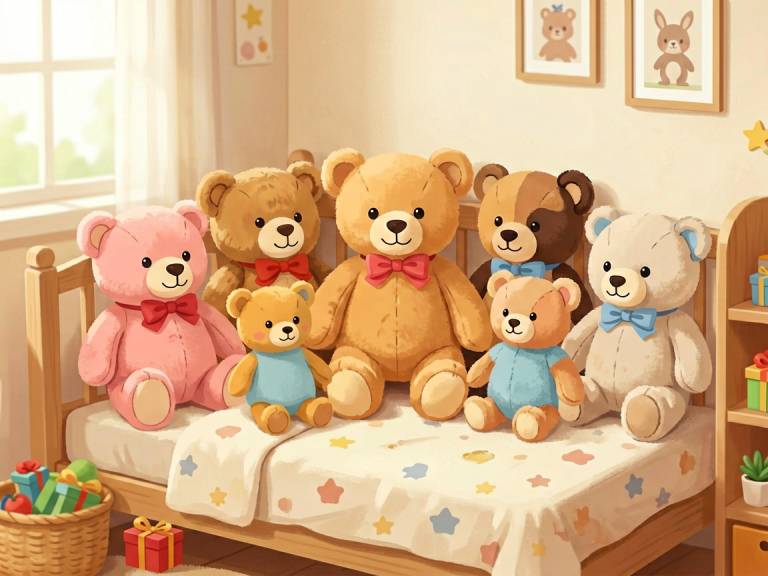
Simple baby dolls with soft bodies and removable (but large) clothing allow your toddler to practice nurturing. Choose dolls with painted-on faces rather than glued-on eyes that could become detached. A crib, stroller, or doll carrier made for these dolls encourages large motor movement as your child pushes or carries it. Likewise, a set of soft, washable stuffed animals—with no beans or beads inside—can be fed, bathed, and put to bed using play props like a small bowl and spoon.
Features to Look for When Choosing Pretend Play Sets
- Multi-functionality: The best toys for an 18-month-old are those that can be used in several ways. A wooden block set, for example, can become a “cake” in the play kitchen, a “car” in a construction scenario, or a “phone” when held to the ear. Avoid overly rigid, single-purpose toys that limit creativity.
- Real-world relevance: Toddlers learn best through imitation of everyday life. Sets that mirror activities they see—cooking, talking on the phone, caring for babies, fixing things—are more engaging than fantasy themes they cannot yet understand.
- Sensory variety: Look for toys that offer different textures, sounds, and visual stimuli. A wooden play food item might have a smooth painted surface, while a fabric one is soft and fuzzy. Some sets include crinkly paper sounds, rattles, or simple melodies. Sensory input helps solidify learning.
- Easy to clean: At an age when everything gets dropped, thrown, and chewed, you want toys that can be wiped down with a damp cloth or tossed in the washing machine. Avoid porous plastics or unsealed wood that can harbor bacteria.
- Encourages interaction: Pretend play is most effective when an adult or older sibling participates. Choose sets that are clearly meant for two or more people—for example, a toy pizza with slice pieces that you can “share” or a tea set with multiple cups.
What to Avoid: Common Pitfalls and Warnings
- Overly complex sets: Many retailers market multi-piece sets with dozens of tiny accessories as “age 18+ months.” In reality, most 18-month-olds will be overwhelmed by 50 tiny plastic taco toppings. Stick to 3-5 high-quality, large pieces that your child can successfully manipulate.
- Toys with unrealistic licenses: Character-driven toys (e.g., Paw Patrol or Peppa Pig) often come with a high price tag and limited play value for this age group. The child typically doesn’t yet know the character, and the toy may be designed as a collectable rather than an open-ended play item.
- Toys with loud or startling sounds: Some electronic pretend play sets emit abrasive sirens, beeps, or voices that can frighten a sensitive toddler. Listen to any sound effects before you buy, and check if there is a volume control switch.
- Second-hand or vintage toys: While thrifting is eco-friendly, older toys may not meet current safety standards. They could contain lead paint (common before 1978 in the US), small parts that have become loose over time, or broken edges. Unless you are certain of the toy’s origin and condition, buy new or from a trusted second-hand seller who checks for recalls.
Tips for Introducing Pretend Play Sets to Your Toddler
- Lead by example: Sit on the floor with your child and demonstrate how to use the toy. Create a simple scenario: “Time to make breakfast! Let’s put the egg in the pan.” Use exaggerated facial expressions and simple language.
- Follow your child’s lead: If your toddler picks up the play phone and holds it to your ear, accept it and say something silly. If they ignore the kitchen and start stacking pots, go with that flow. Pretend play should be unstructured and guided by the child.
- Rotate toys: Don’t dump out every pretend play set at once. Rotate two or three sets each week to keep interest high and prevent overstimulation. Store others out of sight.
- Keep it low-stakes: At 18 months, the “pretend” is just emerging. Your child might only imitate one action (like stirring) and then walk away. That’s perfectly fine. Celebrate the small moments of imitation.
- Incorporate daily routines: Use the pretend play sets to reinforce real-life routines. After bath time, you might say, “Let’s dry the doll with this towel,” or before a meal, “Let’s set the table with the play plates.”
Final Thoughts: Trust Your Instincts
Selecting pretend play sets for an 18-month-old doesn’t have to be a daunting task. By focusing on safety, simplicity, and open-ended possibilities, you can create a play environment that sparks imagination while respecting your child’s developmental stage. Remember that the most valuable “toy” in your home is you—your attention, enthusiasm, and willingness to enter your child’s imaginary world, even if it’s just for five minutes. The pot you hold becomes a drum, the block becomes a cookie, and the simple phone call you share becomes the foundation of a robust, curious mind.
Invest in a few well-made, thoughtful pretend play pieces, and watch with wonder as your 18-month-old begins to weave their first stories, one pretend set at a time.