Learning Tablets vs. Screen-Free Toys: What Science Says About Baby Development
Introduction
In today’s digital era, parents are bombarded with products promising to give their babies a head start in learning. Among the most controversial are “learning tablets”—child-friendly digital devices loaded with interactive apps, flashing lights, and educational games. On the other side of the nursery lies the classic alternative: screen-free toys—wooden blocks, textured balls, stacking rings, and simple musical instruments. The question is not merely about trend or convenience; it is about how a baby’s rapidly developing brain actually absorbs and processes information. Numerous pediatric studies and developmental psychologists now argue that screen-free, tactile, and open-ended play experiences are far more beneficial for infants and toddlers than any digital equivalent. This article explores the key differences between learning tablets and screen-free toys, examines the developmental science behind each, and offers practical guidance for parents navigating this important decision.
The Allure of Learning Tablets: Convenience and Marketing Hype
Learning tablets are often marketed as “educational” tools that can teach letters, numbers, colors, and even foreign languages before a child turns two. Their colorful, animated interfaces capture a baby’s attention instantly, and many parents appreciate the few minutes of quiet time these devices provide. However, a closer look at the evidence reveals significant concerns. The American Academy of Pediatrics recommends no screen time for children under 18 months (except for video chatting), and for children aged 2 to 5, only one hour per day of high-quality programming—and that programming should be co-viewed with a caregiver. Why such caution? Because a baby’s brain is wired to learn best through real-world interactions: through touch, taste, smell, movement, and the emotional feedback of a loving adult. A tablet screen, no matter how “interactive,” cannot replicate the sensory richness of grasping a rubber ball, feeling the texture of a wooden puzzle piece, or watching a caregiver’s facial expressions change in response to a shared laugh. Moreover, many learning apps use “reward loops” (sounds, sparkles, and animations) that overstimulate the infant’s developing reward system, potentially shortening attention spans and making low-stimulation real-world activities—like reading a picture book or exploring a rattle—seem dull by comparison.
The Science of Screen-Free Toys: Why Simple Is Better
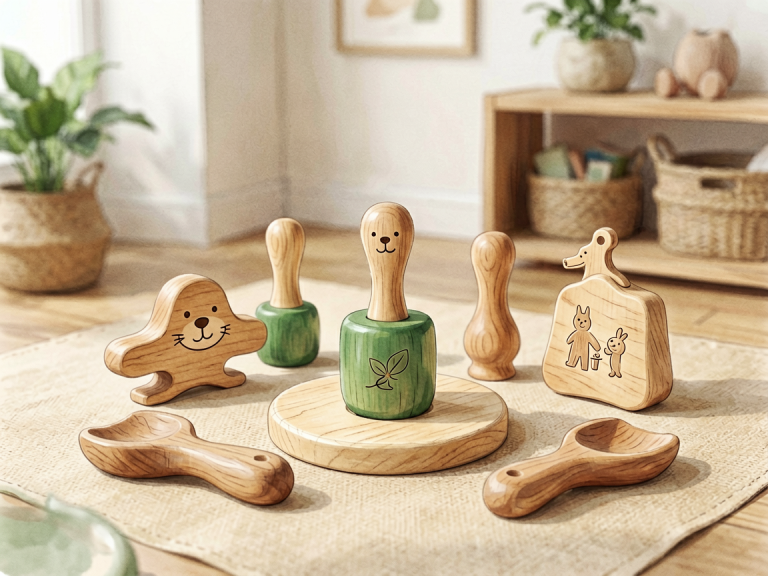
Screen-free toys, by contrast, engage a baby’s entire sensorimotor system. A classic set of wooden blocks, for instance, offers infinite possibilities: stacking, knocking over, sorting by color, rolling, and even chewing. These actions help develop fine motor skills, hand-eye coordination, spatial reasoning, and cause-and-effect understanding—all without a single battery. More importantly, screen-free toys encourage what child development experts call “open-ended play.” When a baby picks up a silicone teether shaped like a star, he is not following a digital script; he is exploring weight, temperature, and texture. When he shakes a rattle, he learns that his own movement produces sound, a fundamental lesson in agency and control. Neuroscientific research shows that such hands-on experiences strengthen neural connections in the sensorimotor cortex far more effectively than passive screen viewing. Additionally, screen-free toys foster social-emotional development. A caregiver who sits on the floor with a baby and rolls a ball back and forth is not just playing—she is building attachment, teaching turn-taking, and modeling language (“Your turn! I roll the ball to you!”). No app can replace that reciprocal human exchange.
Screen Time Risks: Sleep, Language, and Attention
The dangers of excessive screen exposure for babies go beyond missing out on tactile learning. Multiple longitudinal studies have linked early tablet use to delayed language development. One 2017 study published in *JAMA Pediatrics* found that for every 30-minute increase in daily screen time at age 1, a child’s expressive language skills at age 2 were significantly lower. Why? Because screen time displaces the most powerful language-learning tool: back-and-forth conversation with a live adult. A baby who stares at a tablet cannot see the caregiver’s mouth movements, cannot practice the rhythm of turn-taking in a dialogue, and cannot hear words spoken in context with gestures and real objects. Screen exposure also interferes with sleep regulation. The blue light emitted by tablets suppresses melatonin production, making it harder for babies to fall asleep and stay asleep. Poor sleep, in turn, impairs memory consolidation and emotional regulation. Furthermore, the rapid scene changes common in children’s apps have been shown to reduce a toddler’s ability to sustain attention during slower-paced activities like puzzles or story time. In contrast, screen-free toys—especially those that require effort and repetition—naturally train the brain to stay focused.
Practical Guidance for Parents: How to Choose and How to Use
Given the evidence, the optimal approach for babies under age two is clear: prioritize screen-free toys and avoid learning tablets altogether during the first 18 months. However, many families live in a world where screens are unavoidable. The key is to be intentional. If you do use a tablet with an older toddler (age 2+), choose apps that are truly educational (e.g., those that require active problem-solving rather than passive swiping) and co-view with your child, talking about what you see. Keep sessions short—no more than 15–20 minutes at a time—and never use screens as a babysitter. Meanwhile, build a toy box filled with objects that invite exploration: wooden stacking cups, crinkle fabric books, sensory balls with different textures, simple puzzles with large knobs, and musical instruments like a xylophone or shaker eggs. Rotate toys every few weeks to maintain novelty. Most importantly, remember that the most “educational” toy on the planet remains a responsive, loving caregiver. Your voice, your face, your touch—these are the tools that wire a baby’s brain for language, empathy, and curiosity. No tablet can compete.
Conclusion
The debate between learning tablets and screen-free toys for babies is not really a debate at all when viewed through the lens of developmental science. While tablets may offer temporary convenience and a flashy promise of early learning, the evidence overwhelmingly supports the superiority of screen-free, hands-on play for infants and toddlers. From fine motor skills and language development to social-emotional bonding and attention regulation, the benefits of simple, tactile toys far outweigh any supposed advantages of digital screens. As parents, we must resist the marketing pressure to turn every moment into a “learning opportunity” and instead trust in the ancient, powerful process of play. Let babies stack blocks, shake rattles, rip paper, and drop spoons. Let them make messes, make noise, and make eye contact. That is how real learning happens—one smile, one grasp, one giggle at a time.