Building Brains: The Surprising Science of Engineering Toys for 9-Month-Olds
Introduction
At nine months old, a baby is no longer a passive observer of the world. She is a tiny scientist, tirelessly conducting experiments: dropping a spoon to see if gravity still works, shaking a rattle to test sound production, or pushing a block off the table to confirm that objects fall. This is the very essence of scientific inquiry and early engineering thinking. Yet many parents, when shopping for toys, overlook the profound developmental potential hidden in seemingly simple objects. The right science or engineering toy for a nine-month-old does not require batteries, screens, or flashing lights. Instead, it invites the baby to manipulate, explore, and discover cause-and-effect relationships—the foundational skills of both science and engineering. This article will explore why these toys matter, how to choose them, and which specific features support your baby’s rapidly developing brain.
—
The 9-Month-Old Brain: A Window of Wonder
Between eight and twelve months, a baby’s cognitive abilities undergo a dramatic transformation. Neuroscientists call this period the “sensorimotor stage” in Piaget’s theory, during which infants learn through their senses and actions. At nine months, several milestones are particularly relevant to science and engineering play:
- Object Permanence: The baby now understands that objects continue to exist even when out of sight. This is a cornerstone of logical thinking—a precursor to understanding how parts of a system relate to one another.
- Cause and Effect: The baby deliberately repeats actions to produce a predictable outcome. For example, she will bang a toy on the floor to hear the sound again. This is the birth of experimentation.
- Fine Motor Precision: Pincer grasp (thumb and forefinger) allows the baby to pick up small objects, stack rings, or push buttons.
- Spatial Awareness: The baby starts to understand how objects fit together, inside and outside, on top and underneath—the rudiments of engineering concepts like stacking, nesting, and balance.
- Problem Solving: A nine-month-old will try to reach a toy hidden under a cloth, demonstrating goal-oriented behavior.
These emerging abilities mean that a well-designed science or engineering toy can do more than entertain—it can actively strengthen neural pathways associated with logic, reasoning, and creativity. In contrast, passive toys (like a musical mobile that plays without baby’s interaction) provide far less cognitive stimulation.
—
Defining “Science” and “Engineering” for the Infant Mind
When we talk about “science toys” for a nine-month-old, we are not referring to chemistry sets or microscopes. Instead, we mean toys that encourage the baby to observe, predict, test, and draw conclusions about the physical world. An engineering toy, similarly, is one that invites the baby to build, combine, or manipulate components to create a structure or achieve a function.
Key characteristics of such toys include:
- Open-endedness: The toy can be used in multiple ways, not just one prescribed action. A set of stacking cups, for instance, can be piled up, nested, knocked down, filled with smaller objects, or floated in water.
- Sensory Richness: Different textures, weights, temperatures, and sounds provide data for the young scientist to analyze.
- Feedback Mechanism: The toy clearly shows the result of the baby’s action. When she pushes a button, a ball pops up; when she stacks a block too far to the edge, it tumbles. This immediate, unambiguous feedback teaches her that her actions have consequences.
- Gradual Complexity: The toy can be used in increasingly sophisticated ways as the baby grows. A simple shape sorter, for example, starts with just exploring the holes, then later becomes a challenge of matching shapes.
It is important to distinguish between toys that are *truly* interactive versus those that simply react with random noise. A toy that plays a song when any button is pressed teaches little about cause and effect because the baby cannot predict which button does what. The best science toys offer consistent, predictable responses that the baby can learn to anticipate—and then intentionally produce.
—
Selecting the Right Science and Engineering Toys
Not every “educational” toy on the market lives up to its promise. Here are five specific categories of toys that genuinely foster scientific and engineering thinking in a nine-month-old, along with concrete examples and explanations of the skills they develop.
1. Stacking and Nesting Toys (Engineering Foundations)
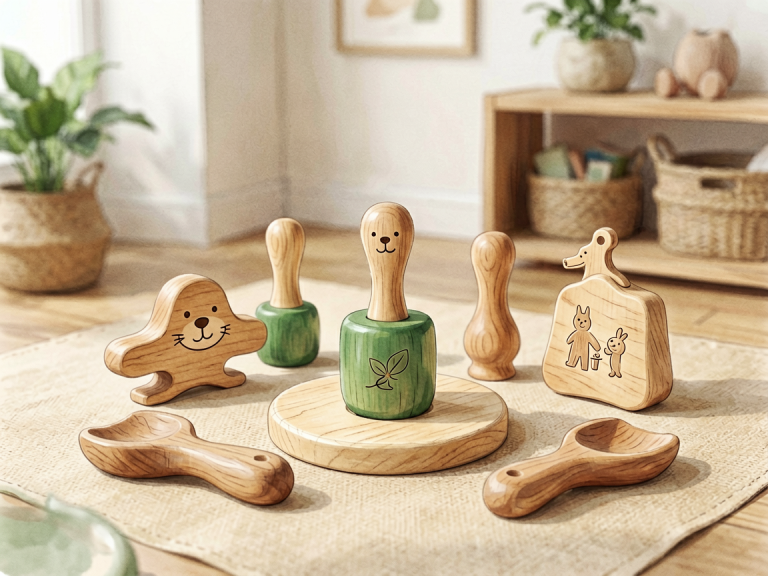
Classic examples: Stacking rings, nesting cups, wooden blocks (large, lightweight).
These toys directly support engineering concepts like balance, gravity, and structural stability. When a nine-month-old tries to place a ring onto a peg, she engages in a primitive form of construction: she must align the hole with the peg, adjust her grip, and release at the right moment. Every time the tower collapses, she learns about instability—a core lesson in structural engineering.
Nesting cups add another layer: she discovers that smaller cups fit inside larger ones, an introduction to volume, size ordering, and spatial relationships. Many parents observe their babies spend long minutes trying to force a large cup into a smaller one—a delightful demonstration of hypothesis testing (“Maybe if I push harder…”) and the subsequent discovery of a physical constraint.
2. Cause-and-Effect Activity Centers
Examples: Simple wooden or plastic activity boards with levers, knobs, pop-up animals, or doors that open.
These are the purest “science toys” for this age. The baby presses a button and a duck pops up; she pushes a lever and a bell rings. Each action produces a distinct, repeatable outcome. Over time, she learns to anticipate the effect and will actively choose which lever to push to achieve a desired result. This is essentially the scientific method in its simplest form: hypothesis (“If I push the red button, the dog will pop up”) → experiment → observation → confirmation or revision.
High-quality activity boards also incorporate different mechanical actions—sliding, turning, pressing, pulling—so the baby learns that different inputs produce different outputs, a foundational concept in systems thinking.
3. Pull-Along Toys (Motion and Physics)
Examples: Wooden animals on wheels, a push-pull lawn mower with rattling parts.
At nine months, many babies begin to crawl or cruise, and they love pulling a toy that follows them. This simple act teaches physics concepts like tension, trajectory, and resistance. When the baby pulls a string, the toy moves in the same direction—cause and effect in motion. If the toy gets caught on a table leg, she must change direction or pull harder, introducing ideas about force and friction.
Pull toys also encourage spatial planning: the baby must look back at the toy while moving forward, coordinating vision and action—a precursor to more complex engineering tasks like navigating a remote-controlled vehicle.
4. Object Permanence Boxes (Scientific Thinking)
Examples: A wooden box with a hole on top and a drawer on the side; a plastic ball drop tower.
These classic Montessori-style toys are excellent for developing logical reasoning. The baby drops a ball into the hole, and it disappears, only to reappear in the drawer below. At first, she may be surprised; after repeated trials, she anticipates the reappearance. This reinforces object permanence and also introduces the concept of a system with an input (dropping) and an output (the ball in the drawer).
More advanced versions have multiple levels or paths, forcing the baby to track the ball’s movement and predict where it will emerge. This is science in action: observing a phenomenon, forming a mental model, and testing it.
5. Textured Sensory Balls and Soft Blocks (Materials Science)
Examples: A set of balls with different surfaces (bumpy, smooth, ridged, soft spikes); fabric blocks with crinkle paper, bells, and mirrors.
While these may not appear “scientific,” they introduce babies to the properties of materials—an important branch of engineering. The baby learns that a spiky ball feels different from a velvet ball, that a fabric block makes a crinkling sound when squeezed, and that a rubber ball bounces while a knitted one does not. She begins to categorize objects based on their sensory properties, which is the foundation of classification—a key scientific skill.
Additionally, holding and manipulating objects of varying weights and textures refines the haptic feedback system that engineers use when designing user interfaces or tactile components.
—
Practical Tips for Playing with Your 9-Month-Old
Even the best science toy becomes ineffective if the adult’s play style stifles the baby’s agency. Here are evidence-based strategies to maximize learning:
- Follow the baby’s lead. If she is fixated on shaking a cup instead of stacking it, let her shake. She is exploring the sound property—a valid scientific inquiry.
- Narrate the action. Say, “You dropped the block! It fell down!” or “Ooh, the ball came out!” This labels cause-and-effect and builds vocabulary.
- Avoid over-correcting. Let the tower fall. Let her “fail” at putting the ring on the peg. Failure is a powerful learning tool; she will try a different angle next time.
- Rotate toys. Babies lose interest if the same five toys are always available. Rotating every few days keeps novelty high and encourages deeper exploration of each toy.
- Create a “provocation.” Place a new toy on the floor near her but slightly out of reach. The challenge of retrieving and manipulating it adds a problem-solving layer.
—
Safety Considerations
Science and engineering toys for nine-month-olds must meet strict safety standards. Small parts are a choking hazard—anything that can fit inside a toilet paper tube is too small. Avoid toys with sharp edges, long strings (potential strangulation), or magnets that could be swallowed. Always check for non-toxic paints and durable construction. Even a seemingly safe stacking cup can become dangerous if it has a hole that allows a tiny finger to get stuck. Supervision is essential, especially during activities like ball drops where the baby might try to put the ball in her mouth. Remember that the best toy is one that engages the brain, not just the mouth.
—
Conclusion
The period around nine months is a golden age of discovery. The baby’s brain is uniquely primed to notice patterns, test actions, and build mental models of how the world works. By selecting toys that tap into these natural impulses—stacking toys, cause-and-effect centers, pull-along objects, permanence boxes, and textured sensory items—parents can provide a rich foundation for future scientific and engineering thinking. These toys do not need to be expensive or high-tech; a simple set of nesting cups can teach more about gravity, order, and perseverance than any app ever could. The most important thing is to let the baby be the scientist—and to marvel at every dropped spoon as a tiny triumph of curiosity. In nurturing that curiosity, we build not just brains, but a lifelong love for figuring out how things work.