Beyond the Brick: The Best Alternatives to LEGO® Style Bricks for 18-Month-Olds
Introduction
Watching a toddler explore the world is a marvel of early childhood. At 18 months, a child is no longer a passive infant; they are a curious, mobile, and increasingly dexterous little person who wants to stack, knock down, and manipulate objects. It is no surprise that many parents instinctively reach for building blocks, and LEGO bricks are often the first name that comes to mind. However, classic LEGO bricks—with their tiny size, sharp edges, and intricate clutch power—are a hazard and a frustration for children under three. The small pieces pose a serious choking risk, and the fine motor skills required to separate them are simply beyond a toddler’s capabilities. Fortunately, the toy world has responded with a wealth of thoughtful alternatives that are safe, developmentally appropriate, and just as engaging. These alternatives not only protect your child from harm but also support the critical cognitive, physical, and social growth that happens at this age. In this article, we will explore the reasons why standard LEGO bricks fall short, establish the criteria for an ideal toddler building toy, and then dive into the five best alternatives that will delight your 18-month-old while giving you peace of mind.
—
Why LEGO Bricks Are Not Suitable for 18-Month-Olds
Before we look at alternatives, it is important to understand exactly why the iconic LEGO brick is off-limits for an 18-month-old. First and foremost is safety. The standard LEGO brick measures just over 1 cm in length and easily fits inside a toddler’s mouth. According to the Consumer Product Safety Commission, any toy or part that can pass through a toilet paper tube (approximately 3.2 cm in diameter) is a choking hazard for children under three. LEGO bricks and their accessories—minifigures, wheels, windows—all fall into this dangerous category. Even if you supervise closely, babies and toddlers are lightning-fast and often stuff objects into their mouths before a parent can react.
Beyond safety, there is the issue of dexterity. An 18-month-old’s pincer grasp is still developing. They can pick up larger objects, but the force required to push two LEGO bricks together and then pull them apart is significant. Frustration often sets in quickly, leading to tears and a discarded toy. Toddlers at this stage learn best through success and repetition; a toy that is too difficult to manipulate will not hold their interest and may even discourage the very fine-motor practice they need.
Finally, the small size of LEGO bricks limits the type of play that is most beneficial for an 18-month-old. At this age, children are exploring cause and effect—what happens when I drop this? What if I bang two blocks together? Can I stack this on top of that? LEGO bricks are so small that the act of stacking feels more like a precise engineering task than a joyful experiment. Larger blocks, by contrast, allow for gross-motor arm movements, whole-hand grasping, and satisfying “crashes” that build confidence and spatial awareness.
—
Criteria for Safe and Developmental Alternatives
When searching for the best LEGO alternatives for an 18-month-old, parents should keep several key criteria in mind. These guidelines will help you filter out toys that are not only safe but also enrich your child’s development.
1. Size and Choking Hazard
All parts should be larger than 1.5 inches (about 4 cm) in any dimension to ensure they cannot be swallowed or lodged in the airway. Many brands explicitly state “choke-test approved” or “for ages 1+.”
2. Material and Durability
Blocks should be made from non-toxic, BPA-free, and phthalate-free materials. Soft plastic, foam, or solid wood with water-based finishes are ideal. Avoid anything with sharp corners or small magnets that could be ingested.
3. Ease of Connection and Separation
The ideal block requires minimal force to connect and disconnect. Some alternatives use a friction-fit that is gentle on little fingers, while others rely on magnetic attraction or simple stacking without any interlocking mechanism.
4. Sensory and Motor Engagement
Look for blocks that offer varied textures, bright colors, and possibly sound or light features. They should encourage both gross-motor movements (lifting, carrying, swatting) and fine-motor skills (grasping, placing, rotating).
5. Open-Ended Play Potential
The best toys for toddlers are those that do not prescribe a single outcome. The building set should allow for free exploration, pretend play, and multiple ways to create—sparking imagination rather than requiring instruction-following.
—
Top 5 Best Alternatives to LEGO Style Bricks for 18-Month-Olds
With these criteria in mind, here are five outstanding alternatives that have been tested by parents, recommended by occupational therapists, and adored by toddlers.
1. Mega Bloks First Builders
Mega Bloks is perhaps the most well-known direct alternative to LEGO for toddlers, and for good reason. The First Builders line features oversized blocks that measure roughly 2 inches by 2 inches, making them completely safe for an 18-month-old. The blocks are hollow plastic, lightweight, and have a gentle interlocking system that even a one-year-old can click together with a simple push. They are also remarkably easy to pull apart, which encourages repetition and reduces frustration.
What sets Mega Bloks apart is the variety of sets. You can find basic bucket sets with 80 pieces in primary colors, or themed sets with animals, wheels, and even a small figure. For an 18-month-old, the plain bucket is ideal because it offers pure, open-ended stacking. Children can build towers, walls, or simply sort the colors. The blocks also fit into larger vehicles or bases that come with some sets, adding a layer of pretend play. The material is soft enough that if a block is thrown (and it will be), it does not damage floors or cause injury. Mega Bloks are dishwasher-safe, a huge plus for hygiene. Although the blocks are larger than LEGO Duplo, they are compatible with Duplo in some cases (though not perfectly), making them a future-proof investment.
2. LEGO Duplo (Large Bricks)
It may seem ironic to list a LEGO product as an alternative to LEGO, but Duplo is a completely different toy from the classic brick. Duplo bricks are exactly eight times the volume of a standard LEGO brick, meeting the size requirement for toddlers. They are sturdy, easy to grasp, and the clutch power is intentionally low so that small hands can assemble and disassemble them without help.
Duplo sets for 18-month-olds often feature large single-piece animals, vehicles, and figures that do not require any building—just imaginative play. The Duplo brick itself is designed so that a child can easily press two together and then pull them apart. Many sets also include basic shapes like arches and wheels. One distinct advantage of Duplo is its compatibility with standard LEGO: when your child turns three or four, their Duplo bricks can be used together with smaller LEGO bricks on the same baseplate, offering a seamless transition. For the 18-month-old stage, the “My First” Duplo sets, such as the Number Train or the Animal Bricks, are excellent. They come with a low number of pieces and a clear thematic focus that supports vocabulary development and imaginative storytelling.
3. Soft Building Blocks (Foam or Fabric)
For the youngest toddlers who are still prone to chewing and mouthing, soft building blocks are the safest choice. There are many brands, including Fisher-Price, B. Toys, and generic foam sets, that produce blocks made from EVA foam or stuffed fabric. These blocks are completely noiseless when knocked over, lightweight, and often feature different textures, mirrors, crinkle paper, or squeakers embedded inside.
Soft blocks are not just safe; they are uniquely suited to the way an 18-month-old plays. A child can bite them without harm, throw them with abandon, or use them as pillows. Because they do not interlock, stacking requires careful balancing, which teaches proprioception and cause-and-effect in a low-risk way. The slight squishiness of the foam provides satisfying sensory feedback. Many sets include blocks with numbers, letters, or animal faces, allowing for early literacy and shape recognition. For an 18-month-old who is still mouthing objects constantly, soft blocks are a worry-free option that supports all forms of exploratory play.
4. Magnetic Tiles (Large, High-Quality Sets)
Magnetic tiles have gained enormous popularity in recent years, and for good reason: they offer a magical experience that feels almost effortless. Tiles like Magna-Tiles or Picasso Tiles are transparent, colorful, and contain strong but safely encased magnets around the edges. When a toddler brings two tiles close together, they snap into place with a satisfying click. There is no pressing or aligning required—just a gentle touch.
However, caution is necessary for an 18-month-old. Not all magnetic tiles are suitable. You must choose sets with tiles that are at least 3 inches wide and do not have small magnets that could become loose. Reputable brands like Magna-Tiles have reinforced edges and meet all safety regulations. For a toddler, the simplest open-ended set of large squares and triangles is perfect. They can lay the tiles flat on the floor to create a “road,” stack them to make a tower, or simply explore how the magnets attract and repel. This type of play builds hand-eye coordination and introduces basic concepts of geometry and polarity. Because the tiles are see-through, they also stimulate visual tracking and color mixing when held up to light. Always supervise magnetic toys to prevent chewing, but when used correctly, they are an exceptional alternative that will grow with the child for years.
5. Wooden Unit Blocks
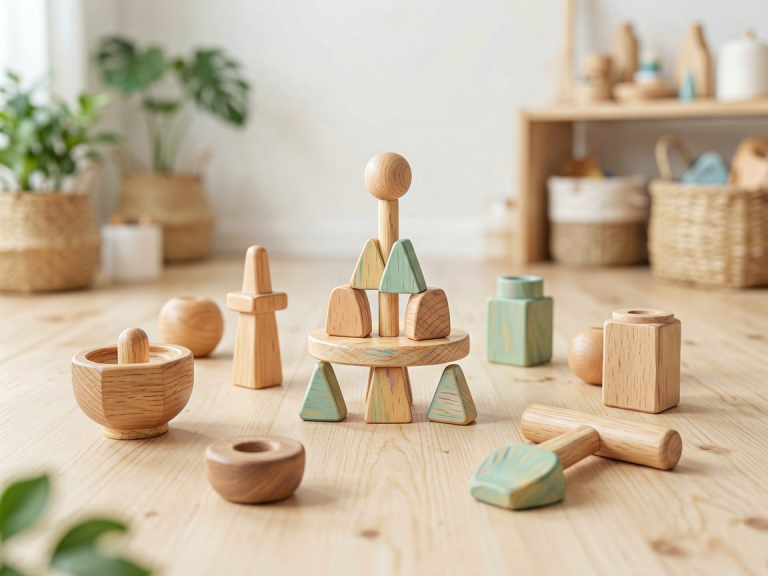
There is something timeless about a set of unpainted or lightly painted wooden blocks. Unlike plastic interlocking blocks, wooden unit blocks are simple rectangles, cubes, cylinders, and arches that children stack and balance without any connectors. Brands like Melissa & Doug, Hape, and Grimm’s offer sets specifically designed for toddlers, with edges that are gently rounded and finishes that are non-toxic.
For an 18-month-old, the weight of a wooden block provides excellent proprioceptive input—the sense of where one’s body is in space. Lifting a slightly heavier block and placing it on top of another requires concentration and motor planning. Wooden blocks also make a satisfying clack sound when they fall, which toddlers find hilarious and educational (they learn consequences!). Because there is no interlocking mechanism, children must develop a steady hand and a sense of balance. These blocks encourage what educators call “constructive play,” where the child is the master of the building process. A simple set of 25 to 40 blocks is more than enough for this age. They can be used for pretend play—a block becomes a phone, a car, or a piece of food. Wooden blocks are durable, sustainable, and often become family heirlooms.
—
How to Choose the Right Set for Your Toddler
With so many excellent options, how do you decide? Consider your child’s current developmental stage and temperament. If your toddler still puts everything in their mouth, start with soft foam blocks. If they are already showing an interest in connecting things and have good motor control, Mega Bloks or Duplo are ideal. If you want a toy that is visually stunning and encourages cooperative play, magnetic tiles are a great choice. For a Montessori-inspired, no-frills approach, wooden unit blocks are unmatched.
Always check the age recommendation on the packaging—but note that many brands are conservative. An 18-month-old can handle most toys labeled “18 months+” or “2 years+,” provided the parts are large. Avoid any set that includes small character figures, wheels that pop off, or other accessories that could become detached. Also consider the number of pieces: more is not always better. Too many blocks can overwhelm a toddler. A starter set of 20–40 pieces is perfect.
—
Conclusion
The search for the best alternatives to LEGO style bricks for an 18-month-old is not about denying your child a beloved toy—it is about giving them the right tool for their current stage of growth. Standard LEGO bricks are a wonderful toy for older children, but for a toddler, safety, ease of use, and developmental appropriateness come first. Mega Bloks, LEGO Duplo, soft foam blocks, magnetic tiles, and wooden unit blocks each offer a unique blend of sensory stimulation, fine-motor challenge, and open-ended creativity. By choosing one—or a combination—of these alternatives, you are not only keeping your child safe but also laying a strong foundation for problem-solving, spatial reasoning, and the pure joy of building. Let your little one stack, tumble, and rebuild to their heart’s content. That is the true spirit of play.