Are Wooden Blocks Worth It for 4-Year-Olds? A Comprehensive Analysis
Introduction
In an era dominated by flashing screens, talking robots, and app-based learning, the humble wooden block can seem almost quaint. Yet parents, educators, and child development specialists frequently champion this classic toy as an essential part of early childhood. For parents of a 4-year-old, the question “Are wooden blocks worth it?” is not merely about cost—it touches on fundamental decisions about how children learn, play, and grow. At age four, children are at a critical juncture: they have outgrown the simple grasping and mouthing of infancy, yet they are still years away from abstract reasoning. Their play becomes more purposeful, imaginative, and social. This article explores the multifaceted value of wooden blocks for 4-year-olds, examining developmental benefits, practical considerations, and comparisons with modern alternatives. Ultimately, the evidence strongly suggests that wooden blocks are not only worth the investment but are one of the most valuable toys a parent can provide for a child at this age.
The Unmatched Developmental Benefits of Wooden Blocks
Fine Motor Skills and Hand-Eye Coordination
At age four, children are refining their fine motor control. Wooden blocks require precise grasping, stacking, and balancing. Unlike plastic blocks that often snap together easily, wooden blocks rely on gravity and friction. A 4-year-old must learn to adjust the angle of their wrist, apply the right amount of pressure, and coordinate their visual perception with their hand movements. Each time a child carefully places a block on top of another, they are strengthening the small muscles in their fingers and hands—muscles that will later be essential for writing, drawing, and using scissors. Research in occupational therapy consistently shows that open-ended building toys like wooden blocks promote bilateral coordination (using both hands together) and the development of a mature pincer grip. These are not trivial skills; they form the neurological foundation for academic tasks.
Spatial Awareness and Early Mathematical Thinking
Wooden blocks are three-dimensional objects, and when a 4-year-old builds a tower, a bridge, or an enclosure, they are engaging in spatial reasoning. They learn that a larger block must support a smaller one, that two blocks of equal size can create a stable base, and that symmetry affects balance. These experiences are early lessons in geometry, physics, and mathematics. Studies have shown that preschool children who engage in block play demonstrate better performance on tests of spatial visualization and mental rotation—skills that predict later success in STEM fields. Furthermore, counting blocks, comparing sizes, and sorting by shape introduce foundational concepts of number sense, classification, and measurement. A set of wooden blocks naturally invites mathematical language: “How many blocks are in your tower?” “Which block is longer?” “Can you make a square with these four triangles?” This kind of embedded learning is far more effective than flashcard drills because it is meaningful and child-directed.
Cognitive Skills and Problem-Solving Abilities
Cause and Effect, Trial and Error
When a 4-year-old builds a tower that collapses, they do not see failure; they see a problem to solve. Wooden blocks provide immediate, unambiguous feedback. If a block is placed incorrectly, the structure wobbles or falls. The child must then analyze what went wrong: Was the base too narrow? Was the block too heavy on top? Did I bump the table? This process of trial and error is the essence of scientific thinking. Unlike digital games that may offer hints or automatic corrections, wooden blocks require the child to generate their own hypotheses and test them. Over time, children develop persistence, frustration tolerance, and the ability to learn from mistakes—all crucial cognitive and emotional capacities.
Executive Function and Planning
Building a complex structure—say, a castle with walls, towers, and a gate—requires planning and sequencing. A 4-year-old must hold a mental image of their goal and then decide which blocks to use, in what order, and how to troubleshoot along the way. This taps into executive functions: working memory (remembering the plan), inhibitory control (stopping themselves from knocking it down impulsively), and cognitive flexibility (adjusting the plan when a block doesn’t fit). Neuroscientists have found that executive function in early childhood is a stronger predictor of academic success than IQ. Wooden blocks, because they are open-ended and require sustained attention, are an ideal tool for developing these higher-order thinking skills.
Creativity and Imaginative Play
Endless Possibilities, No Instructions
One of the greatest strengths of wooden blocks is that they do not come with a prescribed storyline. Unlike a branded playset that dictates a specific narrative (e.g., a princess castle with fixed characters), a set of simple wooden blocks can become anything: a farm, a spaceship, a city, a dinosaur cave, a house for a stuffed animal. At age four, children’s imaginations are blooming, and they often engage in symbolic play where a block represents a car, a person, or a tree. This type of representational thinking is a critical cognitive milestone. Moreover, because wooden blocks are neutral in color and shape (often natural wood or simple primary colors), they do not limit a child’s creative expression. A child can build a rocket today and a zoo tomorrow, using the same materials. This versatility fosters divergent thinking—the ability to generate multiple solutions to a problem—which is the bedrock of creativity.
Storytelling and Language Development
As children build, they often narrate their actions. “This is the door, and the dragon is coming. We need a strong wall.” This spontaneous storytelling expands vocabulary, sentence structure, and narrative skills. While playing alone or with peers, 4-year-olds practice using language to plan, negotiate, and describe. A parent or caregiver who sits nearby and asks open-ended questions (“What happens next?” “Why did the tower fall?”) can further enrich linguistic development. Unlike passive screen time, block play is active, verbal, and socially engaged.
Social and Emotional Growth
Learning to Share, Cooperate, and Negotiate
When two 4-year-olds play with the same set of blocks, they must navigate a miniature social world. They learn to take turns, ask for a specific block, agree on a shared plan, and resolve conflicts when a tower collapses or when someone wants to use the same piece. These interactions are rich opportunities for emotional regulation and empathy. Research in early childhood education shows that cooperative block play correlates with higher levels of prosocial behavior. Moreover, because block play is non-competitive—there is no winner or loser—children can focus on the process rather than the outcome. This reduces anxiety and promotes a growth mindset.
Sense of Accomplishment and Self-Esteem
There is a unique satisfaction in building something tangible with one’s own hands. For a 4-year-old, completing a structure that stands tall provides a powerful sense of mastery. Unlike many digital achievements that are fleeting and abstract, a block tower is real. It can be admired, modified, or knocked down. This concrete feedback helps children develop a realistic sense of their own competence. They learn that their efforts have visible results, which builds intrinsic motivation—the desire to engage in an activity for its own sake rather than for external rewards.
Comparison with Other Common Toys for 4-Year-Olds
Plastic Construction Sets (e.g., LEGO Duplo)
LEGO Duplo blocks are a popular alternative. They are larger than standard LEGO and easier for small hands. However, they rely on interlocking mechanisms that can be frustrating for some 4-year-olds who lack the finger strength to push pieces together tightly. Furthermore, Duplo sets often come with specific themes and instructions, which can stifle open-ended creativity. Wooden blocks, by contrast, require no force to connect and invite unlimited configurations. That said, Duplo offers more detail (wheels, windows, figures) that some children enjoy. A balanced toy collection might include both, but for pure open-ended building, wooden blocks have an edge.
Electronic Tablets and Educational Apps
Many parents wonder if apps can teach the same skills. While some digital games claim to improve spatial reasoning or problem-solving, the evidence is mixed. Screen time for 4-year-olds is best limited, and research indicates that hands-on, three-dimensional play is superior for developing motor skills, depth perception, and social interaction. Moreover, the passive nature of a screen—where tapping a button produces an instant effect—does not teach the patience and resilience that come from physically balancing a block. Wooden blocks also avoid the issues of eye strain, blue light exposure, and addictive game mechanics. For these reasons, wooden blocks are a far healthier choice for cognitive and physical development.
Other Open-Ended Toys (e.g., Magnetic Tiles, Clay)
Magnetic tiles (like Magna-Tiles) are another excellent open-ended toy. They have the advantage of being easier to build vertically because magnets hold pieces together. However, they lack the tactile variety and weight of wood. Wooden blocks offer a different sensory experience: the smell of natural wood, the smoothness or slight roughness of the surface, the satisfying clack as blocks touch. For a 4-year-old, sensory input is critical for brain development. Additionally, magnetic tiles are often translucent and colorful, which can be visually stimulating but may not encourage the same kind of imaginative transformation (a brown wooden block can be a tree, a wall, or a person; a blue translucent triangle is harder to reinterpret). Both are valuable, but wooden blocks are more classic and versatile.
Practical Considerations: Quality, Cost, and Safety
Choosing the Right Wooden Block Set
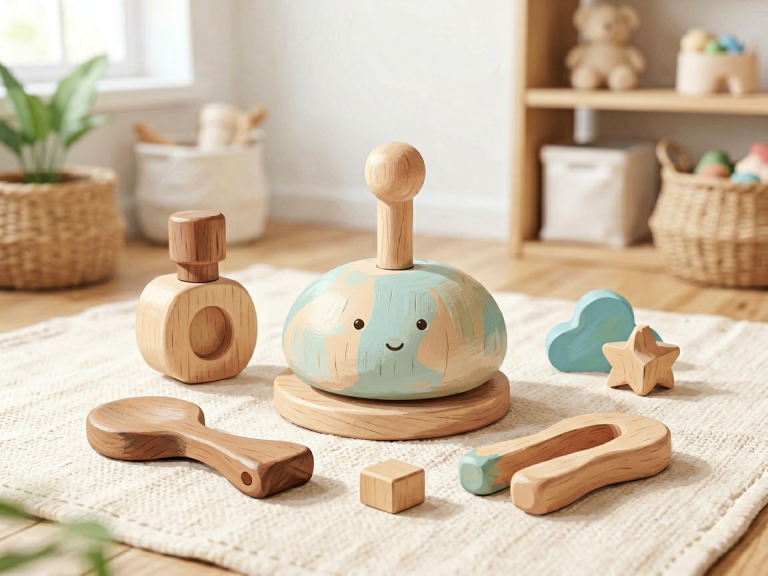
Not all wooden blocks are created equal. For a 4-year-old, look for sets that include a variety of shapes—cubes, rectangles, cylinders, triangles, arches, and half-circles. The blocks should be made of solid, sustainably sourced hardwood (like beech, maple, or birch) rather than soft pine that can splinter easily. The edges should be rounded and smooth, and the paint (if any) should be non-toxic and lead-free. Avoid sets with small parts that could be swallowed—though at age four, choking hazards are less of a concern, but still check. A good starter set might contain 50 to 100 blocks. More blocks allow for more complex builds, but even a small set can be deeply engaging.
Cost and Longevity
High-quality wooden blocks are not cheap. A set of 100 unit blocks can cost between $50 and $150, depending on the brand and wood type. However, they are arguably one of the most cost-effective toys in the long run. A 4-year-old will use them for at least two to three years, and they can be passed down to younger siblings or other children. Unlike plastic toys that break, fade, or become obsolete, well-made wooden blocks can last for decades. Many Montessori classrooms still use blocks from the 1960s. When you calculate the cost per hour of play, wooden blocks are cheaper than most single-use toys or short-lived electronic gadgets. Moreover, they do not require batteries, updates, or Wi-Fi.
Safety and Sustainability
Wooden blocks are generally safer than plastic alternatives that may contain BPA, phthalates, or other chemicals. Natural wood is free from these concerns. They are also more environmentally friendly: wood is renewable and biodegradable, whereas plastic is derived from fossil fuels and lasts indefinitely in landfills. For families concerned about sustainability, wooden blocks are an excellent choice. Additionally, because wooden blocks are heavy and solid, they are less likely to be thrown vigorously than lightweight plastic blocks, reducing the risk of injury. Of course, a child can still hurt themselves by stepping on a block (ouch!), but that is a minor risk compared to sharp plastic edges or broken pieces.
How to Foster Effective Block Play with a 4-Year-Old
Creating a Play-Friendly Environment
To maximize the benefits of wooden blocks, parents should provide a dedicated, uncluttered space where children can build without interruption. A low shelf or a floor mat works well. Avoid over-organizing the blocks by color or shape; instead, store them in a mixed basket that invites exploration. It is also important to allow children to leave their creations up for a while if they wish, as this strengthens their sense of ownership and pride.
The Role of the Adult
Adults can enhance block play without directing it. Instead of saying, “Let’s build a house,” try asking, “What are you planning to make today?” or “I wonder what would happen if you put a triangle on top.” Offer encouragement when structures fall: “Wow, that was a tall tower! What could you do differently next time?” Avoid rescuing the child from frustration too quickly; let them struggle a little, as that is where learning happens. Model building alongside them occasionally, but allow your child to be the lead architect. Also, introduce vocabulary naturally: “That arch is like a bridge,” or “You used three cylinders to make columns.”
Combining with Other Materials
Wooden blocks pair beautifully with other open-ended materials: fabric scraps for roofs or flags, small animal figures, toy cars, or people. This combination extends imaginative play. For a 4-year-old, adding a few natural elements—stones, pinecones, sticks—can also enrich the experience and connect the child with nature. However, be cautious about mixing very small items if there are younger siblings around.
Conclusion: The Verdict on Wooden Blocks for 4-Year-Olds
The question “Are wooden blocks worth it for 4-year-olds?” can be answered with a resounding yes. They are not merely a nostalgic relic of a pre-digital age; they are a scientifically validated tool for developing fine motor skills, spatial reasoning, creativity, problem-solving, executive function, social competence, and emotional resilience. In a world where children are increasingly overscheduled and overstimulated by screens, wooden blocks offer a quiet, focused, and deeply satisfying form of play. They honor the child’s natural drive to explore, build, and imagine. While the initial investment may seem higher than a plastic playset or a tablet app, the returns—in terms of developmental gains, longevity, and pure joy—are immense. For any parent or educator seeking to support a 4-year-old’s holistic growth, a set of quality wooden blocks is not just worth it; it is essential.
*(Word count: approximately 1,250 words)*