The $50 Mistake: Choosing Toys with Limited Play Value for 3-Year-Olds
Every parent has done it. You walk into a store, see a colorful box promising “interactive learning,” and imagine your three-year-old playing happily with it for hours. You spend fifty dollars. You bring it home. Your child is excited for perhaps twenty minutes. Then the toy is abandoned, the batteries die, and you are left with a pile of plastic that does nothing except take up space and occasionally make a grating sound when stepped on. This is the reality of choosing toys with limited play value for 3 year olds. It is a mistake that costs money, creates clutter, and, more importantly, can actually undermine the kind of deep, creative play that young children desperately need.
At three years old, a child is not just playing. She is building language, emotional regulation, physical coordination, and social skills. Play is her full-time job. Yet many of the toys marketed for this age group are designed to be watched, not played with. They flash, sing, move, and perform, but they leave the child as a passive spectator. Understanding what “play value” really means—and why some toys have so little of it—is essential for any adult who buys gifts for a young child.
What Does “Limited Play Value” Actually Mean?
Play value is the measure of how much meaningful, open-ended activity a toy can generate. A toy with high play value can be used in many ways, by children with different moods, interests, and skill levels. It can be transformed. A cardboard box, for example, can become a car, a castle, a cave, or a rocket ship. It has enormous play value.
A toy with limited play value, on the other hand, is rigid. It has one obvious function, and once that function is performed, there is little left to do. Think of a singing electronic dinosaur that walks forward and roars when you press a button. A three-year-old will press the button maybe ten times. Then what? The dinosaur cannot be ridden. It cannot wear a hat. It cannot be anything except a noisy plastic dinosaur. The child has no role in the play except pressing the button and watching. The toy is the active one; the child is merely an audience member.
Other examples of toys with limited play value include remote-control cars meant for adults, plush toys that recite alphabet songs, plastic fire trucks with molded characters and no moving parts, and “educational” tablets loaded with closed apps. These toys are often attractive because they make bold claims about learning. But in most cases, the learning is shallow. The child is passively receiving sounds and lights, not experimenting, creating, or solving problems in a way that builds deep understanding.
Why Three-Year-Olds Need More Than a Spectacle
The human brain grows faster in the first five years than at any other time. But it is not just growing in size; it is growing in connections, and those connections are forged through active experience. When a child reaches for a block, stacks it, watches it fall, and tries again, she is literally building neural pathways related to cause, effect, prediction, balance, and motor control. When she pretends the block is a phone and has an imaginary conversation, she is exercising language, memory, and social reasoning.
Toys with limited play value steal this opportunity. An interactive talking toy may appear to teach the alphabet, but it does not require the child to speak. It does not wait for an answer. It does not respond to a child’s unique ideas. In one study, researchers found that infants and toddlers often learn words more effectively from live social interaction than from screens or audio recordings. The same principle applies to toys: the toy that talks for the child can actually reduce the child’s own talking. Instead of sparking vocabulary, it becomes a noisemaker.
There is also a developmental cost to passive entertainment. At age three, children are learning how to sustain attention, how to manage frustration, and how to entertain themselves. A toy that constantly changes its own actions trains a child to expect external novelty every few seconds. When that novelty does not come, the child becomes bored and demands another toy. Over time, this creates a habit of “novelty junkie” behavior: always wanting the next thing, never deeply engaged with the present thing. This is the opposite of the focused, imaginative play that scientists say is crucial for later learning.
The Hidden Costs of High-Tech, Low-Value Toys
The financial cost is obvious. Five low-play-value toys at fifty dollars each equal two hundred fifty dollars spent on objects that will be ignored within a week. But there are deeper costs too.
One cost is the loss of parent-child interaction. Toys with lights and sounds often seem like a convenient babysitter, and sometimes that is exactly what a tired parent needs. But when a child is left alone with a battery-powered “friend,” the conversation stops. Compare that to playing with a simple set of wooden blocks. A parent can sit on the floor, ask questions, build towers together, and laugh when they tumble. The blocks are not the real toy; the relationship is. The toy is just the tool.
Another cost is the loss of creativity. When a toy has a fixed story, it leaves no room for the child to write her own. A fire truck with a molded plastic firefighter glued into the seat cannot be a delivery truck or a monster or a boat. The story is already written by the manufacturer. A three-year-old does not need a truck with a fixed identity; she needs a collection of objects that she can turn into anything her imagination desires.
There is also an environmental cost. Limited-play-value toys are often made of brittle plastic, require batteries, and break easily. Because the child loses interest quickly, the toy is thrown away rather than passed on. Landfills are full of half-broken singing Elmos and flashing light wands. Choosing high-play-value toys is an act of sustainability as much as an act of good parenting.
Common Mistakes in Toy Selection for a Three-Year-Old
Many adults make the same predictable mistakes when shopping for a young child. The first is buying according to the age label instead of the actual play behavior. The label “for ages 3 and up” usually means nothing more than “does not have small parts that cause choking.” It does not mean the toy is developmentally appropriate. An age label does not tell you whether the toy allows the child to be the agent of play.
The second mistake is confusing “educational” with “beneficial.” A toy that names colors and shapes while the child presses a button is technically educational, but no more so than a box of crayons and paper. In fact, a simple set of colored tokens would allow the child to sort, count, hide, and invent her own games. The token has more play value because the child is doing the learning rather than receiving it.
The third mistake is buying too far ahead or too far behind. A complex construction set with tiny bolts is too difficult for many three-year-olds and will frustrate them. A soft baby rattle is too simple and will be dismissed. The sweet spot is a toy that is just slightly beyond the child’s current skill, one that can be used in a variety of ways but is not so complicated that it requires constant adult instruction.
The fourth mistake is overvaluing brand recognition. Character-themed toys based on popular television shows are often the worst offenders. The character is fixed, the storyline is fixed, and the toy is basically a commercial advertisement. It is fine for a child to love a character, but if the only play activity is clutching a molded plastic figurine, the play value is very limited.
How to Spot a High-Play-Value Toy
The good news is that you do not need to be a child-development expert to choose better toys. You just need to ask a few simple questions.
First, who is doing the playing? If the toy performs and the child watches, it is a low-play-value toy. If the child must act, move, talk, build, or pretend, it is probably a high-play-value toy.
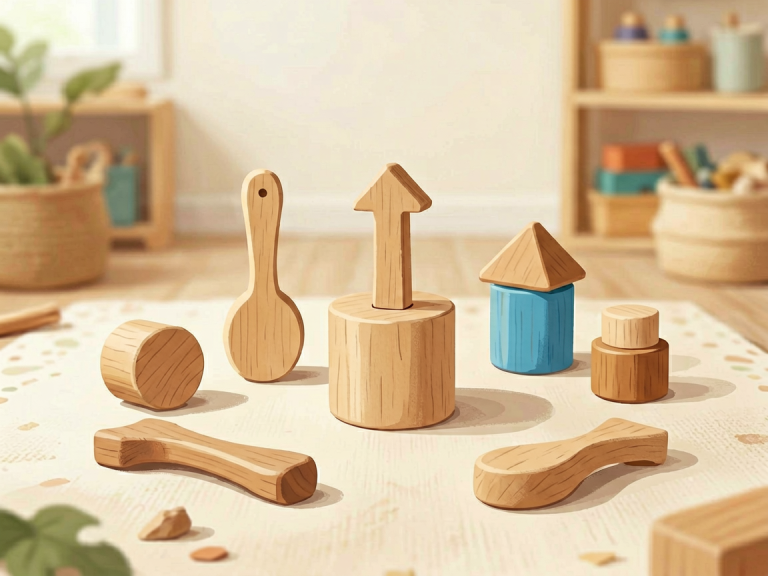
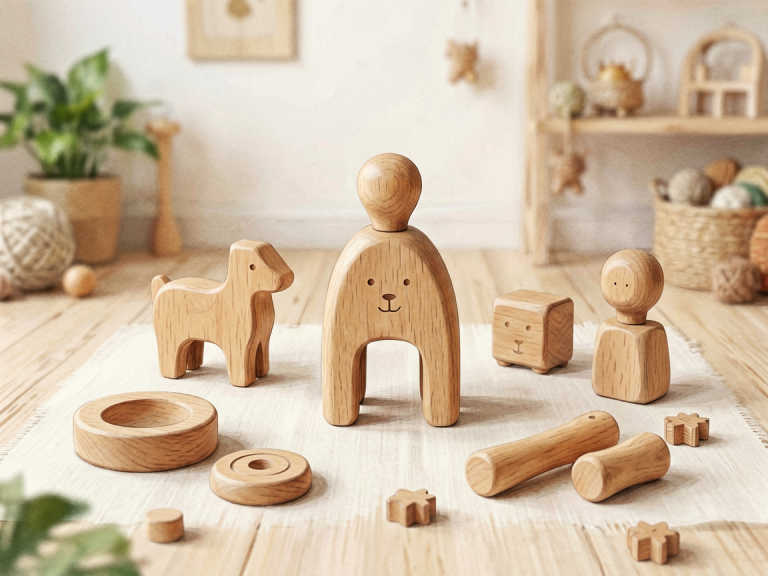
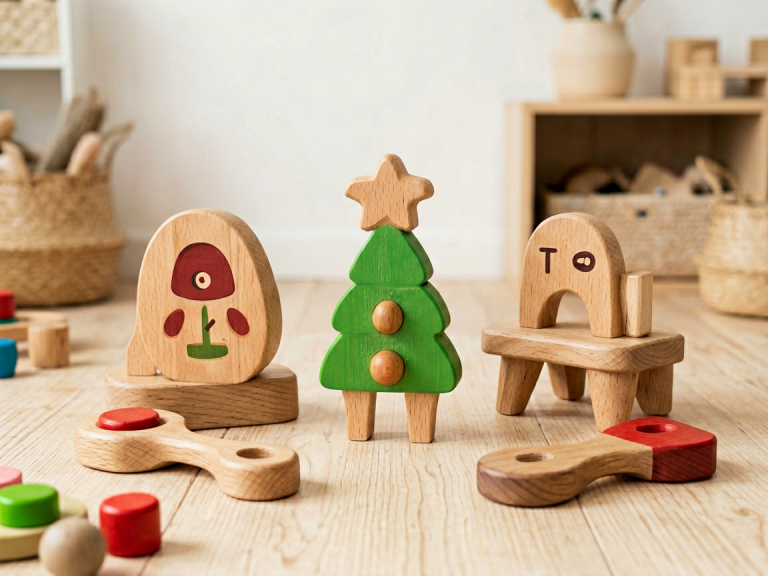
Second, can the toy be used in more than one way? A set of play silks can be a cape, a blanket, a river, a scarf, a tent roof. A collection of cardboard blocks can be a castle, a store, a road, a robot, a sleeping cave. Wooden animals can be zoo animals, farm animals, circus performers, or characters in a made-up story. The more uses, the more play value.
Third, does the toy have an end point? A puzzle has a single correct solution, but after it is solved, a three-year-old can still use the pieces for sorting, counting, and storytelling. A plastic toy with a single button and a fixed response has an end point: once the novelty wears off, it is dead. High-play-value toys often have no fixed end; they exist in an endless loop of possibilities.
Fourth, does the toy invite collaboration? Simple toys like balls, tunnels, swings, and sandboxes are wonderful because they draw adults and other children into the game. A toy that isolates a child and does the entertainment for him is, in the long run, far less valuable.
Finally, consider loose parts. Three-year-olds are natural scientists. They love things they can move, combine, stack, dump, and transform. Beads, pebbles, fabric scraps, bottle caps, empty containers, and natural objects like pinecones and shells are some of the best “toys” on earth. They cost almost nothing, and their play value is essentially infinite.
Practical Strategies for Avoiding the Limited-Play-Value Trap
Changing how you buy toys is easier said than done, especially when grandparents and well-meaning friends show up with boxes of tiny plastic junk. But there are strategies that work.
Make a waiting rule. When you see a toy you think your child will love, wait two weeks. If you still want it, and if your child is still talking about it, consider buying it. Most impulse toy purchases lose their appeal within forty-eight hours.
Set “low-tech” boundaries. For children under four, toys with screens, batteries, and pre-recorded sounds should be minimal. This does not mean no electronic toys at all. A simple audio player with stories and songs can be wonderful. The key is that the child controls the play, not the device.
Use toy rotation. You do not need more toys; you need to bring back old ones. Store some toys out of sight and rotate them every few weeks. The “new” feeling of a forgotten toy is powerful. Rotation also encourages deeper play, because the child has time to explore a smaller set of options instead of being overwhelmed by a mountain of plastic.
Talk to relatives before birthdays and holidays. Give a specific list of high-value toys: building blocks, art supplies, musical instruments, dress-up clothes, magnetic tiles, books, and simple puzzles. If someone insists on buying a character toy, suggest one that is small and non-electronic, such as a simple figurine that can be used in imaginative play.
Most importantly, observe your own child. What does she already do for fun? If she ignores the expensive battery-operated cat and instead spends half an hour pretending to feed a toy spoon to the cat, you have learned something. The most valuable toy is not the one in the advertisement. It is the one that your child uses as a tool for her own imagination.
Conclusion: Choose Tools, Not Spectacles
Choosing toys for a three-year-old should not be about buying the newest, loudest, or most advertised product. It should be about providing raw materials for childhood’s most important job: play. Toys with limited play value are like junk food for the developing brain: sweet for a moment, but empty and unsatisfying. They entertain rather than engage. They produce passive consumers instead of active explorers.
The next time you stand in a store aisle, faced with a flashing, beeping, singing machine in an enormous cardboard box, stop and ask yourself one simple question: “Is this toy going to play with my child, or is my child going to play with this toy?” If the answer is that the toy will do all the work, put it down. Choose the blocks. Choose the cardboard box. Choose the dress-up cape. Choose the set of wooden animals that can be anything, go anywhere, and invite the child to become a storyteller. In the long run, these simple tools are the ones that will be remembered, loved, and played with for years to come.