Wooden Toys and Age Recommendations: A Guide to Safe, Sustainable Play
Introduction
In an era dominated by flashing screens, plastic batteries, and digital noise, wooden toys have made a quiet but powerful comeback. Parents, educators, and child development specialists increasingly turn to these timeless objects, valuing their simplicity, durability, and inherent safety. Yet one question consistently emerges: *What wooden toys are appropriate for which age?* Age recommendations are not arbitrary marketing tactics—they are rooted in developmental psychology, motor skill progression, and safety standards. Choosing the wrong toy for a child’s stage can lead to frustration, missed learning opportunities, or even physical harm. This article provides a comprehensive, evidence-based guide to matching wooden toys with children’s developmental milestones, ensuring that each plaything supports growth while delighting the senses.
Why Age Matters for Wooden Toys
Children’s cognitive, physical, and emotional capacities evolve rapidly. A toy that sparks curiosity in a two-year-old may bore a five-year-old, while a small part meant for a six-year-old could choke a toddler. Wooden toys, though generally safer than many plastic alternatives, still require age-appropriate design. For example, untreated or painted wood can splinter if chewed by a teething infant; small wooden blocks with sharp edges pose risks for crawlers; and complex puzzles with many pieces overwhelm preschoolers who lack fine motor control. Age recommendations also align with the concept of “just-right challenge”—the sweet spot where a toy is neither too easy nor too hard, encouraging prolonged engagement and learning.
0–12 Months: Sensory Exploration and Safety First
Key Developmental Characteristics
Infants in their first year experience the world primarily through their mouths, hands, and eyes. They are developing hand-eye coordination, grasping reflexes, and cause-and-effect understanding. Their sense of touch and taste is paramount.
Recommended Wooden Toys
- Teething rings and rattles: Smooth, rounded wooden rings (such as those from beech or maple) that are free of varnish or made with food-safe oils. They should be large enough not to fit entirely in the mouth, typically wider than 1.5 inches in diameter.
- Grasping toys: Simple wooden shapes like eggs, balls with easy-to-hold ridges, or stacking rings (with a sturdy pole and large, open rings). The rings should be thick and too large to swallow.
- Activity bars or mobiles: Wooden beads strung on a strong cord, hung across a play gym. Ensure the cord is short and the beads are securely fastened to prevent unraveling.
- Wooden mirrors: Non-breakable, wooden-framed mirrors that encourage self-recognition.
Safety Considerations
- No small parts that can be detached or broken off.
- All finishes must be non-toxic (water-based, plant-based oils, or left raw and sanded ultra-smooth).
- Weight: Toys should be light enough for a baby to lift but heavy enough to resist being thrown with force.
- Regular inspection for splinters: Even high-quality wood can develop rough edges with heavy drooling and chewing.
Why These Work
At this stage, toys stimulate oral exploration, help soothe sore gums, and provide early experiences with different textures and weights. The natural grain of wood offers sensory variety that plastic cannot replicate.
1–3 Years: Motor Development and Imaginative Beginnings
Key Developmental Characteristics
Toddlers are walking, climbing, and beginning to use tools. Their fine motor skills improve rapidly—they can stack, twist, and push. Language explodes, and pretend play emerges. They are also prone to throwing objects and testing limits.
Recommended Wooden Toys
- Wooden blocks: Basic cube blocks, unit blocks, and a few curved shapes. Avoid blocks with complex cutouts that could trap fingers. Sets of 20–40 blocks are ideal to encourage stacking and toppling.
- Pull-along toys: Wooden animals on wheels or trains with a short string (string length should be no more than 12 inches to avoid strangulation). These reinforce balance and walking coordination.
- Shape sorters: Wooden boxes with large, brightly colored shapes that fit through corresponding holes. Choose shapes with rounded edges and a lid that does not pinch.
- Simple wooden puzzles: With 3–5 large, sturdy pieces that have knobs on top for easy gripping. Themes like animals or vehicles work well.
- Wooden vehicles: Cars, trucks, and trains that are chunkily proportioned with no small axles that could come loose.
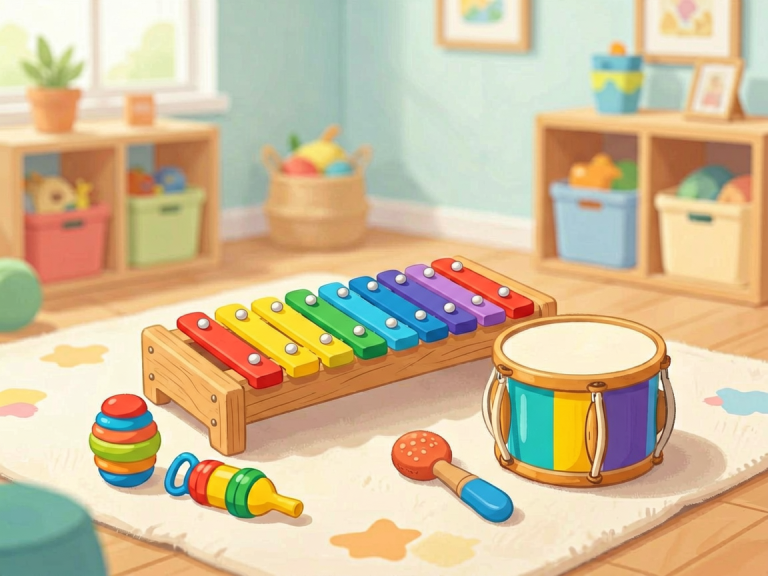
- Wooden instruments: Drums, maracas, and xylophones with firmly attached mallets (the mallet head should be larger than a child’s throat).
Safety Considerations
- Choking hazard: Avoid any part smaller than a toilet paper roll tube. Wooden toys should be one-piece or have parts that cannot be removed without tools.
- No sharp corners or points: Rounded edges are essential.
- Paint quality: If painted, ensure it is lead-free and non-peeling. Water-based paint is safest.
- Durability for throwing: Softwood toys (like pine) may dent but should not splinter.
Why These Work
Toddlers learn cause and effect: a block tower falls when pushed; a shape fits into a hole; a pull-along dog follows. These toys build problem-solving, spatial reasoning, and hand strength. They also encourage early storytelling: a wooden truck becomes a fire engine racing to a rescue.
3–5 Years: Complexity, Creativity, and Social Play
Key Developmental Characteristics
Preschoolers have refined motor control, longer attention spans, and vivid imaginations. They engage in cooperative play, follow simple rules, and enjoy constructing narratives. Their fine motor skills allow them to manipulate smaller pieces, though supervision is still needed.
Recommended Wooden Toys
- Unit building blocks: Larger sets (50–100 pieces) with arches, triangles, cylinders, and columns. These allow for bridges, castles, and cities.
- Wooden train sets: Tracks with switch points, bridges, and engines that click together. The pieces should be compatible with popular open-source systems (like Brio or Thomas) but made of solid wood.
- Puzzles: 12–24 piece jigsaw puzzles with wooden knobs or chunky pieces. Also, pattern-making puzzles where kids replicate images with geometric shapes.
- Wooden food and kitchen sets: Cutting fruits and vegetables that separate with Velcro, along with pots and pans. These encourage role-play and fine motor slicing.
- Wooden threading beads: Large beads (1 inch diameter) with thick strings and a safe wooden needle (blunt tip). This strengthens pincer grasp.
- Balance and stacking games: Wooden peg dolls, rainbow stackers, or wooden stones that challenge balance. These promote patience and problem-solving.
- Wooden memory cards: Wooden tiles with painted images for matching games, often paired with a wooden box.
Safety Considerations
- Choking risk decreases but still present: Avoid beads smaller than 1.25 inches, and ensure any string is short.
- Paint and finish: Still non-toxic, as children may chew on pieces when frustrated.
- Wooden toys with magnets: Ensure magnets are enclosed and cannot be accessed. Rare-earth magnets are dangerous if swallowed.
- Weight: Heavier blocks can hurt if dropped; choose light wood like basswood for large sets.
Why These Work
At this age, children use toys to represent the world. A wooden banana becomes a phone; a block becomes a wall of a castle. Social skills develop as they negotiate sharing trains or building together. Fine motor skills advance through threading, puzzle solving, and stacking. Research shows that open-ended wooden toys (like blocks) foster greater creativity than battery-operated plastic toys that dictate a single use.
5–7 Years: Rule-Based Play and Advanced Construction
Key Developmental Characteristics
Early school-age children can follow multi-step instructions, read simple words, and work on projects for 20–30 minutes. They enjoy games with rules, model building, and activities that require precision. Their hand strength and dexterity allow for smaller, more intricate pieces.
Recommended Wooden Toys
- Wooden construction sets: Kits with planks, pegs, and connectors (like unit blocks but with more variety—think Kapla or Keva planks). These allow building suspension bridges, spiral towers, and geometric shapes.
- Wooden marble runs: Tracks, ramps, and wooden marbles (marbles should be at least 16mm in diameter to prevent choking). Children design the course and test gravity.
- Wooden domino sets: Larger sets with numbers or pictures, encouraging chain reactions and math concepts.
- Wooden board games: Simple strategy games like “Mancala” or “Checkers” with wooden pieces. Or cooperative games like “Hoot Owl Hoot” using wooden tokens.
- Wooden craft kits: Pre-cut wooden shapes to paint, glue, and assemble (birdhouses, model cars, jewelry boxes). Supervision for glue and paint is recommended.
- Wooden puzzles with 50–100 pieces: Intricate scenes with fewer than 100 pieces, preferably with a wooden frame that holds the pieces.
Safety Considerations
- Marbles and small pieces: Ensure the child does not mouth them. Educate about choking.
- Tool use: If kits require gluing or hammering small nails (e.g., birdhouse kits), use child-safe glue and a lightweight wooden hammer. Supervision mandatory.
- Sharp edges: Laser-cut wood may have slight roughness; sand down if needed.
Why These Work
These toys introduce engineering principles, logical sequencing, and patience. A marble run teaches trial and error: if the marble falls, adjust the track. Board games teach turn-taking, counting, and emotional regulation. Craft kits boost pride and fine motor precision. They also bridge solitary play and collaborative projects.
7+ Years: STEM, Strategy, and Heirloom Quality
Key Developmental Characteristics
Older children and pre-teens can handle complex systems, follow written instructions, and engage in long-term projects. They appreciate craftsmanship and may collect or display wooden toys. Their interests diversify—some love building, others love strategy games.
Recommended Wooden Toys
- Advanced block systems: Wooden sets with gears, pulleys, axles, and connectors (like wooden versions of Meccano or Fischertechnik). These teach mechanical physics.
- Wooden geometric puzzles: Tangrams, soma cubes, pentominoes—challenges that require spatial rotation and logic.
- Wooden strategy games: Chess, Chinese Checkers, Go, or “Blokus” in wooden form. High-quality wooden boards and pieces become treasured possessions.
- Wooden model kits: Complex models (ships, buildings, dinosaurs) with dozens of small laser-cut pieces that slot together without glue. Patience and precision are needed.
- Wooden musical instruments: Quality wooden kalimbas, recorders, or even a simple wooden guitar. These encourage music appreciation and fine motor rhythm.
- Wooden marble machines: Large, multi-tiered contraptions with lifts, funnels, and levers. These can take hours to assemble and even longer to perfect.
Safety Considerations
- Small parts: At age 7+, mouthing is rare but still possible for some. Supervise younger siblings.
- Chemical finishes: Older children may use paints or stains themselves; ensure they are water-based and in ventilated areas.
- Sharp tools: Model kits may need sandpaper or a small craft knife (under direct adult guidance).
Why These Work
Wooden toys for this age group stimulate logical thinking, patience, and an appreciation for tactile quality. Unlike plastic toys that often break, these pieces last for decades and can be passed down. They also offer a screen-free alternative for developing focus and problem-solving.
Conclusion
Selecting wooden toys by age is not about stifling a child’s curiosity—it is about setting the stage for safe, meaningful, and developmentally appropriate play. From the smooth teether that soothes an infant’s gums to the intricate marble machine that challenges a ten-year-old’s engineering mind, wooden toys grow with children. They offer sensory richness, environmental sustainability, and an invitation to imagine without limits. When parents, caregivers, and educators pay attention to age recommendations, they ensure that every wooden toy becomes a tool for discovery rather than a hazard or a bore. The next time you reach for a wooden block, a puzzle, or a train, remember: you are not just buying a toy—you are building a child’s future, one grain of wood at a time.