Are Wooden Blocks Worth It? A Comprehensive Analysis of Their Value, Benefits, and Drawbacks
—
Introduction
In the age of digital screens, flashing lights, and interactive plastic toys, the humble wooden block might seem like an anachronism—a relic from a bygone era when children’s play was simpler and quieter. Yet, wooden blocks have persisted in nurseries, kindergartens, and Montessori classrooms for centuries. Parents and educators alike often ask: “Are wooden blocks worth it?” Given their relatively higher price tag compared to plastic alternatives, and the overwhelming variety of modern toys, this question deserves a thorough, evidence-based answer. This article examines wooden blocks from multiple angles—educational, developmental, economic, environmental, and practical—to help you decide whether investing in a set of wooden blocks is a wise choice for your child or classroom.
—
The Educational and Developmental Case for Wooden Blocks
Cognitive Development and Problem-Solving
Wooden blocks are not just simple playthings; they are powerful tools for cognitive growth. When a child stacks blocks, they are engaging in early physics experiments. They learn about balance, gravity, and geometry through trial and error. A tower that falls teaches resilience and cause-and-effect relationships far more effectively than any digital game. According to child development experts, block play supports spatial reasoning—a skill strongly linked to later success in mathematics, engineering, and science. Unlike many electronic toys that provide instant feedback and predetermined outcomes, wooden blocks offer open-ended possibilities. Every build is unique, and every collapse is a new learning opportunity.
Language and Social Skills
Block play often involves collaboration. Two or three children building together must negotiate, share ideas, and communicate their visions. This naturally fosters language development and social competence. A child might say, “We need a bigger block for the base,” or “Let’s make a bridge.” Such exchanges build vocabulary and conversational turn-taking. In contrast, solitary screen time or rigid toys with one “correct” use offer fewer opportunities for such rich verbal interaction. Teachers in play-based classrooms consistently report that block centers are among the most vibrant areas for peer-to-peer conversation.
Creativity and Imaginative Play
Wooden blocks are the ultimate blank canvas. A set of simple rectangular, cylindrical, and triangular blocks can become a castle, a spaceship, a farm, or a city skyline. This open-ended nature encourages divergent thinking—the ability to generate many different ideas from a single starting point. Modern plastic toys often come with pre-molded parts, stickers, and specific themes (e.g., a pirate ship set that only builds a pirate ship). These limit imagination because the child’s role is reduced to assembly. Wooden blocks, by contrast, demand creativity. The child must envision their own world and then construct it.
—
Comparison with Plastic and Electronic Alternatives
Durability and Longevity
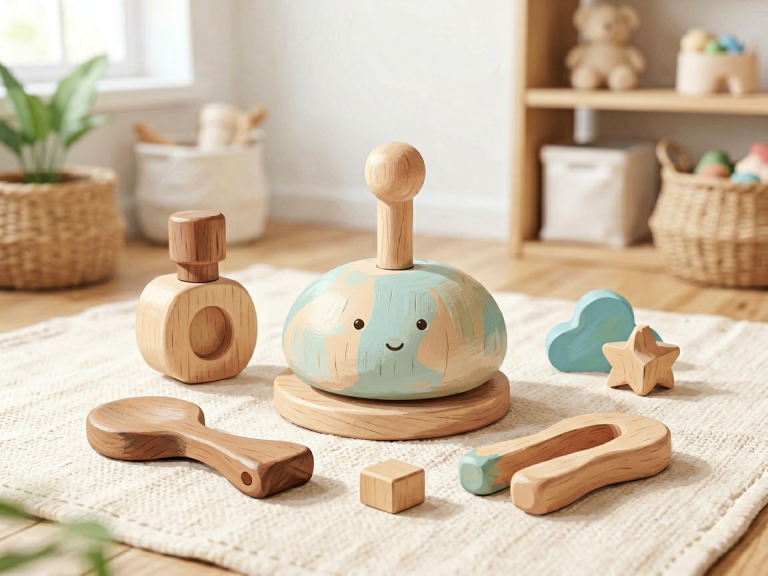
One of the first arguments in favor of wooden blocks is their durability. A high-quality set of wooden blocks made from solid beech, maple, or birch can last for decades—often surviving multiple children and even grandchildren. They do not crack, fade, or break easily. Plastic blocks, while lightweight and colorful, are more prone to chipping, cracking, or losing their vibrant colors over time. Some cheap plastic blocks may contain harmful chemicals like BPA or phthalates, especially if intended for very young children who mouth toys. Wooden blocks, especially those finished with non-toxic, water-based paints or natural oils, pose minimal health risks.
Sensory Experience
Wooden blocks provide a unique sensory experience that plastic cannot replicate. The weight, texture, and warmth of wood are grounding. Children feel the grain, the smoothness, and the solid weight in their hands. This tactile feedback is crucial for developing fine motor skills and hand-eye coordination. Plastic blocks, while often lighter, feel hollow and sometimes slippery. The sound of wooden blocks clacking together is acoustically satisfying, whereas plastic produces a tinny rattle. For children with sensory processing differences, natural materials like wood can be calming and more engaging.
Screen-Free Engagement
In an era when children are exposed to screens from infancy, wooden blocks offer a precious respite. They require no batteries, no charging, and no apps. They encourage physical manipulation, whole-body movement (crawling, reaching, carrying), and focused concentration. Electronic toys often interrupt a child’s flow with sounds, lights, or prompts, which can fragment attention spans. Wooden blocks, in their silence, allow for deep, uninterrupted immersion in play—the kind of state that psychologists call “flow,” which is essential for creativity and learning.
—
Environmental and Ethical Considerations
Sustainability
For environmentally conscious parents, wood is a renewable resource when harvested responsibly. Many manufacturers now use FSC-certified wood (Forest Stewardship Council) that ensures sustainable forestry practices. Wooden blocks also biodegrade at the end of their life, unlike plastic, which persists in landfills for centuries. Additionally, wooden blocks are often locally produced, reducing carbon footprint from shipping. However, it is important to check the source: some cheaper wooden toys come from rainforest timber or use toxic paints. Always look for non-toxic, lead-free finishes and reputable brands.
Long-Term Value versus Upfront Cost
There is no denying that a good set of wooden blocks can be expensive—often $50 to $150 for a comprehensive set, while a large bag of plastic blocks might cost $20. However, the math changes when you consider lifespan. A $100 wooden block set that lasts 30 years and serves two or three children costs about $3 per year. A $20 plastic set that cracks after two years and must be replaced costs $10 per year. Moreover, wooden blocks do not become obsolete. They never go out of style, and they do not require software updates. Their value is timeless.
—
Practical Concerns and Potential Drawbacks
Weight and Safety
Wooden blocks are heavier than plastic ones. While this provides a satisfying feel, it also means that a falling block can cause a painful bump or bruise if a child is not careful. For toddlers who are still unsteady on their feet, it is wise to supervise closely. Some parents prefer foam or lightweight plastic blocks for very young infants. However, for children over 18 months, the risk is generally low if the blocks are not too large or too sharp-edged. Many wooden block sets are chamfered (edges rounded) to reduce injury.
Storage and Mess
Wooden blocks are solid and take up space. Unlike interlocking plastic blocks that can be clicked into compact shapes for storage, loose wooden blocks must be tidied into a bin or shelf. This can be a practical challenge for families with limited space or a child who dislikes cleanup. However, this can also be turned into a learning opportunity: sorting, stacking, and organizing blocks is itself a valuable executive function skill.
Potential for Monotony
Some children may initially find wooden blocks less exciting than flashy, sound-making toys. The appeal of blocks often grows with maturity and exposure. A one-year-old may simply knock down towers, but a three-year-old begins building elaborate structures. By age five or six, block play can involve storytelling, symmetry, and engineering. The key is for adults to model creative play: build alongside the child, add accessories (e.g., toy animals, scarves, cardboard tubes), and rotate the block set occasionally to keep it fresh.
—
Conclusion: Are Wooden Blocks Worth It?
So, are wooden blocks worth it? The answer is a clear yes—for most families and educational settings. The benefits far outweigh the drawbacks, especially when one considers the rich developmental opportunities, the unparalleled durability, the environmental sustainability, and the timeless appeal of open-ended play. While the upfront cost may be higher, the long-term investment in a child’s cognitive, social, and emotional growth is incalculable. Wooden blocks do not beep, spin, or flash, but they teach children something far more valuable: how to think, create, and persist. In a world cluttered with disposable, single-use toys, a beautifully crafted set of wooden blocks remains a singularly worthwhile purchase. If you choose wisely—selecting non-toxic, sustainably sourced, age-appropriate blocks—you are not just buying a toy; you are giving a child the gift of limitless imagination. And that, truly, is priceless.