The Perils of Overindulgence: Why Buying Too Many Toys for a 6-Month-Old Does More Harm Than Good
Introduction
Walking through the baby aisles of any major retailer, one is bombarded with an overwhelming array of colorful, noise-making, light-flashing objects designed to stimulate the youngest of minds. For parents of a six-month-old, the temptation to fill a nursery with these commercial treasures is almost irresistible. After all, every advertisement, every parenting blog, and every well-meaning grandparent seems to insist that "more is better" when it comes to infant development. Yet a growing body of child development research, coupled with the lived experience of pediatricians and early childhood educators, suggests exactly the opposite: buying too many toys for a six-month-old is not just unnecessary—it can be genuinely counterproductive. This article explores the multifaceted reasons why restraint in toy purchases is not only wise but essential for the healthy development of infants, the sanity of parents, and the health of the planet.
The Allure of the Toy Aisle: Why Parents Overbuy
Marketing and the Myth of "Developmental Necessity"
The infant toy industry is a multi-billion-dollar global enterprise, and its marketing engines are finely tuned to exploit parental anxiety. Every package promises "brain-building," "sensory stimulation," and "milestone acceleration." For the parent of a six-month-old—a child who is just beginning to sit up, grasp objects, and explore the world—the implicit message is that without these specialized tools, their baby might fall behind. In reality, the developmental needs of a six-month-old are remarkably simple: they need secure attachment, responsive caregivers, safe space for movement, and a few age-appropriate objects to mouth, shake, and drop. The notion that a particular plastic rattle with flashing lights is superior to a wooden spoon or a soft fabric ball is a fabrication of advertising, not science.
Social Pressure and the "Baby Shower Effect"
Social dynamics further fuel the overbuying phenomenon. Baby showers, family visits, and the well-intentioned generosity of friends and relatives often result in a sudden flood of toys. A single baby shower can deliver dozens of plush animals, stacking rings, activity gyms, and electronic gadgets. Parents, feeling grateful and perhaps a little guilty, accept them all, even when they know their home cannot accommodate such abundance. The social norm that "more gifts mean more love" creates a powerful incentive to accumulate, and the six-month-old becomes the unwitting recipient of an avalanche of plastic and fabric.
The Developmental Impact: Less Is More
Overstimulation and the Fragile Infant Nervous System
A six-month-old's brain is developing at an astonishing rate, forming up to one million new neural connections every second. However, this remarkable plasticity comes with a significant vulnerability: the infant's nervous system is easily overwhelmed. When a baby is surrounded by dozens of toys—each one beeping, flashing, or dangling—their attention becomes fragmented. Instead of focusing deeply on one object, they flit from stimulation to stimulation, never truly engaging with any single item. Research in developmental psychology has shown that infants in environments with fewer toys exhibit longer attention spans, more creative play, and greater persistence when solving simple problems. Overstimulation, by contrast, can lead to irritability, disrupted sleep, and even feeding difficulties, as the baby's system never fully settles.
The Paradox of Choice in Infancy
Barry Schwartz, in his landmark book *The Paradox of Choice*, demonstrated that adults become paralyzed and dissatisfied when presented with too many options. The same principle applies, albeit differently, to infants. A six-month-old is in the sensorimotor stage of development, as defined by Jean Piaget—they learn by doing, by repeating actions, and by observing cause and effect. When a baby has only two or three toys, they will explore each one thoroughly: they will mouth its texture, drop it to see if it falls, shake it to hear its sound, and rub it against their cheek. This deep, repetitive exploration is the foundation of learning. But when a baby is presented with twenty toys, they may pick up one, drop it immediately, and reach for another without ever truly investigating the properties of any. The result is superficial engagement, not deep learning.
Hindered Creativity and the Decline of "Loosely Structured" Play
Perhaps the most insidious consequence of an overabundance of toys is the suppression of creativity. Six-month-olds do not need toys that "do" things for them; they need objects that they can act upon. A simple cotton scarf, a set of wooden rings, or a ball of crinkly paper offers infinite possibilities because the baby must invent the interaction. In contrast, a battery-operated toy that sings a song when a button is pressed is a closed system: the child learns only to press the button, and the toy performs the same action every time. This does not build creativity; it builds passivity. When the nursery is filled with these "closed" toys, the baby's natural drive to experiment and invent is replaced by a conditioned expectation of external entertainment.
Financial and Environmental Costs: The Hidden Burden
The Economic Drain on Families
The financial implications of buying too many toys for a six-month-old are often underestimated. The average middle-class family in the United States spends several hundred dollars on toys for a baby during the first year of life, and a significant portion of that money is wasted. Six-month-olds outgrow their toys quickly—not because they have mastered them, but because they move on to new developmental stages. A toy that fascinated a six-month-old may be completely ignored by an eight-month-old who is crawling and wants to explore the whole house. The result is a closet full of barely used plastic that must be stored, cleaned, and eventually discarded or given away. For families already stretched by the costs of diapers, formula, childcare, and healthcare, this unnecessary expenditure adds real financial stress.
The Environmental Toll of Plastic and Electronics
From an environmental perspective, the overproduction and overconsumption of infant toys is a quiet catastrophe. The vast majority of toys sold for six-month-olds are made of plastic, often containing multiple materials that cannot be easily recycled. They are packaged in layers of cardboard and plastic shrink wrap, shipped across oceans, and often end up in landfills within a year. Electronic toys, with their batteries and circuit boards, pose an even greater disposal challenge. Given that a single baby in a developed country may cycle through dozens of such toys, the cumulative waste is staggering. In a world grappling with plastic pollution and climate change, the decision to buy fewer, higher-quality toys is a meaningful act of environmental stewardship.
The Emotional Toll on Parents and Babies
Parental Guilt and the "Enough" Anxiety
Ironically, the more toys a parent buys, the more anxious they often become. The relentless pressure to provide the "best" for a six-month-old can morph into a compulsion to purchase every recommended toy, every sensory kit, every Montessori-approved object. Yet this constant acquisition does not alleviate parental guilt; it exacerbates it. When a nursery is overflowing, parents may feel overwhelmed by clutter, frustrated by the time spent organizing and cleaning, and guilty that their baby does not seem to appreciate the abundance. A simpler approach—just a few thoughtfully chosen toys—can liberate parents from this cycle of consumption and allow them to focus on what truly matters: interacting with their baby through eye contact, conversation, and gentle touch.
The Baby's Signal: Cues of Overload
How can parents tell if their six-month-old is overwhelmed by too many toys? The signs are subtle but observable. A baby who is overstimulated may turn away from toys, begin to fuss, cry more frequently, or have difficulty settling for naps. They may engage in repetitive, self-soothing behaviors such as rocking or hair-pulling. Some babies even become "hypervigilant," scanning the room constantly instead of settling into focused play. Pediatricians often advise parents to observe their baby's cues and to limit environmental chaos. A cluttered play area is not a sign of abundance; it is a source of stress for an infant whose developing brain is desperately trying to make sense of a chaotic world.
Practical Guidelines: A Minimalist Approach to Infant Toys
The Essential Toy Collection for a 6-Month-Old
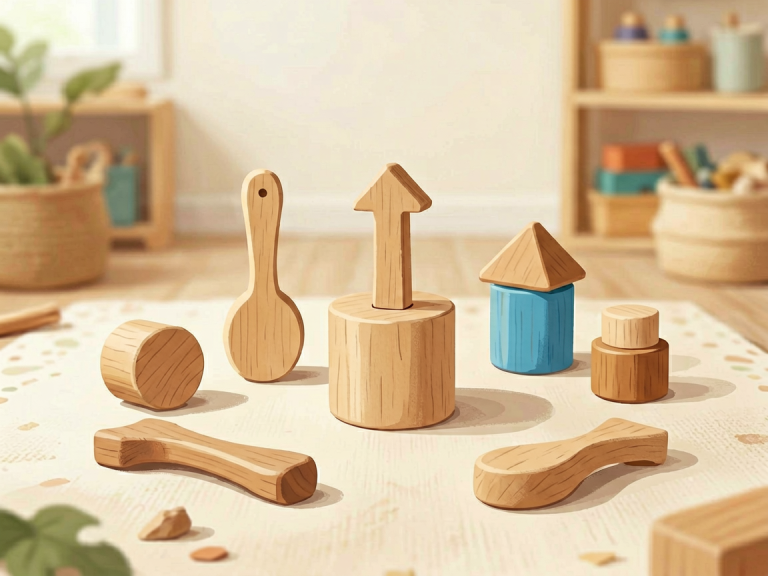
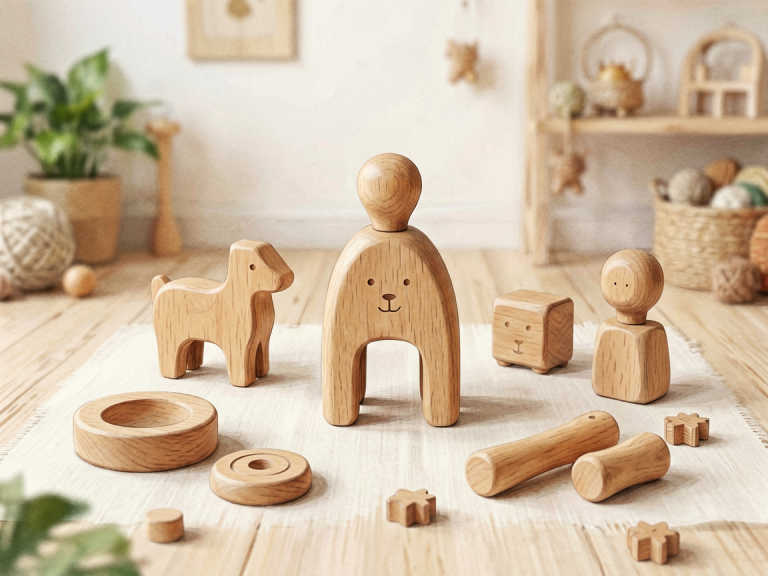
What does a sensible toy collection look like for a six-month-old? At this age, the baby's primary "toy" is the caregiver's face and voice. Beyond that, a handful of objects suffice: one or two soft, graspable rattles; a set of teething rings made of natural wood or silicone; a small, unbreakable mirror for self-discovery; a simple fabric ball or crinkle cube; and perhaps a textured book made of cloth or board. That is all. These items support the key developmental tasks of mouthing, grasping, shaking, transferring from hand to hand, and beginning to understand object permanence. Nothing more is needed.
Rotating Toys: The Secret to Sustained Interest
Instead of buying new toys every month, parents can adopt a "rotation" system. Store the majority of toys out of sight, and put out only three to five at a time. Every few days or once a week, swap them for a different set. This strategy works because novelty is relative: a toy that the baby has not seen for a week feels brand new, even though it is not. Rotation not only saves money but also extends the useful life of each toy, deepens the baby's engagement, and keeps the nursery from devolving into visual clutter.
Prioritizing Interaction Over Objects
The most important "toy" for a six-month-old is a responsive, loving adult. Singing, talking, making funny faces, and engaging in gentle physical play—these interactions build the neural pathways for language, emotional regulation, and social connection far more effectively than any product sold in a store. Parents who feel tempted to buy another toy should instead invest their time: ten minutes of floor-time play with the baby, a walk around the neighborhood pointing out trees and dogs, or a shared bath with warm water and a single cup. These experiences are free, priceless, and far more developmentally rich than a shelf full of blinking gadgets.
Conclusion: Embrace Simplicity
Buying too many toys for a six-month-old is a well-intentioned mistake, but a mistake nonetheless. Driven by marketing, social pressure, and the deep desire to give our children every advantage, parents fall into the trap of abundance. Yet the science is clear: infants thrive on simplicity. A few well-chosen objects, combined with rich human interaction, provide all the stimulation a six-month-old's developing brain requires. Moreover, a minimalist approach reduces parental stress, saves money, and lightens the environmental footprint. The next time you find yourself reaching for that bright plastic rattle or that electronic activity centre, pause. Ask yourself: "Does my baby truly need this, or does my own anxiety need it?" More often than not, the answer will be the latter. In the end, the greatest gift we can give our six-month-old is not a mountain of toys, but the freedom to explore a quiet, orderly world with a loving parent by their side. That is the richest play gym of all.