Magnetic Tiles vs. Wooden Blocks: Which Building Toy Best Supports a Three-Year-Old’s Growth?
Introduction
The playroom floor is a battlefield of colorful possibilities. For parents and educators of three-year-olds, few decisions spark as much debate as the choice between magnetic tiles and wooden blocks. Both toys have earned their place on nursery shelves, but they represent fundamentally different philosophies of early childhood development. Magnetic tiles, with their satisfying magnetic click and translucent colors, offer a modern, high-tech twist on construction play. Wooden blocks, timeless in their simplicity, have supported the imaginations of children for generations. At age three, a child is rapidly developing fine motor skills, spatial reasoning, language, and social-emotional competence. The toy that occupies their hands during these critical years can shape how they approach problem-solving, creativity, and even scientific thinking. This article explores the unique benefits and limitations of each option, helping you make an informed choice based on your child’s temperament, your family’s values, and the developmental milestones that matter most at this age.
Developmental Benefits at Age Three: Fine Motor Skills and Hand-Eye Coordination
Wooden Blocks: Precision and Grip Strength
Three-year-olds are in a sweet spot of manual dexterity. They can stack, balance, and sort with increasing control. Traditional wooden blocks, typically cut from solid hardwood and sanded smooth, require precise alignment and careful placement. When a toddler tries to balance a rectangular block on top of a square one, they must adjust their grip, coordinate their wrist movement, and apply just the right amount of force. This process strengthens the small muscles of the hand and fingers—muscles that will later be essential for holding a pencil, cutting with scissors, and tying shoelaces. Wooden blocks also have weight and texture; the tactile feedback of a solid piece of wood teaches a child about gravity and friction in a way that lightweight plastic cannot replicate. Because wooden blocks are non-magnetic, a child cannot cheat the physics—if a tower is unstable, it will fall. This honest feedback loop encourages persistence and adaptive problem-solving.
Magnetic Tiles: Magnetism as an Assistive Tool
Magnetic tiles, on the other hand, lower the barrier to vertical construction. The embedded magnets snap pieces together effortlessly, allowing a three-year-old to build towers, cubes, and simple houses without the frustration of constant collapse. While this instant gratification can be motivating, it reduces the fine motor challenge. The child does not need to align blocks perfectly; the magnets will pull them into place even with a sloppy approach. Critics argue that this diminishes the development of precise hand control. However, proponents note that magnetic tiles encourage a different type of skill: two-handed coordination and symmetrical building. A child may hold a square tile with one hand and attach a triangle with the other, learning to work bilaterally. Moreover, the slick plastic tiles are harder to grip than textured wood, which can actually promote stronger grasp patterns in some children. The key is that magnetic tiles emphasize speed and exploration over precision, which may be better suited for children who become easily frustrated or who have lower muscle tone.
Spatial Reasoning and Early STEM Concepts
Wooden Blocks: The Classic Geometry Laboratory
A set of wooden blocks is a three-dimensional geometry curriculum. Children naturally experiment with symmetry, balance, weight distribution, and volume. A three-year-old stacking blocks learns that a wide base supports a taller tower, and that a cylinder rolls while a cube stays put. These implicit lessons form the foundation of engineering and physics. Wooden blocks also come in unit sizes (often based on the classic 1:2:4 ratio), which introduce proportional thinking. When a child realizes that two small squares can replace one rectangle, they are engaging in early fractions and equivalence. Furthermore, because wooden blocks are solid and opaque, children must use mental imagery to visualize what a structure looks like from different angles. This spatial visualization skill is strongly correlated with later success in mathematics and STEM careers.
Magnetic Tiles: Light, Color, and Structural Innovation
Magnetic tiles take spatial reasoning in a different direction. Their transparency allows children to see inside their creations, making concepts like interior volume and cavity visible. A child building a cube with magnetic tiles can observe how the faces connect and how the interior hollow space is formed—something impossible with solid wooden blocks. This visual transparency supports understanding of nets, surfaces, and three-dimensional shapes from multiple perspectives. Moreover, magnetic tiles encourage geometric exploration beyond simple stacking. Because magnets allow connections at angles that would be unstable with wood (for example, attaching a tile to the side of another at a 90-degree angle without underlying support), children can create more complex, cantilevered structures earlier. This promotes flexible thinking and innovation. Many magnetic tile sets also include wheels and special shapes (hexagons, arches), introducing concepts of rotation, symmetry, and tessellation. For a three-year-old, the immediate feedback of “snap” reinforces cause-and-effect learning in a way that is highly engaging.
Creativity and Open-Ended Play
Wooden Blocks: The Limitless Blank Canvas
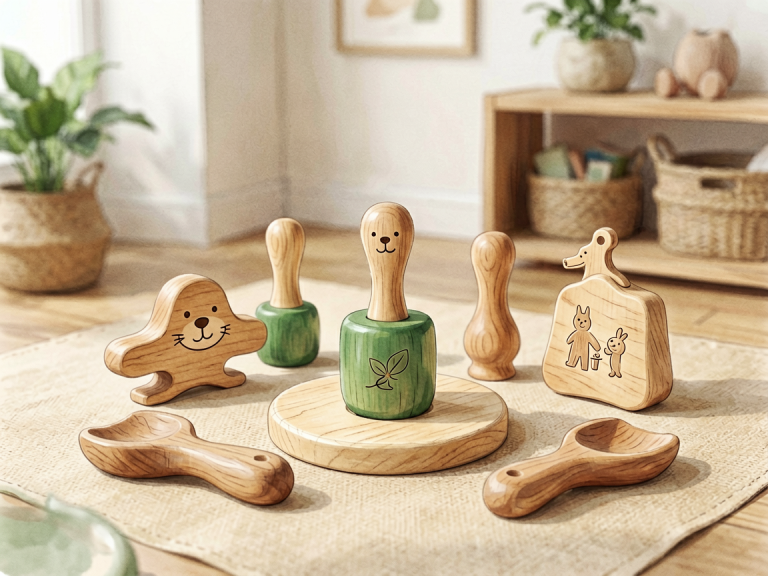
One of the greatest arguments for wooden blocks is their neutrality. They have no prescribed function, no printed patterns, no pre-designed characters. A three-year-old can decide that a rectangular block is a phone, a bridge, a sandwich, or a bed for a toy animal. This symbolic play is crucial for cognitive development and language growth. Without prescribed shapes, the child’s imagination must fill the gaps. Research in Reggio Emilia and Montessori philosophies emphasizes that open-ended materials allow children to become the architects of their own play narratives. Wooden blocks also age beautifully; a two-year-old will stack them, a three-year-old will build houses and bridges, a five-year-old will create complex castles with arches and ramparts. This longevity means the same set can support years of increasingly sophisticated play.
Magnetic Tiles: Guided by Geometry
Magnetic tiles, while also open-ended, subtly guide play toward certain types of structures. The shapes are predetermined—squares, triangles, rectangles, and occasionally hexagons or pentagons. A child cannot use a magnetic tile as a phone as easily as a wooden block; the transparent plastic and metallic edge feel less organic. The magnetic connection also encourages building upward and outward in geometric patterns, often leading to castles, rockets, and symmetrical designs. Some educators worry that magnetic tiles may limit narrative play because children become preoccupied with the mechanics of snapping and the novelty of magnetism rather than with storytelling. However, many three-year-olds happily incorporate magnetic tile structures into pretend play (e.g., “this is a rocket ship going to the moon”). The key difference is that wooden blocks invite more improvisation in *what* the object represents, while magnetic tiles invite exploration of *how* the object can be constructed.
Social and Emotional Learning
Wooden Blocks: Lessons in Patience and Resilience
Building with wooden blocks can be frustrating. A tower that falls is a genuine disappointment. For a three-year-old, learning to manage that frustration is a critical emotional milestone. Wooden blocks teach that failure is a natural part of creation. When an adult helps a child rebuild (“Look, this side was a little uneven”), the child learns problem-solving language and emotional regulation. Stacking blocks also encourages turn-taking and cooperation in group play. Because wooden blocks do not lock together, children must negotiate space and share resources carefully. If one child knocks over another’s tower, it becomes a teachable moment about empathy and respect.
Magnetic Tiles: Reduced Frustration, Faster Collaboration
Magnetic tiles, by contrast, are more forgiving. Structures are less likely to collapse because the magnets provide stability. This can reduce emotional meltdowns and allow children to feel a sense of mastery. For three-year-olds who are easily discouraged, magnetic tiles can build confidence and persistence. They also facilitate collaborative play more smoothly: children can easily add pieces to a friend’s structure without fear of dislodging it. This can foster positive social interactions and shared pride in a joint creation. However, some argue that the ease of assembly reduces the opportunity to learn from failure. The best approach may be to introduce both toys, allowing a child to experience the gentle guidance of magnets when they need a confidence boost, and the honest challenge of wood when they are ready for deeper learning.
Safety and Practical Considerations
Wooden Blocks: Durability and Natural Materials
For three-year-olds, safety is paramount. High-quality wooden blocks are typically made from beech, maple, or birch and finished with non-toxic, water-based paints or left natural. They are free of BPA, phthalates, and magnets—which can be dangerous if swallowed. Wooden blocks are also less likely to have sharp edges or small parts. However, they can splinter over time, and cheaply made blocks may contain toxic paints or glues. Parents should look for brands that comply with ASTM F963 (US safety standard) or EN71 (European standard). Another practical point: wooden blocks are heavier and can cause injury if thrown, though at age three most children have moved beyond this stage.
Magnetic Tiles: Magnet Safety and Choking Hazards
Magnetic tiles have two primary safety concerns: the magnets themselves and the plastic casing. If a tile breaks—which is rare with reputable brands like Magna-Tiles or PicassoTiles—the small magnets inside can become choking hazards. Ingesting multiple magnets can cause serious internal injuries. Therefore, parents should regularly inspect tiles for cracks or loose edges. Additionally, some lower-cost sets may have weaker magnets that separate easily, leading to frustration or breakage. High-quality magnetic tiles are made from non-toxic ABS plastic and are dishwasher safe. They are lighter than wooden blocks, reducing the risk of injury from falling blocks. Their smooth surfaces are also easier to clean—a major plus for parents of three-year-olds who often slobber, sneeze, and spill on toys.
The Verdict: Should You Choose One or Both?
After weighing the developmental benefits, creativity, social learning, and safety, the honest answer is that the best choice depends on the child—and ideally, a home or classroom should include both. For a three-year-old who is highly energetic and prone to frustration, magnetic tiles can provide a calming, success-oriented introduction to building. For a child who already has good fine motor control and enjoys patient challenge, wooden blocks offer deeper lessons in physics and resilience. Many educators recommend starting with magnetic tiles around age two and transitioning to include wooden blocks by age three or four, when a child can handle the emotional ups and downs.
If budget is a concern, wooden blocks are often more cost-effective over the long term because they never break (unless abused) and remain relevant into elementary school. Magnetic tiles, on the other hand, tend to wear out around ages 5–6 as children crave more complex construction kits. However, the unique spatial thinking that magnetic tiles promote is difficult to replicate with wood alone.
In conclusion, the magic of play at age three lies not in the toy itself, but in the adult who joins the child on the floor. Whether you choose magnetic tiles or wooden blocks—or a thoughtful mix of both—the most important element is your presence: talking about what the child is building, asking open-ended questions, and celebrating the process over the product. The best toy is the one that sparks a conversation, inspires a story, and leaves a child asking for “just one more minute” when it is time to clean up. Happy building.