Magnetic Tiles for a 6-Month-Old: A Wise Investment or a Safety Risk?
Introduction
As a new parent, the market for developmental toys can feel overwhelming. Every colorful package promises to enhance your baby’s cognitive abilities, fine motor skills, and creativity. Among the most popular contemporary toys for toddlers and preschoolers are magnetic tiles—those translucent, geometric shapes that snap together with hidden magnets. They are praised by educators and praised on social media for their open-ended play potential. But if you have a six-month-old, you may be wondering: *Should I buy magnetic tiles for my baby?* The short answer is no, for reasons rooted in safety and developmental appropriateness. However, the full answer requires a nuanced look at infant development, toy safety standards, and alternative play options. This article will examine the key factors—from physical hazards to age-appropriate stimulation—so you can make an informed decision for your little one.
Understanding the Developmental Stage of a 6-Month-Old
At six months, your baby is in a period of rapid growth. Physically, most infants can sit with support, roll over, and may begin to crawl or scoot. They are also entering the oral stage of exploration: everything goes into the mouth. This is how babies learn about texture, shape, and taste. Their vision is still developing, and they are most interested in high-contrast patterns, faces, and objects they can grasp and manipulate. Fine motor skills are emerging—they can reach for objects, transfer them from hand to hand, and practice a raking grasp. However, they lack the coordination for precise stacking or aligning. Magnetically connecting tiles is a complex two-handed task that demands wrist rotation and force control, which is far beyond a six-month-old’s ability.
Moreover, a six-month-old’s understanding of cause and effect is limited to simple actions like shaking a rattle or batting a hanging toy. Magnetic tiles, by contrast, rely on the invisible force of magnetism—a concept that won’t be grasped for months or years. While an older toddler might delight in the “snap” of two tiles joining, a baby will likely be confused or frustrated. Instead of fostering learning, the toy may become just another object to chew on or drop.
The Appeal of Magnetic Tiles: Why Parents Consider Them
It’s understandable why magnetic tiles attract parents of young infants. Their bright, translucent colors stimulate visual interest, and they offer a “growing with your child” promise. Many manufacturers market magnetic tiles for ages 3+, but some parents buy them early, hoping to use them for tummy time or as a sensory prop. On social media, you may see photos of babies lying next to colorful tile structures, and well-meaning relatives might gift a set. Additionally, parents who value Montessori or STEM learning may see magnetic tiles as a future investment. However, the question isn’t whether tiles are educational in general—it’s whether they serve any purpose for a six-month-old right now. Unfortunately, the answer is almost always no, and buying them early could pose dangers that outweigh any theoretical future benefit.
Safety Concerns: The Primary Reason for Caution
The most critical reason to avoid magnetic tiles for a six-month-old is safety. Here are the specific hazards:
1. Choking and Ingestion Hazards
Standard magnetic tiles are small enough for a baby to fit in their mouth. While many brands claim “large” pieces (typically about 3 inches square), the shape is still small enough to block an infant’s airway if inserted fully. More alarmingly, the magnets themselves can become dislodged. If a baby chews on a tile and pops out a magnet—or if a tile cracks—the small, powerful magnet can be swallowed. Ingesting multiple magnets is a medical emergency: they can attract each other through intestinal walls, causing perforations, infections, or death. For this reason, the American Academy of Pediatrics (AAP) strongly advises keeping magnetic toys away from children under three—and especially from infants who mouth everything.
2. Sharp Edges and Breakage
Although most magnetic tiles are made of sturdy ABS plastic, repeated chewing by teething babies can cause cracking. Broken plastic edges can become sharp, risking cuts to gums or lips. Some cheaper brands have been recalled due to magnet leakage or sharp seams. Even premium brands like Magna-Tiles recommend ages 3+ and warn against use with infants.
3. High-Density Magnets and Pinch Risk
The magnets inside tiles are usually neodymium, which are extremely strong for their size. When two tiles snap together, they can pinch small fingers—or worse, a baby’s delicate skin can get caught between them. An infant exploring by pressing tiles together may not have the motor control to avoid pinching themselves, leading to tears and distress.
4. Supervision Is Nearly Impossible
Even if you vow to watch your baby every second, the reality is that babies are fast and unpredictable. A parent reaching for a diaper or turning to answer a phone can miss the moment a tile goes into the mouth. Safety experts emphasize that the best way to prevent choking is to keep hazardous objects entirely out of reach. With magnetic tiles, the risk is simply too high for a six-month-old’s stage of development.
Developmental Appropriateness: What a 6-Month-Old Really Needs
Beyond safety, consider your baby’s developmental needs. At six months, the most beneficial toys support:
- Sensory exploration (textures, sounds, visual contrast)
- Motor skills (grasping, shaking, banging)
- Social interaction (face-to-face play, peek-a-boo)
- Early cause and effect (shaking a rattle makes noise, pushing a button activates lights)
Magnetic tiles do not effectively address any of these for a six-month-old. The satisfaction of connecting magnets is too abstract. A baby cannot build a tower or a shape; they will simply be confused by why the tiles stick together or slide apart. Instead, the tiles may become frustrating because they don’t respond to the baby’s actions in predictable ways (e.g., they don’t rattle, crinkle, or squeak). Meanwhile, the bright colors are nice, but a simple set of stacking cups, a textured ball, or a high-contrast board book offers more appropriate sensory engagement without the safety risks.
Alternative Toys for a 6-Month-Old
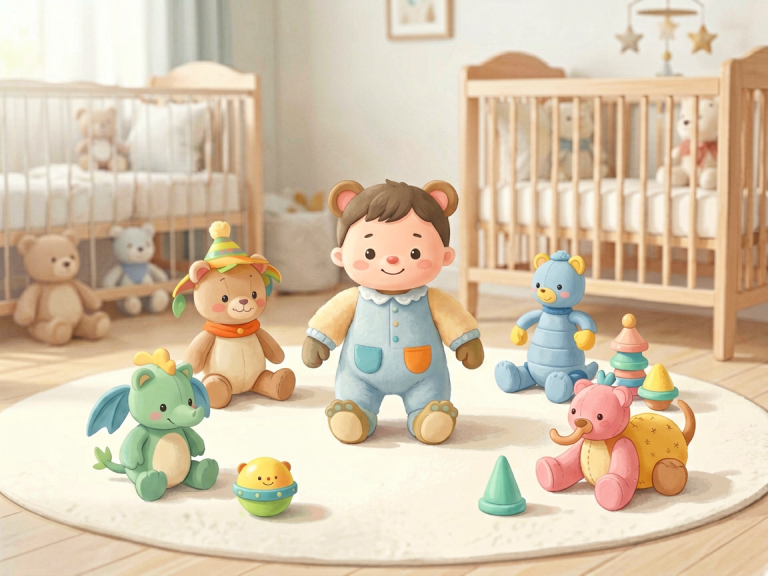
If you are looking for toys that stimulate your baby’s development while being safe and age-appropriate, here are excellent alternatives to magnetic tiles:
- Soft fabric blocks – Lightweight, chewable, and often crinkly or with tags. They satisfy the need to grasp and mouth, and they can be knocked over as the baby grows.
- Ring stacking toys – Large rings with a central post. They teach size discrimination and hand-eye coordination, and they are too large to swallow.
- O-ball or textured grasping toys – The O-ball’s open design makes it easy for small hands to hold, and it can be rolled, thrown, or chewed.
- Activity gyms or play mats with dangling toys – Encourage reaching, batting, and visual tracking. The suspended toys often have rattles or mirrors.
- Baby-safe mirrors – Babies love looking at their own reflection, which supports social-emotional development.
- Sensory balls – Bumpy, soft, or water-filled balls offer varied tactile input.
All of these alternatives are designed specifically for infants and pass rigorous safety standards for the 0-12 month age range. They are also more likely to hold a baby’s attention because they respond to simple actions (squeezing, shaking, batting) with immediate feedback.
When Could Magnetic Tiles Become Appropriate?
If you already own magnetic tiles and plan to use them later, here is a general timeline:
- Around 12–18 months: Some toddlers may begin to stack two or three tiles, but they still mouth objects frequently. Most pediatricians recommend waiting until 2–3 years.
- 24–36 months: Under close supervision, toddlers can start to explore magnetic tiles on a flat surface. However, the risk of swallowing magnets still exists.
- 3+ years: By this age, most children have stopped mouthing non-food items and can follow safety rules like “don’t put tiles in your mouth.” Open-ended play with magnetic tiles truly begins at this stage.
Thus, purchasing magnetic tiles now for future use is not a terrible idea—if you store them securely out of reach and commit to waiting two and a half years. But if you are tempted to let your six-month-old play with them even for a minute, it is wiser to choose a different toy now.
Expert Recommendations: What Pediatricians and Toy Safety Organizations Say
To solidify the argument, let’s look at expert consensus. The American Academy of Pediatrics (AAP) publishes a list of toy safety tips. They explicitly warn that toys with small parts, magnets, or button batteries should be kept away from children under 3. The U.S. Consumer Product Safety Commission (CPSC) has recalled numerous magnetic toy sets due to ingestion incidents. The National Association for the Education of Young Children (NAEYC) recommends that toys for infants should be “mouthable” (safe to chew), easy to grasp, and free of small parts. Magnetic tiles fail all three criteria for a six-month-old.
Moreover, developmental psychologists emphasize that babies at this age learn best through social interaction and simple cause-and-effect toys, not complex construction sets. A 2021 study in *Pediatrics* noted that toy-related injuries in infants under 1 most commonly involve choking, and the second most common cause is falls (from furniture, not toys), but magnetic ingestion is a growing concern. The bottom line: no legitimate expert would recommend magnetic tiles for a six-month-old.
Conclusion: The Verdict
So, should you buy magnetic tiles for your six-month-old? No, not for immediate use. The risks—choking, magnet ingestion, pinching, and frustration—far outweigh any speculative educational benefit. Your baby will gain far more from age-appropriate toys that are designed to be chewed, grasped, and explored safely. However, if you find a great deal and intend to store the tiles in a locked cabinet until your child is at least 3 years old, you can purchase them as a future investment. In that case, just be extremely disciplined about keeping them out of reach.
Remember, the best toy for a six-month-old is you—your face, your voice, your gentle touch. No magnetic tile can replace the rich learning that happens during simple interactions like singing, reading, or playing peek-a-boo. Use your budget and energy on items that enrich your baby’s world *now*, and save the magnetic tiles for the toddler years when they will truly spark creativity and delight. Your baby’s safety and developmental stage deserve nothing less.