Introduction: A Sticker That Speks Volumes
Title: The Hidden Dangers and Developmental Dividends of Plastic Toys: Why Age Recommendations Matter More Than You Think
Every plastic toy sold in the United States, the European Union, Australia, and many other developed markets carries a small but legally mandated label: a warning sticker that reads “Not suitable for children under 3 years” or a simple age range like “Ages 3+”. Parents often glance at these stickers and move on, believing them to be rough guidelines or marketing tactics. In reality, age recommendations for plastic toys are the result of rigorous safety testing, child development research, and decades of data on choking hazards, chemical exposure, and cognitive readiness. Understanding why these recommendations exist—and how to interpret them—can protect your child from injury, support their developmental milestones, and save you from wasting money on toys that are either too dangerous or too boring. This article dives deep into the science behind plastic toy age labels, the risks of ignoring them, and practical tips for choosing the right plastic toys at every stage.
The Safety Imperative: Why Small Parts and Chemicals Dictate Age Limits
Choking Hazards and the “Small Parts” Rule
The single most important reason for age recommendations on plastic toys is the prevention of choking, suffocation, and ingestion injuries. The U.S. Consumer Product Safety Commission (CPSC) defines a “small part” as any object that fits entirely inside a cylinder 1.25 inches in diameter and 2.25 inches long—roughly the size of a child’s windpipe. Children under three years old explore the world through their mouths, and their tracheas are narrow and easily obstructed. Plastic toys with detachable wheels, eyes, buttons, or even plastic-screw caps can become lethal projectiles if swallowed.
But the danger extends beyond obvious small parts. Many parents assume that a solid, one-piece plastic toy is safe for a toddler, but consider this: a plastic toy that is 1.5 inches in diameter can still block an infant’s airway if the child manages to force the entire toy into their mouth. That is why age recommendations for infants (0–12 months) typically specify “large, lightweight plastic objects” with no removable components. For toddlers (12–24 months), toys must be robust enough to withstand chewing without breaking into jagged shards. For preschoolers (3 years and up), small parts are allowed only under strict supervision because the child has developmentally progressed beyond the oral-exploration stage.
Chemical Safety: Phthalates, BPA, and the Hidden Toxins in Plastic
Age recommendations also reflect chemical exposure thresholds. Young children have a higher metabolic rate and a lower body weight relative to adults, making them far more vulnerable to plastic additives such as phthalates, bisphenol A (BPA), and heavy metals used in pigments. The European Union’s Toy Safety Directive (2009/48/EC) sets migration limits for these chemicals that are ten times stricter for toys intended for children under three than for those aged three and older. Why? Because infants and toddlers put toys in their mouths for extended periods, and their developing endocrine systems are especially susceptible to hormone disruptors.
Plastic toys labelled “for ages 3+” may legally contain higher levels of softening agents or colorants that, while safe for a child who does not mouth the toy, would pose a risk to a younger sibling. A common mistake parents make is handing a 2-year-old a plastic building block set that says “Ages 4+” because the pieces are large. That set might be made from polyvinyl chloride (PVC) with phthalates that exceed safety limits for children under three. The age recommendation is not just about size—it is about material composition. Always check that plastic toys for the youngest children are labelled as “BPA-free”, “phthalate-free”, and ideally carry the ASTM F963 (U.S.) or CE (EU) certification.
Developmental Fit: Why Age Recommendations Aren’t Just About Safety
Cognitive and Motor Skill Milestones
Beyond safety, age recommendations ensure that a plastic toy’s complexity matches a child’s current developmental stage. A toy that is too advanced frustrates the child, potentially leading to disengagement or even tantrums; a toy that is too simple provides no challenge and is quickly abandoned. Plastic toys are especially versatile for developmental scaffolding because they can be molded into precise shapes that target fine motor skills, cause-and-effect reasoning, and spatial awareness.
For example, consider plastic stacking rings. For infants (6–12 months), the rings should be large, soft plastic with a single, straight post. The recommended age of “6 months+” reflects the fact that babies at this stage are developing palmar grasp and hand-eye coordination, but lack the precision to align a ring on a tapered post. A stacking toy labelled “18 months+” might have a curved post that requires rotating the ring—a task too complex for a 10-month-old. Similarly, plastic jigsaw puzzles for toddlers (2–3 years) should have only two to four large pieces with pegs, while puzzles for 4-year-olds can have ten or more interlocking pieces. The age label is a proxy for the expected level of executive function, patience, and dexterity.
Social and Emotional Readiness
Plastic toys that involve turn-taking, role-playing, or competition often have older age recommendations because they require emotional regulation. A plastic board game with cards and dice, even if the pieces are large, might be labelled “Ages 5+” because a 3-year-old lacks the impulse control to wait for their turn. Plastic toy kitchens, which look harmless, are typically recommended for ages 2–3 and up because younger children may put the small plastic food items in their mouths or attempt to climb onto the stove. The age recommendation here prevents not only physical accidents but also social frustration.
Language and Pretend Play
Plastic figurines, vehicles, and playsets can ignite rich pretend-play scenarios, but only when the child’s symbolic thinking has matured. A 15-month-old may mouth a plastic animal and then drop it; a 3-year-old uses that same animal to create a story. Age recommendations for plastic character toys (like police cars, fire stations, or farm sets) often start at 18–24 months because that is when children begin to imitate observed behaviors. Below that age, the toy is not developmentally useful—it is just a colorful object.
Common Misconceptions and Risks of Ignoring Labels
“My Child Is Advanced for Their Age”
Many parents believe their child is an exception—a 2-year-old who can stack blocks meant for a 4-year-old. While developmental precocity does occur, it does not override the physical safety aspects of an age recommendation. A child may have the cognitive ability to understand a building set, but if the set contains small plastic gears or connectors that are 0.8 inches in diameter, the child’s still-developing motor coordination could lead to accidental swallowing. Moreover, the chemical safety limits are based on the entire population of children of a given age, including those who mouth toys. A 2-year-old who is very verbal may still mouth objects when tired or stressed. Better to err on the side of the label.
“The Toy Looks Safe—It’s Soft Plastic”
Another dangerous belief is that soft plastic automatically means safe. Some soft plastics, like those used in “squishy” toys or bath toys, can be a choking hazard because they are compressible and can mold to the throat. Moreover, soft PVC bath toys often have holes that trap mold—a biological hazard that is not addressed by age labels but is more dangerous for infants with weaker immune systems. Age recommendations on soft plastic toys typically avoid recommending them for babies under 18 months precisely because of the molding and hygiene risks.
The “Hand-Me-Down” Pitfall
Vintage plastic toys from a decade or more ago often lack modern age recommendations and may contain lead-based paints, phthalates, or small parts that no longer meet current safety standards. A beloved plastic toy from a parent’s childhood could be a dangerous antique. Always check that any plastic toy given as a hand-me-down complies with current regulations, and if the original age label is worn away, default to the youngest child in the house.
Practical Guidelines for Choosing Plastic Toys by Age
Birth to 12 Months: Safety-First Selection
- Recommended characteristics: Large (diameter > 1.75 inches), one-piece plastic toys, no batteries, no seams. Examples: plastic rattles, teething rings, activity balls with no loose parts, high-contrast plastic mirrors.
- What to avoid: Any plastic toy with a button, detachable eyes, or vinyl coating. Avoid plastic toys that are lightweight enough for a baby to lift easily; they should be heavy enough to stay put but not heavy enough to cause injury if dropped.
- Age recommendation reading: Look for “Newborn+” or “0+”, but even then, never leave a baby unsupervised with a plastic toy. Some plastics, even those labelled safe, can crack if chewed repeatedly.
12 to 24 Months: Exploration and Mouthing
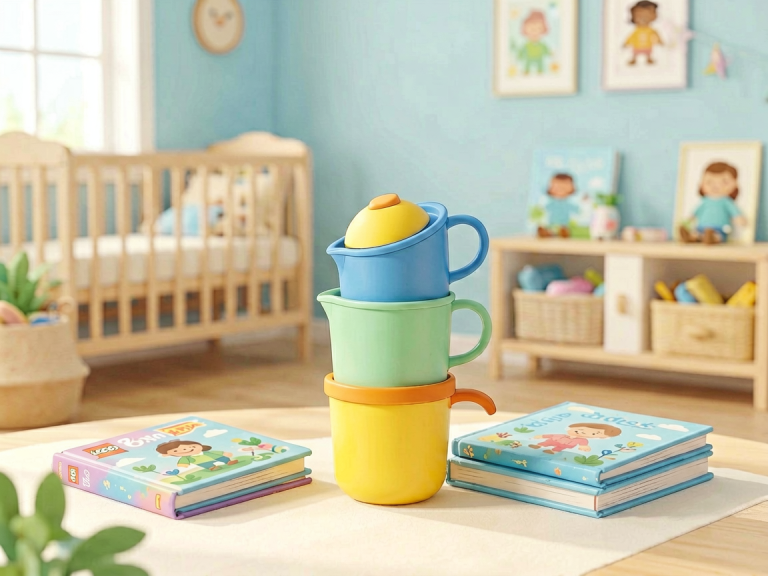
- Recommended characteristics: Plastic toys that are durable enough for chewing, with no small parts that can be pried off. Good options: plastic shape sorters with large, chunky pieces; plastic cars with no wheels that come off (wheels should be flush with the body); plastic stacking cups.
- What to avoid: Plastic toys with thin walls that can shatter when dropped (common in cheap Easter egg toys). Also avoid plastic toys that make loud sounds that could damage hearing; look for sound-level testing on the package.
- Age recommendation reading: “12 months+” or “18 months+” is reliable, but beware of toys labelled “3+” that seem large—those are not tested for the same chemical limits.
2 to 4 Years: Fine Motor and Pretend Play
- Recommended characteristics: Plastic building blocks (larger than Lego Duplo but smaller than toddler cubes), plastic train tracks that snap together (but with no small magnets), plastic animal sets with no removable limbs, plastic dollhouse furniture.
- What to avoid: Plastic toys with batteries that are not secured by a screw-fastened compartment (toddlers can open sliding battery doors). Also avoid plastic toys with long cords, strings, or ribbons—strangulation risk.
- Age recommendation reading: “2+” or “3+” is standard. If a set contains multiple pieces, check the number—more than 20 pieces for a 2-year-old is overwhelming and increases choking risk.
4 Years and Up: Complex Structures and Creativity
- Recommended characteristics: Plastic construction sets with small interlocking parts (e.g., Lego, K'Nex), plastic figurines with removable accessories, plastic board games with cards and dice, plastic science kits.
- What to avoid: Still watch for small parts if you have a younger sibling around. Some plastic craft kits include glue or solvents; age recommendations for those are usually “8+” due to chemical toxicity.
- Age recommendation reading: Most plastic toys for this age range are safe, but always check for manufacturer recalls (easily done via the CPSC website) and avoid plastic toys that smell strongly of chemicals—an indicator of off-gassing.
Conclusion: Read, Respect, and Reassess
Age recommendations on plastic toys are not marketing fluff or legal CYA (cover your a**). They are a distillation of hundreds of peer-reviewed studies on childhood development, thousands of emergency room reports, and decades of manufacturing best practices. By respecting these labels, you dramatically reduce the risk of choking, chemical exposure, and developmental mismatch. But the label is only the starting point—you must also consider your child’s unique behavior, the presence of siblings, and the condition of the toy itself. Plastic toys can be wonderful tools for learning, but only when chosen with intention and vigilance. Next time you pick up that colorful plastic tractor or building set, pause and read the small print. That tiny sticker might save you a trip to the emergency room—and give your child exactly the challenge they need to grow.