Introduction
Title: The Ultimate Parent Guide to Buying Play Kitchens for 6-Month-Olds: Safe, Stimulating, and Developmentally Appropriate Choices
When you hear the term "play kitchen," your mind likely jumps to elaborate wooden sets with tiny pots, pretend food, and a miniature stove—perfect for a toddler who can stand, walk, and engage in imaginative role-play. But what about a six-month-old? At this age, your baby is just beginning to sit up independently, exploring the world through their mouth, hands, and eyes. They crave sensory stimulation, cause-and-effect feedback, and safe objects to grasp and chew. Can a play kitchen truly be appropriate for such a young infant?
The answer is a cautious yes—with significant caveats. A traditional play kitchen is not suitable for a six-month-old due to small parts, sharp edges, and safety hazards. However, there is a growing market for infant-friendly play kitchens that prioritize soft textures, large moving parts, and sensory features designed for babies under one year old. This guide will walk you through everything you need to know to make a wise, safe, and developmentally enriching purchase. From safety checklists to recommended features, we will help you find a play kitchen that delights your little one without causing parental anxiety. Remember: at six months, the goal is not to teach cooking but to foster curiosity, fine motor skills, and sensory awareness.
Why Consider a Play Kitchen for a 6-Month-Old?
You might wonder why you should even think about a play kitchen when your baby cannot yet walk or talk. The reasoning lies in early brain development. Between four and eight months, infants experience a rapid growth in cognitive abilities. They begin to understand object permanence, cause and effect, and simple patterns. A play kitchen designed for this age group can deliver these benefits:
- Sensory Stimulation: Bright colors, contrasting patterns, crinkle fabrics, squeakers, and mirrors engage multiple senses.
- Fine Motor Practice: Grasping soft utensils, turning large knobs, and opening fabric doors strengthen hand-eye coordination.
- Cause-and-Effect Learning: Pressing a button that makes a sizzling sound or flipping a switch that lights up teaches early logic.
- Social and Emotional Growth: Sitting near you while you cook can become a bonding activity; even a simple kitchen provides a shared focus.
- Language Development: Naming objects (“spoon,” “pot,” “apple”) introduces vocabulary in context.
Of course, you must choose a kitchen that matches your baby's physical abilities. A six-month-old typically can sit with support, reach for objects, and bring them to their mouth. They cannot stand or walk, so the kitchen must be accessible from a seated or lying position. The right product transforms playtime into a rich learning experience.
Safety First: Key Features to Look For
Safety is non-negotiable when shopping for any baby product, but play kitchens designed for infants present unique risks. Here are the critical safety criteria:
- No Small Parts: Avoid any accessories smaller than a D-size battery or that can fit inside a toilet paper roll. Six-month-olds explore with their mouths, and choking hazards are deadly. Look for large, one-piece utensils or soft felt food that cannot be torn apart.
- Non-Toxic Materials: Ensure the product is labeled BPA-free, phthalate-free, and lead-free. Wood should be smooth and sealed with water-based paint; fabric should be machine-washable and flame-retardant; plastic should be food-grade or specifically infant-safe.
- Sturdy Construction: Even though your baby cannot stand, they may pull themselves up on furniture. The play kitchen must be stable and cannot tip over. If it has legs, they should be wide-set and weighted. For floor-level models, the base should not slide.
- No Sharp Edges or Pinch Points: Run your hand over every surface. All corners should be rounded. Hinges on doors or oven doors should have slow-close mechanisms to prevent tiny fingers from getting caught.
- Secure Batteries: If the kitchen has lights or sounds, battery compartments must be secured with a screw. Loose batteries are a choking and chemical hazard.
- Cordless Design: Avoid any product with long cords (for lights or plugs) that could be pulled or wrapped around the baby.
Always check for safety certifications like ASTM (American Society for Testing and Materials) or EN71 (European standard for toy safety). If the product is marketed for ages 18 months or older, do not use it for a six-month-old—even under supervision. Only purchase items explicitly designed for infants or with a recommended age of 6+ months.
Age-Appropriate Elements: What to Look For
A safe play kitchen is not enough; it must also be developmentally appropriate. Here are the features that make a kitchen engaging for a six-month-old:
- Low Profile: Since your baby cannot stand, the kitchen should sit on the floor or be a flat mat. Many infant kitchens are essentially soft activity boards or fabric cubes placed in front of the baby. Look for models that are no more than 12–18 inches high so your baby can reach while sitting or tummy-timing.
- Large, Easy-to-Grasp Parts: Knobs should be at least 2 inches in diameter, preferably with a textured surface. Utensils should be soft (silicone or fabric) and oversized. Avoid tiny measuring cups or spoons.
- Sensory Variety: The best infant kitchens include multiple textures: soft fabric “vegetables,” crinkly paper inside a “pan,” a mirror for self-discovery, and a teether attached via a strap. Some have a squeaker that sounds like steam or a bell that rings when a “pot” is lifted.
- Cause-and-Effect Feedback: A simple press of a button that lights up or plays a gentle tune is perfect. Avoid loud, jarring sounds—babies can be easily frightened. Opt for soft melodies, clicking sounds, or gentle buzzes.
- Color and Contrast: High-contrast colors (black and white, red and yellow) capture infant attention better than pastels. Bold patterns help develop visual tracking.
- Portability: A lightweight kitchen that you can move from room to room allows the baby to play near you while you cook or do chores. Some fabric kitchens fold flat and fit in a diaper bag.
Remember, at this age, “pretend play” is not yet conceptual. Your baby will not understand that the plastic apple represents a real fruit. Instead, they will enjoy the physical properties: how it feels, what sound it makes, and how it responds to their actions.
Materials and Construction: Soft vs. Hard
The debate between fabric play kitchens and wooden or plastic ones is central for this age group. Let’s break down the pros and cons:
- Fabric and Soft Play Kitchens: These are the safest choice for six-month-olds. They are lightweight, have no sharp corners, and are often machine-washable. They include plush vegetables, fabric pots, and felt stoves. Many attach to a play mat or have a built-in “wall” for tummy time. The downside is that they may lack durability—some babies can rip seams or pull off buttons. Look for reinforced stitching and double-layered fabrics.
- Plastic Play Kitchens: Some plastic models are designed for young babies, with large rounded shapes and no small parts. They tend to be easier to clean (wipe with a damp cloth) and can include realistic lights and sounds. However, check that the plastic is soft enough not to cause injury if the baby falls on it. Avoid hard, rigid plastic with sharp edges. Also, be cautious of shiny surfaces that might scratch.
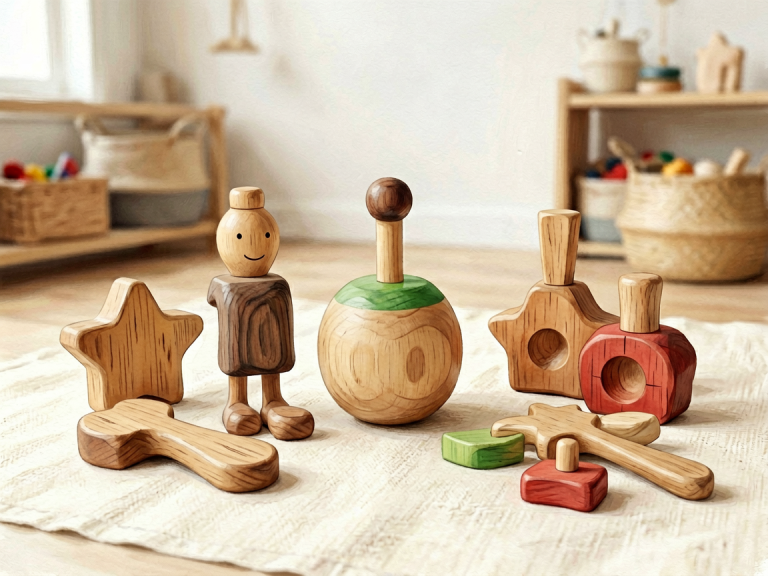
- Wooden Play Kitchens: Generally not recommended for six-month-olds. Solid wood is heavy, can have splinters, and often includes many small pieces (pots, pans, pretend food) that pose choking hazards. If you love the idea of wooden toys, look for a minimalist wooden activity board (like a busy board) that includes kitchen-themed elements (e.g., a wooden stove knob, a sliding latch). But full wooden kitchen sets should wait until at least 18 months.
For a six-month-old, a combination of soft fabric and durable plastic (or silicone) is ideal. The “kitchen” part can be a padded mat or a soft cube, while the accessories are made from safe, mouthable materials.
Size and Accessibility: Floor Play Matters
Because your baby cannot stand, the play kitchen must be placed directly on the floor or on a low play mat. Consider the following spatial factors:
- Mat vs. Standalone: Many infant kitchens come as a floor mat with attached toys (like a cooking station printed on the mat with fabric 3D elements). This is excellent because the baby can lie prone or sit on the mat. Standalone units should have a low base that the baby can reach while sitting.
- Leg Clearance: If the kitchen has legs (like a miniature table), ensure there is enough space underneath for a crawling baby. However, at six months, most babies are not crawling yet, but they may roll or pivot. Legs can be a tripping hazard. Floor-level models avoid this.
- Stability for Future Use: Even if your baby cannot stand now, they may pull up to a stand in a few months. If you buy a soft kitchen, it is safe. For plastic or wooden units, look for wall anchor kits or choose a model that is heavy enough not to tip. Better yet, choose a product that evolves with your baby. Some fabric kitchens convert to a toddler-sized play kitchen later by attaching legs or a frame.
Interactive Features: Balancing Fun and Overstimulation
Babies have short attention spans. A play kitchen with too many sounds, lights, and moving parts can overwhelm them. Look for a balance. Here are guidelines:
- One or Two Sound Effects: A gentle “ding” when a bell is rung or a soft sizzle when a knob is turned is enough. Avoid products with multiple songs, flashing strobes, or loud alarms.
- Textured Surfaces: Crinkle paper, faux wood grain, fleece “dish towel,” and smooth silicone are all great. Babies love to rub them against their cheeks.
- Mirror Time: A baby-safe acrylic mirror (not glass) attached to the kitchen encourages self-recognition and visual tracking.
- Detachable Teethers: Some kitchens include a silicone teething ring shaped like a carrot or a spatula. This is a big plus—your baby can chew safely.
- Open-Ended Play: Even at six months, a simple drawer that opens and closes provides endless fascination. Doors that slide or flip are also excellent.
Top Recommendations (General Guidance)
Although I cannot endorse specific brands, I can describe the types of play kitchens that meet the criteria:
- Fabric Activity Cube Kitchens: These are soft cubes with kitchen scenes on each side—one side has a stove and a turning knob, another has a sink with a squeaky “faucet,” a third has a mirror, etc. They are lightweight, washable, and perfect for floor play.
- Play Mat with Attached Kitchen Items: A large cushioned mat printed with a kitchen layout, with detachable soft “food” pieces, a fabric “oven mitt,” and a pocket for “utensils.” The mat itself is the play surface.
- Soft Cloth “Kitchen” with Sensory Tags: Some products are essentially a large stuffed “stove” with multiple sensory elements (ribbons, crinkles, rattles) sewn in. No small parts, all attached.
- Minimalist Busy Board with Kitchen Theme: A small wooden or plastic board that mounts on a wall or sits on the floor, featuring knobs, switches, a zipper, and a fabric “apron.” Ensure all parts are large and secured.
Avoid any kitchen that comes with separate miniature plastic food items, tiny measuring cups, or small magnetic pieces. These are for older children.
Final Tips for Parents
- Supervise Always: Even the safest toy requires your watchful eye. A six-month-old can still manage to break something or find a way to hurt themselves.
- Clean Regularly: Soft fabric kitchens can collect dust, saliva, and food crumbs. Machine-wash according to instructions or spot-clean. Plastic parts should be wiped with mild soap.
- Observe Your Baby’s Interest: Some babies are mesmerized by the kitchen; others prefer simple rattles. Do not force play. If your baby ignores the kitchen, put it away and try again in a month.
- Consider Future Value: You might find a play kitchen that starts as a sensory mat for an infant and later becomes an upright kitchen for a toddler. This long-term usability is worth the investment.
- Look for Second-Hand Options: Gently used soft kitchens are often available at a fraction of the cost. Just inspect for wear, missing parts, and any safety concerns.
- Trust Your Gut: If a product seems too complex or flimsy, it probably is. There is no shortage of infant-safe toys, so choose one that gives you peace of mind.
Conclusion
Buying a play kitchen for a six-month-old might seem unconventional, but when chosen carefully, it can be a wonderful addition to your baby's playroom. The key is to prioritize safety, sensory stimulation, and age-appropriate design. Forget miniature stoves and plastic burgers—your baby needs soft textures, cause-and-effect buttons, and large, mouth-safe objects. By following this guide, you can select a play kitchen that not only delights your infant now but also grows with them, laying the foundation for creativity and learning. Happy shopping, and enjoy watching your little one explore the wonderful world of “cooking” in the safest, most nurturing way possible.