The Hidden Danger in Discovery: Choking Hazards in Children’s Science Kits
Introduction
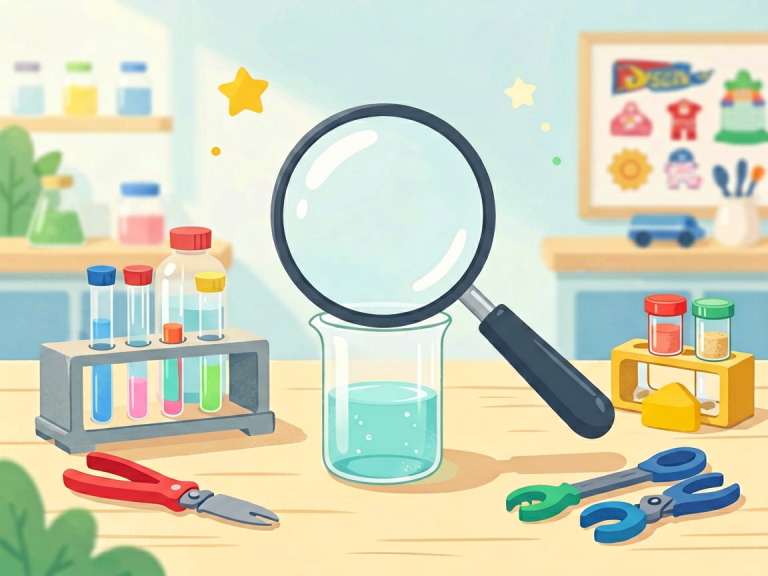
Science kits have long been celebrated as gateways to curiosity, creativity, and critical thinking. From erupting volcanoes to crystal-growing experiments, these colorful boxes promise to turn living rooms into mini laboratories and children into budding scientists. Yet beneath this veneer of educational fun lurks a serious and often overlooked threat: choking hazards. While parents and educators eagerly embrace the benefits of hands-on learning, they may not fully grasp that many science kits contain small parts—magnets, batteries, tiny test tubes, or granular chemicals—that can easily become lodged in a child’s airway. According to the U.S. Consumer Product Safety Commission (CPSC), choking is a leading cause of injury and death among children under five, and science kits, despite their educational label, are not immune to this risk. This article explores the specific choking dangers embedded in children’s science kits, examines current safety standards, and proposes actionable measures for manufacturers, parents, and regulators to ensure that discovery does not come at the cost of a child’s life.
Understanding Choking Hazards: Small Parts and Vulnerable Airways
Choking occurs when an object blocks the trachea, preventing oxygen from reaching the lungs. For children under three years old, the trachea is roughly the diameter of a drinking straw, making them particularly susceptible to obstruction by small items. The CPSC defines a “small part” as any object that fits completely into a cylinder approximately 1.25 inches (31.7 mm) in diameter and 2.25 inches (57.1 mm) deep—an approximation of a young child’s throat. Common choking culprits in science kits include:
- Button batteries: Often used to power microscopes, LED flashes, or electronic components. If swallowed, they not only pose a choking risk but can also cause severe internal burns due to electrolytic leakage.
- Mini magnets: Found in kits for constructing molecules or demonstrating magnetic fields. When two or more magnets are ingested, they can attract through intestinal walls, leading to perforations, sepsis, or death.
- Small glass vials, pipettes, and test tubes: These can break and create sharp fragments, but if intact, their size and shape make them ideal airway blockers.
- Granular chemicals: Salt-like substances such as sodium bicarbonate, citric acid, or calcium chloride. While not always solid “parts,” a large amount poured into the mouth can clump and obstruct breathing.
- Plastic connectors, caps, and beads: Used in engineering or crystal-growing kits, these are often indistinguishable from toy parts that are regulated under stricter standards.
The danger is compounded by the fact that many science kits are marketed for children as young as five or six, yet contain components that fail the CPSC small-parts test. A 2022 study published in the journal *Pediatrics* reviewed 50 popular science kits and found that nearly 40% contained at least one item that could fit entirely into a child’s mouth, with 15% containing multiple such items.
The Specific Risks in Science Kits: Beyond Typical Toys
Unlike conventional toys, science kits present a unique combination of visual appeal, small size, and ambiguous purpose. A child may mistake a small magnet for a candy, a glass vial for a juice bottle, or a packet of sodium bicarbonate for sugar. The very nature of scientific exploration encourages tasting, smelling, and handling—behaviors that amplify choking risk.
Chemical Confusion
Many science kits include chemical powders that appear deceptively harmless. For example, a common “volcano” kit contains baking soda (sodium bicarbonate) and citric acid. While these are generally non-toxic, a child who scoops a large spoonful into their mouth may inhale the fine powder, causing airway irritation or, in extreme cases, clumping that blocks the trachea. Moreover, some kits include substances like copper sulfate or potassium permanganate, which are toxic and require careful handling—instructions that are often ignored by young children.
Battery and Magnet Dangers
Electronic components, such as small motors or lights, rely on coin-cell batteries. These smooth, shiny discs are irresistibly mouth-sized and are among the most dangerous choking objects because they can become lodged in the esophagus and begin corroding within hours. A 2023 report from the National Safety Council noted that over 3,500 button battery ingestion incidents occur annually in the United States, and science kits contribute to a growing share. Similarly, rare-earth magnets used in kits to build molecular models can cause catastrophic internal injuries if swallowed—a scenario that has led to multiple recalls, including the 2020 recall of a popular chemistry set from a major toy retailer.
Glass and Sharp Components
Despite the availability of plastic alternatives, many premium science kits still incorporate thin glass vials or thermometers. Broken glass poses a laceration hazard, but intact glass items also present choking risks. A glass stirring rod or a tiny pipette can easily be placed in the mouth, and if it breaks during attempted removal, the consequences are dire.
Case Studies and Real-World Incidents
The abstract danger of choking is made concrete by several documented incidents. In 2019, a six-year-old boy in Texas was rushed to the emergency room after swallowing a small LED light from a “rocket science” kit. The light had come loose from its plastic housing and lodged in his throat. Fortunately, doctors removed it with forceps, but the boy required sedation and observation. In a more tragic case from 2021 in the United Kingdom, a three-year-old girl died after inhaling a tiny plastic bead from a “crystal growing” kit; the bead was part of a decorative polymer mixture and had not been properly secured.
These incidents are not isolated. The CPSC has issued more than a dozen recalls related to science kits in the past five years, citing choking hazards as the primary reason. In 2022 alone, the agency recalled three different brands of chemistry sets that contained small glass vials or magnets that did not meet federal safety standards.
Regulatory Landscape: Gaps and Inconsistencies
The safety of children’s products is governed by a patchwork of regulations that vary by country. In the United States, the Consumer Product Safety Improvement Act (CPSIA) sets mandatory standards for toys, including the small-parts test (16 CFR Part 1501). However, science kits often fall into a gray area: they are classified as “toys” by some retailers and as “educational equipment” by others, which may exempt them from certain labeling or testing requirements. For example, a kit labeled “ages 8+” may avoid the small-parts test because the standard only applies to toys intended for children under three. Yet eight-year-olds can still choke; the developmental variability among children means that a ten-year-old with a narrow airway could be at risk.
In the European Union, the EN 71 standard (Safety of Toys) includes detailed requirements for small parts, but enforcement is inconsistent, especially for kits imported from non-EU countries. China’s national standard GB 6675 similarly has gaps, particularly regarding button batteries and magnets, which are not explicitly covered.
Furthermore, warnings on packaging are often inadequate. A common label like “Choking hazard – small parts” may be printed in tiny font on the back of the box, easily missed by busy parents. Instructions rarely emphasize that children should never put kit components near their mouths, and supervision guidelines are vague.
Mitigation Strategies for Parents and Educators
Given the regulatory shortcomings, the responsibility largely falls on adults to assess and mitigate choking risks. The following steps can significantly reduce danger:
- Inspect before use: Open the kit and examine every component. Remove any item that fits inside a standard toilet paper roll (roughly the same diameter as the CPSC small-parts test cylinder).
- Age-appropriate selection: Ignore the manufacturer’s age recommendation if it seems too generous. A good rule of thumb is to avoid kits with small, loose parts for children under six. Even for older children, direct supervision is crucial.
- Battery compartment security: Ensure that any electronic component has a screw-secured battery door. Kits with slide-off or pop-open battery covers should be avoided.
- Chemical handling: Treat all powders and liquids as potential choking and poisoning hazards. Use containers with child-resistant caps, and never allow children to eat or drink near the experiment area.
- Teach safe habits: Explain to children that science kit parts are not food. Role-play scenarios where they practice saying “no” when tempted to taste a colorful bead.
- Immediate response training: Parents should learn the Heimlich maneuver for children and know how to identify signs of choking (inability to cry, cough, or breathe).
The Role of Manufacturers: Designing for Safety
Manufacturers bear the ultimate ethical and legal responsibility for product safety. Forward-thinking companies can adopt several design changes:
- Eliminate small loose parts wherever possible: Use large, integrated components that cannot be disassembled by a child. For example, replace miniature test tubes with larger, unbreakable plastic tubes molded into a single unit.
- Replace button batteries with rechargeable, wired power sources: If a battery is necessary, secure it with a tamper-proof screw and include a prominently labeled warning on the device itself.
- Magnets: Use large, encapsulated magnets that are too big to swallow, or design magnetic assemblies that cannot be separated.
- Non-toxic and inert materials: Choose chemicals that are safe to ingest in small quantities (e.g., using sodium chloride instead of copper sulfate for color-change experiments).
- Clear, visible warnings: Print choking-hazard warnings on the front of the box in bold, large font. Include a pictogram of a child choking.
- Age-specific labeling: Develop stricter internal testing protocols that reflect real-world child behavior, not just regulatory minimums.
Several manufacturers have already set positive examples. The brand “Thames & Kosmos,” for instance, now uses large, plastic components and includes a safety card with clear choking warnings and instructions for emergency response. Such practices should become industry-wide rather than exceptions.
Conclusion
Science kits are invaluable tools for nurturing a love of discovery and inquiry. They transform abstract concepts into tangible wonders, fostering skills that last a lifetime. Yet this very potential is undermined when a child’s safety is jeopardized by hidden choking hazards. The small parts, batteries, magnets, and chemicals that make these kits exciting also make them dangerous—especially for young children who are naturally drawn to mouth objects.
Addressing this issue requires a multi-pronged approach: stricter and more harmonized regulations that close loopholes for “educational” products; manufacturers who prioritize safety over cost or novelty; parents who remain vigilant and educated; and educators who incorporate choking prevention into their science lessons. Until then, every opened science kit carries a silent risk—a risk that, with awareness and action, can be minimized. Let us ensure that the pursuit of knowledge does not come at the cost of a child’s breath.
*(Word count: approximately 1,450)*