Building Blocks of Curiosity: The Transformative Power of Science and Engineering Toys for Toddlers
Introduction
In a world that increasingly prizes innovation and technical literacy, the early years of childhood have become a focal point for educators, psychologists, and parents alike. Long before a child can read or write, they are already constructing mental models of how the world works—through play. For toddlers, play is not merely a pastime; it is the primary vehicle for cognitive, motor, and emotional development. Among the vast array of playthings available today, science toys and engineering toys occupy a uniquely powerful position. These toys do more than entertain; they lay the foundation for logical reasoning, spatial intelligence, and a lifelong appetite for discovery. But not all toys marketed as “educational” deliver genuine developmental value. This article explores why high-quality science and engineering toys are essential for toddlers, how they support specific areas of growth, and what parents should look for when selecting them.
The Critical Window of Early Childhood Development
The toddler years—roughly ages one to three—are marked by explosive brain growth. At this stage, neural connections are being formed at a rate of more than one million per second. Every sensory experience, every problem-solving attempt, and every physical manipulation of an object helps wire the brain for future learning. This is also the period when children begin to understand cause and effect, object permanence, and basic physics: “If I push this block, it falls.” “If I fit this shape into the hole, it stays.” Science and engineering toys capitalize on these natural curiosities by providing structured yet open-ended opportunities for experimentation. Unlike passive toys (such as those that simply light up or play music), active construction and exploration toys demand that the child be the agent of change. This agency is critical for developing executive function skills—working memory, cognitive flexibility, and inhibitory control—that predict later academic success.
Defining Science and Engineering Toys for Toddlers
It is important to distinguish genuine science/engineering toys from gimmicky products that merely bear a STEM label. For toddlers, a science toy does not need to involve chemistry sets or microscopes. Instead, it should invite observation, comparison, and prediction. Examples include simple water tables that allow pouring and siphoning, magnetic blocks that demonstrate attraction and repulsion, or nature exploration kits with magnifying glasses and bug catchers. Engineering toys, meanwhile, focus on construction, balance, and structural integrity. Classic examples are large interlocking building bricks (like Duplo), wooden unit blocks, gears and pulleys sets, and toddler-friendly tools like plastic screwdrivers and hammers. The common thread is that these toys require the child to manipulate physical objects to achieve a goal—stacking a tower, making a marble run, or connecting two pieces. They are inherently hands-on and often involve trial and error.
Cognitive Benefits: Problem-Solving and Critical Thinking
One of the most profound benefits of engineering toys is their ability to teach problem-solving in a concrete, satisfying way. A toddler attempting to build a stable tower must consider gravity, weight distribution, and symmetry. If the tower collapses, the child must reassess and try a different approach. This iterative process is the essence of the scientific method: hypothesis, test, analyze, revise. Over time, toddlers develop what psychologists call “executive attention”—the ability to focus on a goal despite distractions. For example, a child working with a gear set must align teeth precisely; missing one gear forces the whole mechanism to stop, teaching the importance of systematic thinking. Similarly, simple science toys like ramps and balls allow children to explore variables: Does a heavier ball roll faster? What happens if I raise the ramp higher? These experiments build an intuitive understanding of physics long before formal equations are introduced.
Motor Skills and Spatial Awareness
The physical manipulation required by construction toys directly supports fine motor development. Picking up small blocks, fitting pegs into holes, and twisting gears strengthen the small muscles in the hands and fingers—the same muscles needed later for writing. Gross motor skills are also engaged when toddlers move large blocks or push a toy car along a track. Beyond muscle development, these toys enhance spatial reasoning. Research shows that early spatial skills are a strong predictor of later achievement in STEM fields. When a toddler rotates a shape to fit it into a sorter, or builds a three-dimensional structure from a mental image, they are practicing mental rotation, visualization, and geometry. Magnetic toys, in particular, offer a unique spatial challenge because the polarity forces the child to think about orientation and distance.
Fostering a Growth Mindset and Resilience
Perhaps the most overlooked benefit of science and engineering toys is their emotional and psychological impact. Because these toys are inherently unpredictable—a tower will fall, a marble will fly off the track, a magnet will repel instead of attract—they present repeated opportunities for failure. In a supportive environment, these failures become learning moments rather than frustrations. A child who watches their carefully built block tower tumble must decide whether to cry or rebuild. With gentle adult guidance, they learn that mistakes are normal and that persistence leads to success. This cultivates a “growth mindset,” the belief that abilities can be developed through effort. Conversely, toys that always work perfectly (like electronic gadgets that play a song when a button is pressed) can inadvertently teach children that outcomes are fixed and out of their control. Engineering toys put the child in the driver’s seat, building both confidence and resilience.
Safety Considerations and Age-Appropriate Design
When selecting science and engineering toys for toddlers, safety is paramount. Children under three are prone to putting objects in their mouths, so all pieces must be larger than a standard choke-test cylinder (roughly 1.25 inches in diameter). Avoid toys with small magnets, button batteries, or sharp edges. Materials should be non-toxic, BPA-free, and durable enough to withstand being dropped, chewed, and thrown. Additionally, the complexity of the toy must match the child’s developmental stage. A toddler who cannot yet coordinate both hands will struggle with a complex gear system; a simpler stacking ring or nesting cups may be more appropriate. Many excellent engineering toys are designed with graduated difficulty—for example, a block set that includes both large, easy-to-grasp cubes and smaller, more precise pieces for later stages. Look for toys that offer a “just right” challenge, not too easy to cause boredom and not too hard to cause persistent frustration.
How to Choose the Right Toys: Practical Guidelines
Given the overwhelming number of options on the market, parents may feel lost. Here are a few evidence-based guidelines:
- Prioritize open-endedness. The best toys can be used in many ways. A set of wooden blocks can become a castle, a bridge, a car, or a rocket. Open-ended toys encourage creativity and sustained engagement.
- Look for toys that promote “constructive play.” This means the child builds, modifies, or creates something. Avoid toys that merely require pushing a button or watching a screen.
- Choose toys with real mechanical principles. Gears, pulleys, levers, ramps, and magnets introduce tangible physics. Even a simple set of plastic cups for stacking can teach balance and volume.
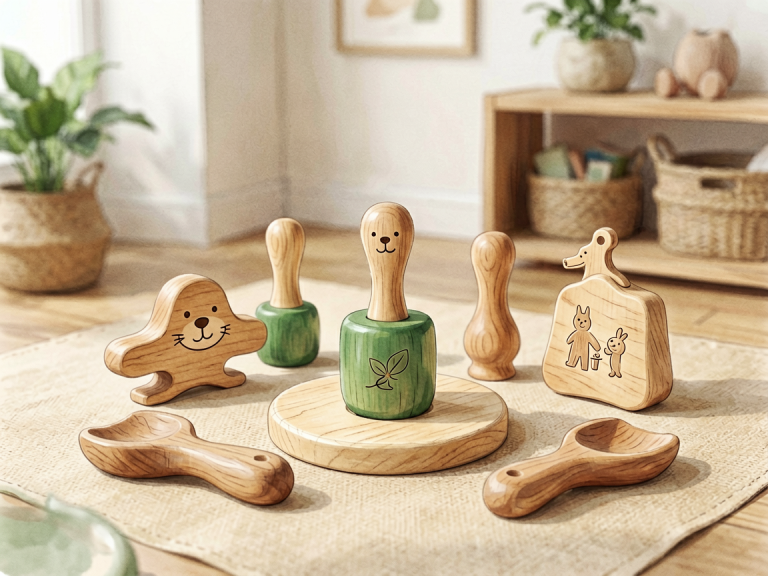
- Incorporate natural materials. Wood, metal, and fabric offer different sensory experiences than plastic. Natural materials often have more weight, texture, and variability, which enhances tactile learning.
- Rotate toys to maintain novelty. Toddlers thrive on novelty, but they also benefit from repeated practice. Rotating a small selection of toys every few weeks keeps interest alive without overwhelming the child.
- Involve the child in the selection process. When possible, let the toddler handle the toy in the store or watch a short demonstration video online. Their genuine interest is a strong indicator of sustained play.
The Role of Parents and Caregivers
While science and engineering toys are designed for self-directed exploration, adult involvement can dramatically amplify their benefits. A parent sitting beside a toddler, naming the shapes, asking open-ended questions (“Why do you think the red block fell?”), and celebrating attempts rather than outcomes, transforms play into rich language and cognitive learning. However, it is crucial to avoid overdirecting. The adult should act as a “scaffold,” providing just enough support to keep the child engaged without taking over. For example, if a toddler is struggling to fit a piece into a shape sorter, instead of grabbing the piece and pushing it in, the parent can rotate the shape and say, “Hmm, it doesn’t fit that way. Can you try turning it?” This preserves the child’s sense of accomplishment. Additionally, parents should model curiosity themselves—wondering aloud, testing hypotheses, and showing delight in discovery. Children imitate what they see, and a parent who treats a block tower collapse as a fascinating mystery rather than a failure teaches a powerful lesson.
Conclusion
Science and engineering toys for toddlers are far more than trendy educational products. They are essential tools that harness a child’s innate curiosity and channel it into meaningful cognitive, motor, and emotional growth. From building towers that teach gravity to experimenting with magnets that introduce invisible forces, these toys provide a hands-on, joyful introduction to the principles that govern our physical world. When chosen thoughtfully, used safely, and supported by engaged caregivers, they can spark a lifelong love of learning and problem-solving. In an age of screens and passive entertainment, giving a toddler a set of wooden blocks or a simple gear set is an act of profound faith—faith in the child’s ability to create, to fail, to try again, and ultimately to understand. That, in essence, is the beginning of both science and engineering: not a set of facts, but a way of thinking.